

You run your tongue behind your lower front teeth and feel something rough and hard. Or you notice a yellow line along the gums that brushing does not shift. Maybe a small piece even broke off while you were eating. It is natural to wonder what it is, why it formed even though you brush every day, and whether you can get rid of it yourself.
That hard deposit is tartar, also called dental calculus. It is plaque that has taken up minerals from saliva and turned hard. It is very common, and it is easy to manage: a dental cleaning removes it, and good daily habits slow down how fast it comes back.
This article explains what tartar is made of, how quickly plaque hardens, where tartar likes to build up and why, whether it can fall off by itself, why scraping at home is not worth the risk, what helps prevent it, and what happens at a cleaning visit.
In short: tartar is hardened plaque. Plaque starts to pick up minerals from saliva within the first couple of days, so cleaning every surface each day is what keeps it soft and removable. Once it has hardened, brushing cannot remove it, and pieces that break off leave the rest behind. A dentist removes it safely with scaling, and an anti-tartar toothpaste helps slow new buildup.
Tartar on your teeth: a quick self-check
Keep up daily care and your regular check-ups
- Teeth feel smooth when you run your tongue over them, especially behind the lower front teeth.
- Gums are pink and firm and do not bleed when you brush or floss.
- Your last check-up and cleaning was within the interval your dentist suggested.
Time to book a check-up and cleaning
- A rough, hard ridge behind the lower front teeth or along the gum line that brushing does not remove.
- A yellow, brown or dark line where the teeth meet the gums.
- Breath that stays unpleasant even after brushing.
- A piece of hard deposit broke off by itself.
See a dentist soon
- Gums bleed often, look red or swollen, or seem to be pulling back from the teeth.
- A tooth feels loose, or there is pus or a bad taste near the gum.
- You tried to scrape tartar off at home and the gum is now sore or cut.
What tartar is, and how it differs from plaque
Plaque is a soft, sticky film of bacteria that forms on teeth every day. MedlinePlus notes that plaque begins to build up within about 20 minutes after eating. The American Dental Association explains that plaque not removed by thorough brushing and cleaning between the teeth can harden into tartar. Siriraj Hospital describes the same process in Thai terms: plaque at the gum line meets the minerals in saliva and turns into tartar, which is why it is also called salivary stone.
Cleveland Clinic describes tartar as mostly dead bacteria that have become mineralized, with a small amount of protein from saliva. Its minerals are mainly calcium phosphate, along with calcium carbonate and magnesium phosphate. Studies of tartar report that around 70 to 90 percent of it is mineral. Tartar is porous, so it picks up color from coffee, tea and tobacco, and its surface is always covered by a fresh, living layer of plaque. That is why tartar keeps irritating the gums even though the hard part itself is no longer alive.
| Point | Plaque | Tartar |
|---|---|---|
| Texture | Soft, sticky film | Hard, rough deposit |
| Usual color | Whitish or nearly invisible | Yellow to brown above the gum, darker below the gum |
| Removed by | Brushing, floss and interdental brushes every day | Scaling by a dentist |
| Time to form | Starts within minutes to hours after eating | Plaque left in place hardens over days to about two weeks |
What causes tartar, and how fast it forms
Saliva naturally carries calcium and phosphate. When plaque sits undisturbed, these minerals start to settle into it. A 2024 study in BMC Oral Health summarizes earlier research: about half of the mineral uptake happens in the first two days, and the process is largely complete in around 12 days. That timeline is the reason daily cleaning matters so much. Plaque removed every day never gets the chance to harden.
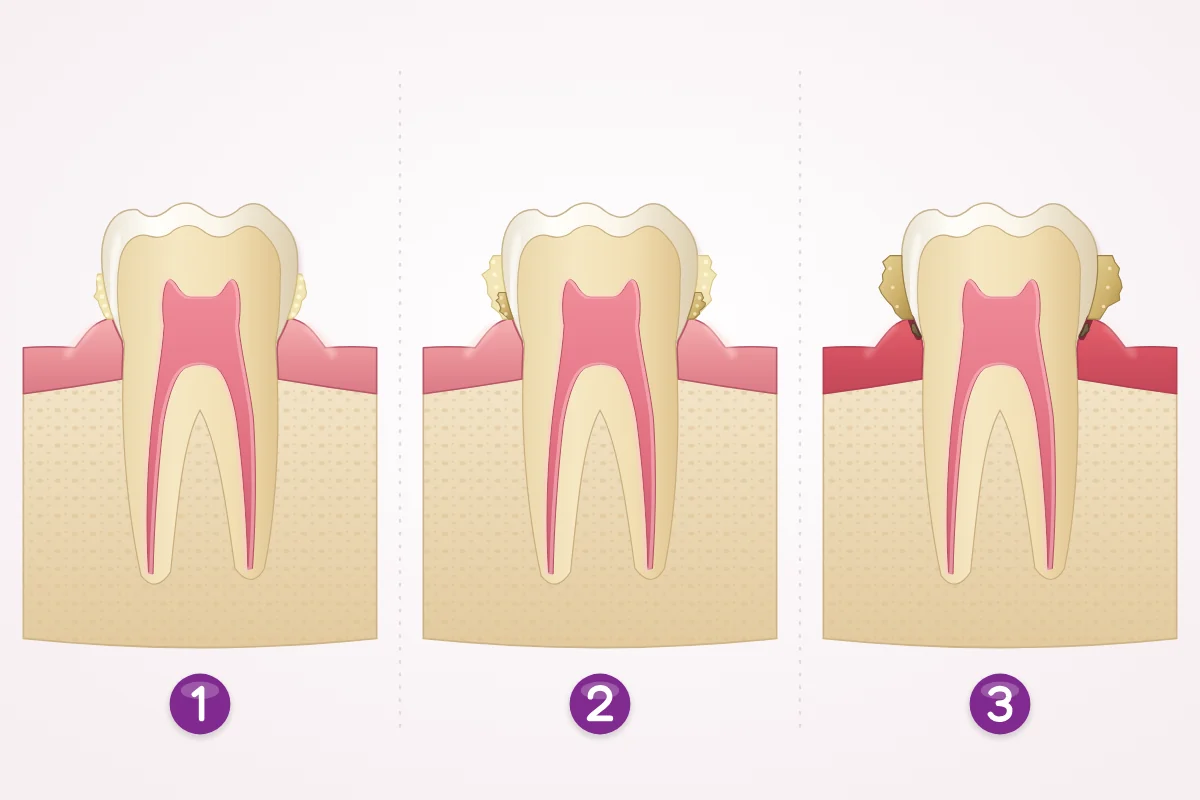
Some people build tartar much faster than others, even with good brushing. A 2020 study in the Journal of Clinical Medicine found exactly that: some people with good plaque control still form calculus quickly, and in that study the fast formers more often had crowded teeth and differences in their saliva. So if your dentist says you are a quick tartar former, it is not a judgment on your brushing. It simply means shorter cleaning intervals and a few extra habits suit you.
| Factor | Why it adds tartar | Helpful steps |
|---|---|---|
| Missed areas when brushing or no cleaning between teeth | Plaque stays long enough to harden. | Brush 2 minutes twice a day and clean between the teeth daily. |
| Smoking | Smokers have more tartar above and below the gum, and it stains dark. | Quitting helps, and the difference narrows over time. |
| Crowded or overlapping teeth | More corners where plaque hides. | Interdental brushes or floss, and a dentist shows you the hard spots. |
| Braces, crowns and bridges | Edges and wires trap plaque. | Extra cleaning around the edges and more frequent cleanings if advised. |
| Dry mouth | Less saliva to rinse plaque away. | Sip water often and tell your dentist about medicines you take. |
| Frequent sugary snacks | Feeds plaque bacteria all day. | Keep sweets to mealtimes and drink water afterward. |
Smoking stands out in the research. In a Swedish study of 258 adults, supragingival tartar was found in 86 percent of current smokers compared with 65 percent of people who had never smoked, and former smokers looked much like non-smokers. A later study by the same group found tartar below the gum on X-rays in 71 percent of smokers compared with 28 percent of non-smokers. A 2024 review notes that smoking raises the calcium level in saliva, which helps explain why.
Where tartar builds up, and why there
Tartar is most common close to the openings of the salivary glands, where saliva rich in minerals flows over the teeth. The two classic spots are the tongue side of the lower front teeth, near the glands under the tongue, and the cheek side of the upper back teeth, near the opening of the parotid gland. A review in the European Journal of Oral Sciences notes that in people who brush well and see a dentist regularly, tartar above the gum is mostly limited to these areas near the salivary ducts.
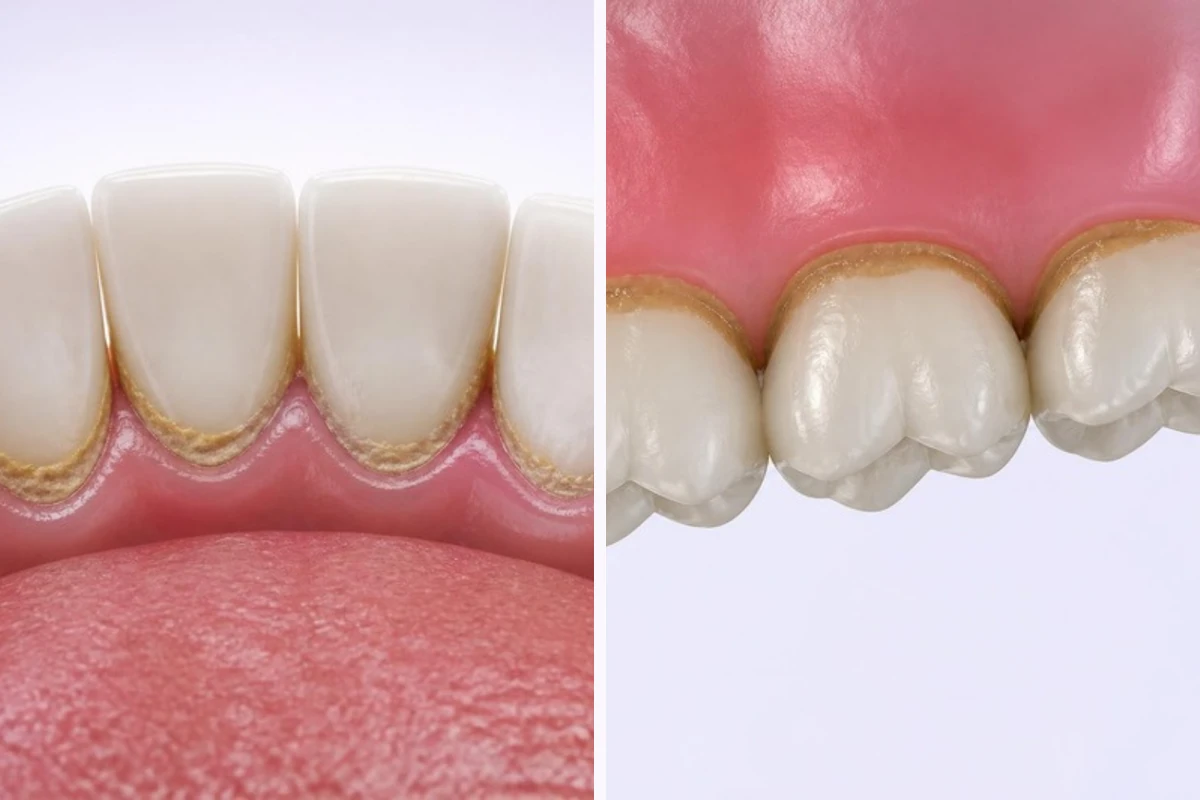
Above the gum and below the gum
Tartar above the gum is the part you can see or feel. It usually starts yellow and darkens with food, drinks and smoking. Tartar below the gum forms inside the small space between the gum and the tooth. Cleveland Clinic notes it can look dark, even black, partly because of blood from inflamed gums. You cannot see it in a mirror; a dentist finds it with a fine instrument and sometimes on X-rays. Research links tartar below the gum with gum pockets getting deeper over time, which is why it is cleaned with deep cleaning rather than a regular polish.
Deep cleaning or regular cleaning: what is the difference?
Can tartar come off by itself?
Tartar does not dissolve or disappear on its own. A piece can crack and break off, often while chewing something firm, and it can feel as if the problem has solved itself. What usually happens is that the outer part breaks away while the base stays attached to the tooth, often with a rough edge that collects plaque even faster. Siriraj Hospital asks the same question in its patient article and answers that tartar needs to be removed by a dentist.
Cleveland Clinic gives practical advice for this moment: if a piece of tartar comes off, contact your dentist rather than picking at what is left. It is also a good time to look at the area. When gums have been pushed back by tartar, the tooth can feel more exposed or sensitive once a piece falls away, and a dentist can check the gum and clean the rest smoothly.
Can you scrape tartar off at home?
Metal scalers and tartar removers sold online, and videos showing people scraping their own teeth, make it look simple. The professional advice is consistent: leave it to a dentist. The Department of Medical Services in Thailand has advised the public to have tartar removed by a dentist rather than doing it themselves with any tool, because it is easy to slip and damage the tooth surface or the gum, and tools that are not sterile can cause infection. Cleveland Clinic states that tartar has to be removed by a dental professional and that scraping at home can damage your teeth.
The reasons are practical. You cannot see the tongue side of your own teeth properly, the gum is soft and cuts easily, and tartar can be pushed further under the gum instead of being lifted off. A dentist works with light, magnification, angled instruments and an ultrasonic scaler, and also checks for decay and gum problems at the same visit.
| Home method | What actually happens | A better choice |
|---|---|---|
| Metal scaler bought online | Can cut the gum, scratch the tooth and push tartar below the gum. | Book a cleaning; keep the area clean with a soft brush meanwhile. |
| Picking with a toothpick or pin | The NHS notes toothpicks can damage the gums. | Floss or an interdental brush of the right size. |
| Vinegar, lemon or other acids | Acids are linked with erosion of tooth enamel. | Plain water after meals; scaling for hard deposits. |
| Baking soda or charcoal powder | Baking soda is a mild polish used in some toothpastes; there is no evidence it dissolves hardened tartar. | A fluoride toothpaste, anti-tartar if you form tartar quickly. |
Why removing tartar early is good for your gums
Removing tartar keeps the gum line smooth and easy to clean, which helps the gums stay healthy. The ADA notes that tartar above the gum line can lead to swollen gums that bleed easily, the early stage of gum disease called gingivitis. Because tartar is rough and porous, it holds plaque right against the gum and keeps it irritated. Research describes it as a factor that helps gum disease continue and progress, even though plaque is what starts it.
- Gums: less bleeding and swelling once the rough surface is gone.
- Breath: tartar and the plaque on it carry an odor, so cleaning often helps.
- Appearance: stains held in tartar come off with it, so teeth look cleaner.
- Early checks: decay and gum pockets hidden under tartar become easier to find.
Gum disease is common: the CDC reports that about 4 in 10 adults aged 30 and over in the United States have periodontitis. Keeping tartar under control is one of the simplest ways to look after your gums, together with daily cleaning between the teeth.
Bleeding gums and gingivitis: what to do
How to slow tartar down: a daily plan
Saliva will always carry minerals, so the goal is to clear plaque away before it has time to harden. These steps fit into a normal day.
- Brush twice a day for about 2 minutes with a fluoride toothpaste, including before bed. The NHS recommends a toothpaste with at least 1,350 ppm fluoride for adults, and spitting out afterward rather than rinsing.
- Angle the bristles toward the gum line. Tartar starts where the tooth meets the gum, so that is where the brush needs to be.
- Give extra time to the tongue side of the lower front teeth and the cheek side of the upper back teeth.
- Clean between your teeth once a day with floss or interdental brushes. Siriraj Hospital recommends flossing once or twice a day.
- If you form tartar quickly, consider an anti-tartar toothpaste (see below).
- Drink water after coffee, tea and sweet drinks, and if you smoke, consider support to quit.
- Keep your check-up and cleaning visits at the interval your dentist suggests.
Do anti-tartar toothpastes work?
Yes, for slowing new tartar. These toothpastes contain ingredients such as pyrophosphates, zinc salts or copolymers that delay the hardening of plaque and keep deposits soft for longer. A systematic review of 32 reports found that these toothpastes significantly reduced calculus scores. In individual trials, people who had their teeth cleaned first and then used an anti-tartar toothpaste formed roughly 14 to 40 percent less new tartar than with a regular toothpaste, depending on the formula and the length of the study. The trials measured new tartar after a cleaning, so the toothpaste gives its full benefit right after a scaling visit. Tartar that has already hardened still needs a dentist.
Does an electric toothbrush help?
It can help some people. A Cochrane review of 51 trials found that electric toothbrushes removed about 21 percent more plaque than manual brushes after three months or more, with about 11 percent less gum inflammation. The NHS considers a manual brush equally good if you reach every surface, so the right brush is the one you use well, twice a day.
Common myths and the facts
| Myth | Fact |
|---|---|
| Tartar falls off by itself, so there is no need to remove it. | Pieces can break off, but the base stays on the tooth. A dentist removes the rest smoothly. |
| If I brush well, I will never get tartar. | Brushing slows it a lot, but some people form tartar quickly even with good care. Regular cleanings suit them. |
| Scaling wears away tooth enamel. | Siriraj Hospital notes that scaling does not affect the tooth itself. It removes deposits sitting on the tooth. |
| Scaling makes teeth loose or gappy. | Scaling does not create gaps. Where gum disease has already lowered the gum, the space becomes visible once tartar is gone, and the gum can heal better. |
| Anti-tartar toothpaste removes the tartar I already have. | It slows new tartar. Hardened tartar needs scaling. |
| Lemon juice or vinegar dissolves tartar. | Acids are linked with enamel erosion. Water after meals and regular cleanings are safer. |
Tartar removal with a dentist, in brief
Most people feel vibration and some sensitivity during scaling. If your teeth or gums are sensitive, tell the dentist, who can use local anesthetic, and Airflow uses a fine spray instead of scraping on the tooth surface. Most people have a check-up and cleaning about every six months, and your dentist may suggest a different interval based on your gums and how quickly you form tartar.
A Cochrane review found that, for adults without severe gum disease who see a dentist regularly, routine scaling every 6 or 12 months made little difference to gum inflammation but did slightly reduce tartar. That is a good reminder that daily cleaning does most of the work for your gums, and that the right cleaning interval is a personal one. The full answers on pain, sensitivity and timing are in our article on scaling.
Does teeth cleaning hurt, and how often should you have it?
Tartar removal at the clinic, step by step
- Check-up: the dentist examines your teeth, gums and fillings, and takes X-rays if needed.
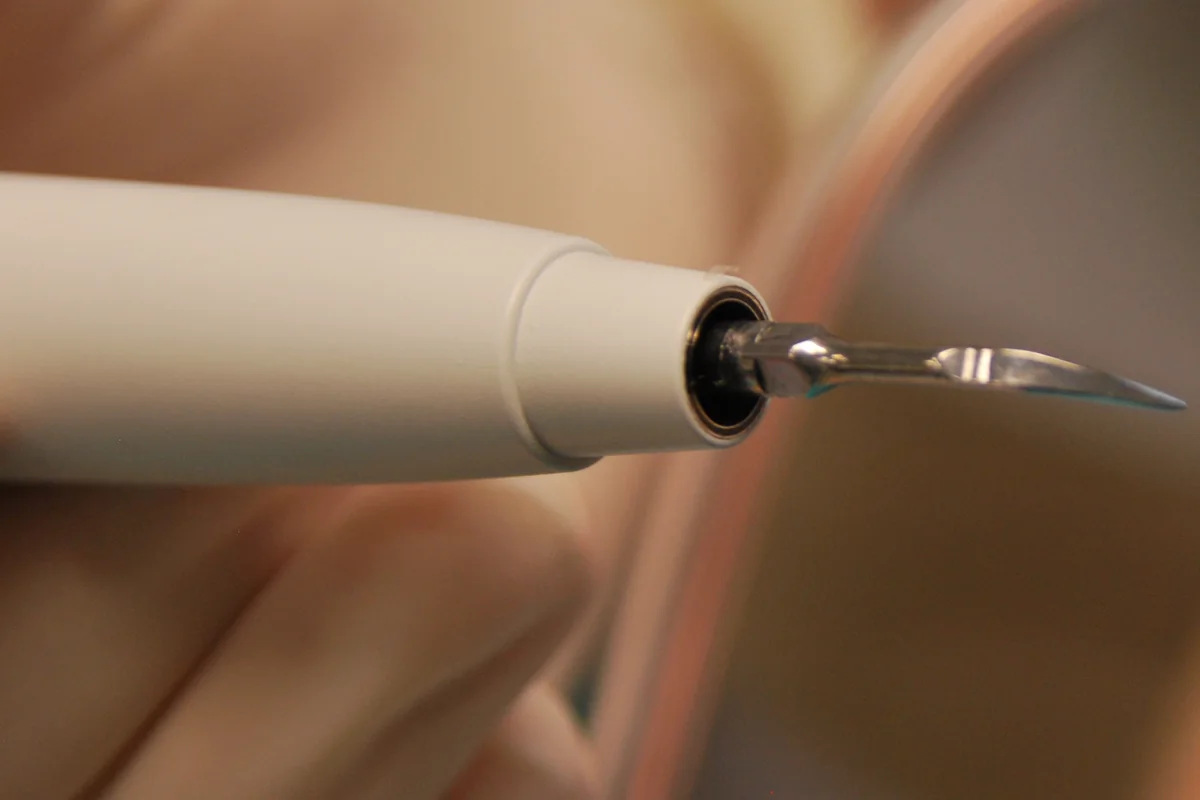
- Cleaning: tartar is removed with an ultrasonic scaler and hand instruments, then the teeth are polished. Airflow uses a spray of fine powder, air and water to clean plaque and stains, including small hard-to-reach spots.
- GBT option: plaque is first stained so you and the dentist can see it. Older, thicker plaque shows a darker color, and the dentist points out the spots to brush better.
- Tartar below the gum: if there is tartar under the gum or signs of gum disease, regular cleaning is not enough. Deep cleaning (scaling and root planing) cleans below the gum line, is often done over more than one visit, and is planned with the periodontists at the clinic.
- Advice and next visit: the dentist shows the areas to brush or floss better and explains any treatment that may be needed, such as a filling or gum treatment.
After GBT, it helps to avoid dark foods and drinks such as coffee, tea, cola, soy sauce and curry for about 3 hours, because freshly cleaned teeth pick up stains more easily. Cleaning costs depend on the amount of tartar and the method used, and they are listed on our prices page. If you are using Thai Social Security, you pay at the clinic, the clinic issues a medical certificate and receipt, and you claim the benefit yourself. If you take blood thinners, in some cases you do not need to stop them and in some cases the dentist may first consult the doctor who looks after you; please do not stop any medicine on your own. If you are pregnant, let the dentist know and the dentist will plan your care.
If this sounds like you: what to do
These are example situations, not patient stories, to help you find the next step that fits.
- You feel a rough edge behind your lower front teeth and your last cleaning was a year ago: book a check-up and cleaning, and ask the dentist to show you that area so you can brush it better.
- A piece of tartar came off while eating and the tooth feels a little sensitive: keep brushing gently with a soft brush and book a visit so the rest can be removed and the gum checked.
- You brush carefully but your dentist says tartar comes back fast: ask about a shorter cleaning interval and an anti-tartar toothpaste, and use interdental brushes in the gaps.
- You smoke and your tartar is dark: scaling removes the stain held in tartar, and quitting helps tartar build up more slowly over time.
- You wear braces or have a bridge and see yellow buildup at the edges: ask about GBT and the right interdental brush size for your gaps.
- You bought a metal scaler online and the gum is now sore: put it away, rinse with warm salt water, and book a visit so a dentist can check the gum and finish the cleaning.
Frequently asked questions about tartar
How long does it take for plaque to turn into tartar?
Mineralization starts early. Research summarized in a 2024 study suggests about half happens in the first two days and most is complete in around 12 days. Cleaning every surface each day keeps plaque from reaching that point.
Why do I still get tartar when I brush every day?
Brushing often misses the gum line and the spaces between teeth, and some people simply form tartar faster because of their saliva or crowded teeth. Cleaning between the teeth daily, giving extra time to the salivary gland areas and a shorter cleaning interval usually help.
Can tartar fall off by itself?
Pieces can break off, but the base usually stays on the tooth and the edge left behind collects plaque quickly. Contact your dentist rather than picking at the rest.
Can I scrape tartar off myself?
Leave it to a dentist. Home scraping can cut the gum, scratch the tooth and push tartar further under the gum, and tools that are not sterile can cause infection. Daily brushing and cleaning between the teeth are the safe home part.
Is there a toothpaste that removes tartar?
Anti-tartar toothpastes slow new tartar from forming. Tartar that has already hardened needs scaling. Starting one right after a cleaning helps it work well.
Why is my tartar black?
Tartar takes up color from coffee, tea, tobacco and red wine. Tartar below the gum is often dark because of blood from inflamed gums. Dark tartar near the gum line is a good reason for a check-up, because part of it may be below the gum.
Does tartar cause bad breath?
It can. Tartar and the plaque on it have an odor, and they create spaces where food and bacteria collect. Cleaning often helps, and if the smell comes from decay or gum disease, the dentist explains the treatment needed.
Will my teeth look whiter after tartar is removed?
Teeth usually look cleaner and brighter because the stain held in tartar comes off too. Scaling does not change the natural color of the teeth; for that, ask about whitening.
Summary
Tartar is plaque that has hardened with minerals from saliva. It forms over days, so cleaning every surface daily keeps it soft and easy to remove. Hardened tartar needs a dentist.
- Tartar builds up most near the salivary glands: behind the lower front teeth and on the cheek side of the upper back teeth.
- Pieces can break off, but the base stays; contact a dentist rather than picking at it.
- Home scraping risks the gum and tooth; scaling at the clinic is safe and quick.
- Anti-tartar toothpaste, cleaning between the teeth and not smoking slow new tartar.
- Your dentist sets a cleaning interval that suits how fast you form tartar.
References
Cleveland Clinic: Tartar (Dental Calculus)
American Dental Association (MouthHealthy): Plaque
American Dental Association: Toothpastes (Oral Health Topics)
Siriraj Hospital, Mahidol University: Tartar, a hazard close to home (Thai)
Department of Medical Services, Thailand, advice on scaling at home (Matichon, 2020, Thai)
MedlinePlus (US National Library of Medicine): Gingivitis
MedlinePlus (US National Library of Medicine): Tooth decay
NHS (UK): How to keep your teeth clean
CDC (US): About Periodontal (Gum) Disease
Jin Y, Yip HK. Supragingival calculus: formation and control. Crit Rev Oral Biol Med, 2002
Thakur et al. Dental calculus composition in rapid and slow calculus formers. BMC Oral Health, 2024
Fons-Badal C et al. Salivary and dental factors in rapid and slow calculus formers. J Clin Med, 2020
Bergström J. Tobacco smoking and supragingival dental calculus. J Clin Periodontol, 1999
Bergström J. Tobacco smoking and subgingival dental calculus. J Clin Periodontol, 2005
Lamont T et al. Routine scale and polish for periodontal health in adults. Cochrane Review, 2018
Yaacob M et al. Powered versus manual toothbrushing for oral health. Cochrane Review, 2014
Järvinen VK et al. Risk factors in dental erosion. J Dent Res, 1991
Hara AT, Turssi CP. Baking soda as an abrasive in toothpastes. JADA, 2017