

You came in for what you thought was a routine cleaning, and the dentist says you need deep cleaning instead, maybe in two or more visits, with numbing. Many people leave that appointment with the same questions: is this really necessary, is it just a bigger cleaning, will it hurt, and will my teeth feel loose afterwards?
The short answer is reassuring. Both treatments remove the same thing, the bacteria and tartar that cause gum disease. The difference is where they work. A regular cleaning works on the tooth above the gums and just below the gum edge. Deep cleaning reaches the root surfaces inside deeper gum pockets, where a toothbrush and an ordinary cleaning cannot reach. Large reviews of the research show it is an effective first treatment for gum disease, and most people go back to normal routines the same day.
This article walks you through the decision and the process. You will find a quick self-check, a side-by-side table of the two treatments, what pocket depth numbers mean, the procedure step by step, a treatment timeline, a day-by-day recovery guide, what results the research shows, the role of antibiotics and lasers, common myths, signs to call the clinic, and answers to the questions people search for most.
In short: a regular cleaning cleans above the gums and suits healthy gums or mild gingivitis. Deep cleaning, also called scaling and root planing, cleans the roots inside pockets deeper than about 3 to 4 mm to treat periodontitis. It is done under local anesthesia, often area by area, and is followed by a recheck once the gums have healed and by regular maintenance visits.
Regular cleaning or deep cleaning? A quick self-check
Only a gum examination with pocket measurements can give the answer, but these signs help you guess which group you are likely in before your visit.
A regular cleaning is likely enough
- Your gums are pink and firm, and they bleed only now and then, if at all.
- You have a check-up and cleaning about every 6 months, and tartar is light.
- Your teeth feel firm and your gum line has not changed.
Deep cleaning may be recommended
- Your gums bleed often when you brush or floss, and have done so for weeks.
- It has been a long time since your last cleaning, and there is hard tartar near or under the gums.
- Your teeth look longer, gaps have appeared, or food packs between teeth more than before.
- You have bad breath or a bad taste that keeps coming back even with good brushing.
- You smoke, or you have diabetes, both of which are linked with gum disease.
Book a check soon
- A tooth feels loose, or your bite feels different when you chew.
- A gum is swollen with pus, or there is a bump on the gum that comes and goes.
- Your gums bleed on their own, not only when you brush.
If most of your answers are in the first group, a regular check-up and cleaning is usually the right next step. If you see yourself in the second or third group, book a gum check, which measures the pockets and gives you a clear answer.
Bleeding gums and gingivitis: what to do
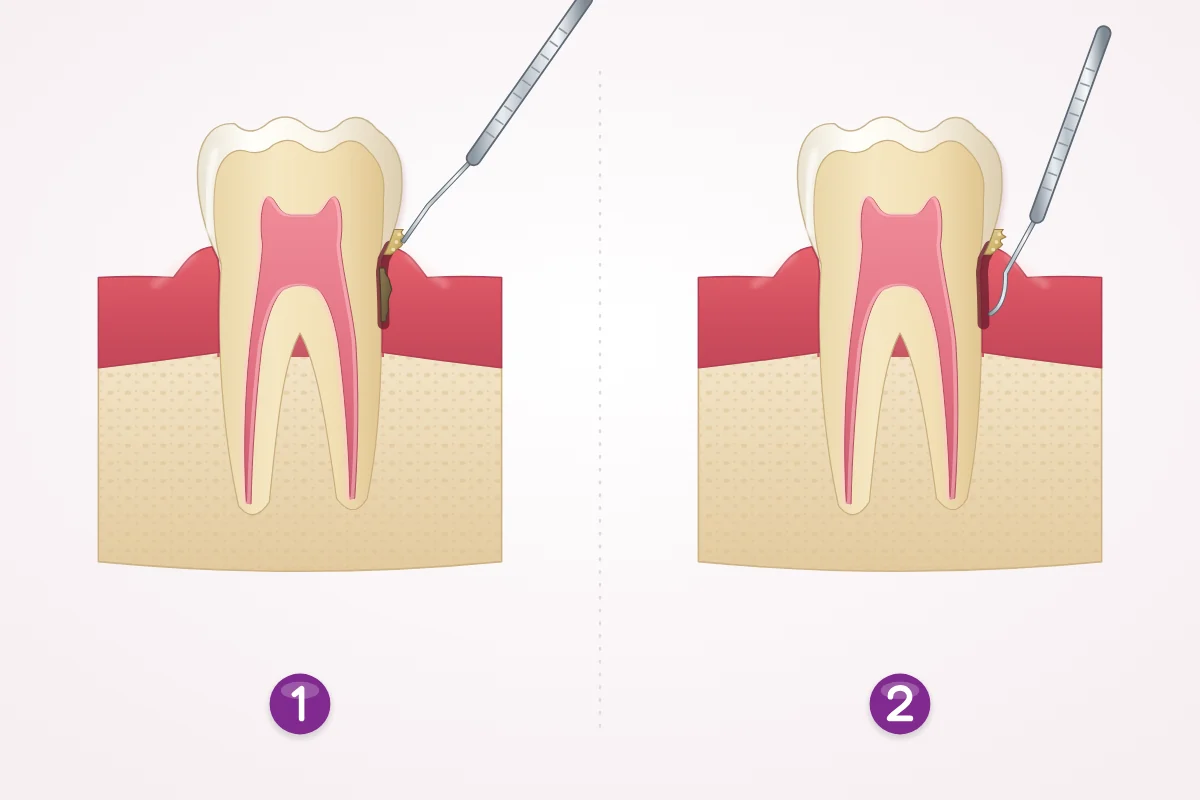
Deep cleaning and regular cleaning side by side
Both use similar instruments, so from the dental chair they can feel alike. What changes is the depth, the goal and the plan around it. This table puts the two side by side.
| Topic | Regular cleaning (scaling and polishing) | Deep cleaning (scaling and root planing) |
|---|---|---|
| Where it cleans | The crowns of the teeth above the gums, and just under the gum edge | The root surfaces inside deeper gum pockets, below the gum line |
| What it treats | Prevention, and gingivitis where the bone is still intact | Periodontitis, where the gum has started to detach and bone has been lost |
| Typical pocket depth | Up to about 3 mm | More than about 3 to 4 mm, often with bleeding when measured |
| Numbing | Usually not needed; sensitive areas can be numbed | Local anesthesia for the area being treated is usual |
| Number of visits | Usually one visit | One long visit or several, area by area, plus a recheck |
| Measurements before and after | A check of teeth and gums, with X-rays if needed | Pocket depths around every tooth and X-rays of the bone, measured again after healing |
| How you feel afterwards | Teeth may feel smooth and a little sensitive for a short time | Gums may be sore for a couple of days; teeth may be more sensitive for some weeks |
| How often it is done | About every 6 months for most people | Once as active treatment, then maintenance cleanings every 3 to 6 months, as your dentist advises |
One way to picture it: a regular cleaning is like cleaning a floor, while deep cleaning is like cleaning out a crack in that floor that has collected dirt deep inside. The crack is the gum pocket, and the dirt stuck to its walls is tartar and bacteria on the root.
Pocket depth: the numbers that decide
Around every tooth there is a shallow groove where the gum meets the tooth. In healthy gums it is about 1 to 3 mm deep, and a gentle probe slides in without bleeding. When plaque stays along the gum line, the gum becomes inflamed. If inflammation continues, the fibers that hold the gum to the tooth break down, the bone around the root starts to shrink, and the groove deepens into a pocket.
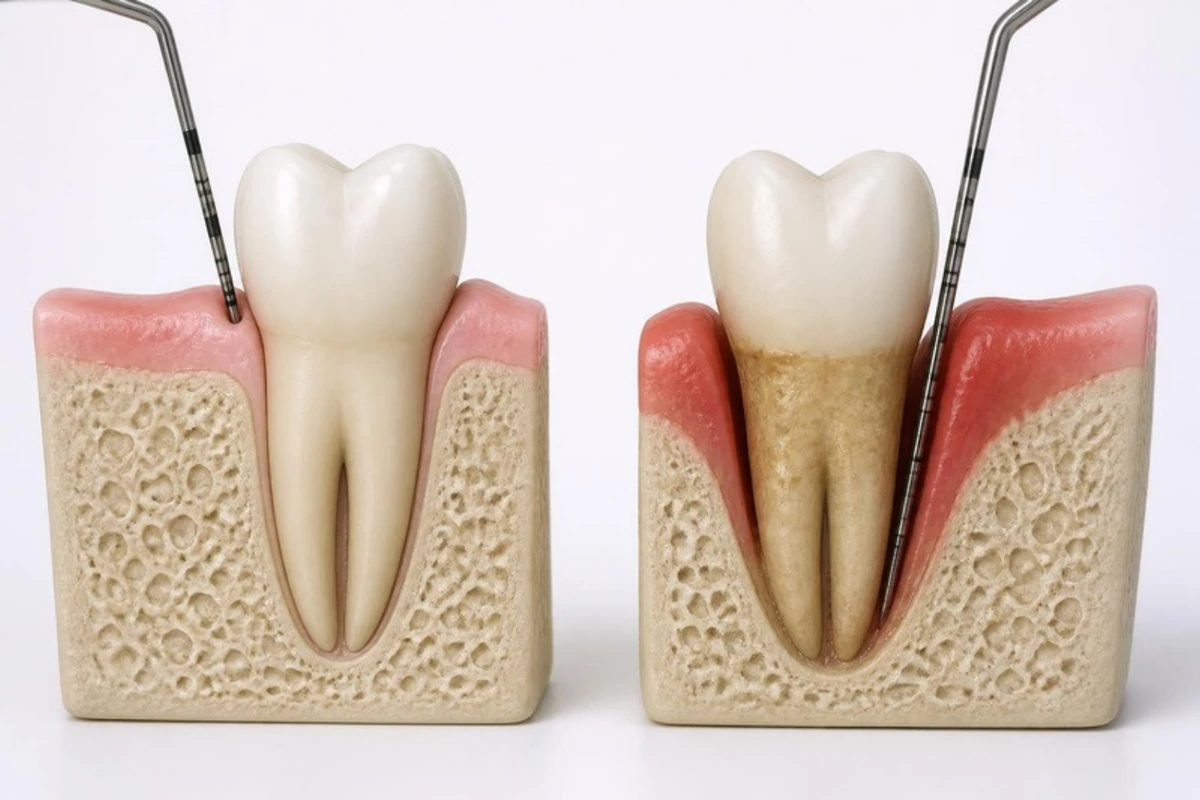
A deeper pocket is a sheltered space with little oxygen, where bacteria thrive and plaque hardens into tartar on the root. A toothbrush reaches only a millimeter or so under the gum, so once a pocket forms, home care alone cannot clean it. That is the reason deep cleaning exists: it removes what is stuck on the root so the gum can heal and tighten around a clean, smooth surface.
A Thai dental faculty explains it in the same way: in gingivitis the pockets are no deeper than about 3 mm and scaling without injected numbing is usually enough, while in periodontitis pockets go beyond 3 mm, in some places or throughout the mouth, so the roots must be cleaned to the depth of each pocket.
What the measurements usually mean
| Pocket depth measured | What it usually means | Usual next step |
|---|---|---|
| 1 to 3 mm, no bleeding | The gums are healthy | Regular check-ups and cleanings |
| 1 to 3 mm, bleeding | Gingivitis: the gum is inflamed but has not detached | A cleaning and better home care at the gum line |
| 4 to 5 mm | Early to moderate periodontitis in that area | Deep cleaning of those roots, then a recheck |
| 6 mm or more | More advanced disease, with more bone lost | Deep cleaning first; pockets still deep after healing may need gum surgery |
These ranges are a guide, not a rule. Your dentist also looks at bleeding when the pocket is measured, how much the gum has receded, X-rays of the bone, whether teeth move, and your health and habits. One mouth often has healthy areas next to deeper pockets, so a plan may include a regular cleaning for some teeth and deep cleaning for others.
How deep cleaning is done, step by step
Deep cleaning is a non-surgical treatment. There are no cuts or stitches. Most of the time is spent on careful, systematic cleaning of each root surface.
- Review and plan: your dentist goes over your pocket chart and X-rays, explains which areas need deep cleaning, and how many visits it will take.
- Numbing: local anesthesia is given to the area being treated. You stay awake, and you feel pressure and vibration rather than sharp pain.
- Scaling: tartar and plaque are removed above and below the gum with ultrasonic instruments, which use vibration and a water spray, and with fine hand instruments.
- Root planing: the root surfaces inside the pockets are cleaned and smoothed, so plaque has fewer rough spots to cling to and the gum can reattach more snugly.
- Rinse and check: the pockets are flushed and checked, and your dentist tells you how to care for the area over the next few days.
- Home care coaching: you are shown how to clean along the gum line and between the teeth in the areas that need it most. This step matters as much as the cleaning itself.
A Thai periodontal teaching script makes the same point clearly: if the gums are cleaned at the clinic but the patient cannot clean them well at home afterwards, the disease comes back. Deep cleaning removes what has built up; your daily cleaning keeps it from building up again.
Quadrant by quadrant, or the whole mouth at once?
Dentists often divide the mouth into four quarters and treat one or two per visit. Others treat the whole mouth in one long session or within the same day. A 2022 Cochrane review of 20 trials found no clear difference in results between full-mouth and quarter-by-quarter treatment, and a 2020 systematic review reached the same conclusion. The choice can therefore be based on how much needs treating, your comfort with longer sessions, your general health and your schedule.
For visitors staying in Chiang Mai for a limited time, this is useful to know: ask your dentist whether your treatment can be grouped into fewer, longer visits, and plan the recheck around your travel.
Hand instruments or ultrasonic?
Both work. A systematic review of trials comparing them found no meaningful difference in results, and the European periodontal guideline recommends hand or powered instruments, alone or combined. Dentists usually combine them: ultrasonic tips are quick on heavy tartar, and hand instruments give fine control on the root surface.
The treatment timeline, from first check to maintenance
Deep cleaning is not a single event but the core of a short program. Knowing the sequence helps you plan work, travel and appointments.

| When | What is done | What you do |
|---|---|---|
| Visit 1: gum examination | Pockets measured around every tooth, X-rays, a gum chart, then a plan and estimate | Tell your dentist about your health, every medicine you take, smoking and pregnancy |
| Deep cleaning visits | One long visit or several, usually one or two areas of the mouth at a time | Eat before you come, and follow the home care you are shown |
| About 2 weeks after | Often a short review of healing and home cleaning, with extra coaching where needed | Keep cleaning gently but thoroughly, even where it is tender |
| After the gums have healed (often 1 to 3 months) | Re-evaluation: pockets measured again and compared with the first chart | Ask what changed, and which areas still need attention |
| If some pockets are still deep | Repeat cleaning for moderate pockets, or gum surgery for deeper ones | Discuss the options and timing with your dentist |
| Long term | Maintenance cleanings, often every 3 to 6 months, with pockets checked over time | Keep the appointments and the daily routine; this is what keeps the result |
The timing above is a typical pattern drawn from periodontal guidance and teaching material, not a fixed rule. The European guideline says re-evaluation happens after an adequate healing period, and that maintenance visits should be set between 3 and 12 months apart depending on each person. Your dentist sets the dates that fit your gums.
After deep cleaning: a day-by-day recovery guide
Most people return to work or normal activities the same day. What you feel afterwards depends on how deep the pockets were and how inflamed the gums were before. This guide shows what is common and what helps.
| Time after treatment | What is common | What helps |
|---|---|---|
| First few hours | Numbness in the lip, cheek or tongue; light oozing of blood | Wait until the numbness wears off before eating or hot drinks, so you do not bite your cheek or burn your mouth |
| Days 1 to 3 | Sore, tender gums; some bleeding when you brush | Pain relief as your dentist advises; soft, lukewarm food; a soft brush; keep cleaning gently |
| Week 1 | Soreness fading; bleeding when brushing becoming less | Go back to cleaning between the teeth every day, gently |
| Weeks 1 to 8 | Sensitivity to cold, and sometimes to sweets, that slowly eases | A toothpaste for sensitive teeth; avoid very cold drinks for a while; tell your dentist if it is not improving |
| Weeks 2 to 4 | Gums firmer and paler; bleeding and tenderness mostly settled | Keep the routine; notice which spots still bleed and mention them at the recheck |
MedlinePlus notes that bleeding and tenderness of the gums should go away within 3 to 4 weeks of treatment, and Cleveland Clinic describes soreness lasting a couple of days and sensitivity to heat and cold that usually settles within a month or two. A review of studies on root sensitivity after gum treatment found that it is common in the first days and is usually mild to moderate and temporary.
What to eat
- Once the numbness has gone, you can eat normally as long as it does not hurt.
- For the first day or two, soft and lukewarm foods are more comfortable: rice soup, eggs, tofu, steamed fish, soft noodles, ripe fruit.
- Spicy, very sour, very hot or very cold foods may sting tender gums or sensitive roots for a while.
- Hard, crunchy foods and small seeds can poke into healing pockets; chew them on the other side or wait a few days.
- Smoking slows gum healing. If you smoke, deep cleaning is a good moment to cut down or stop.
Why teeth can look longer or feel loose afterwards
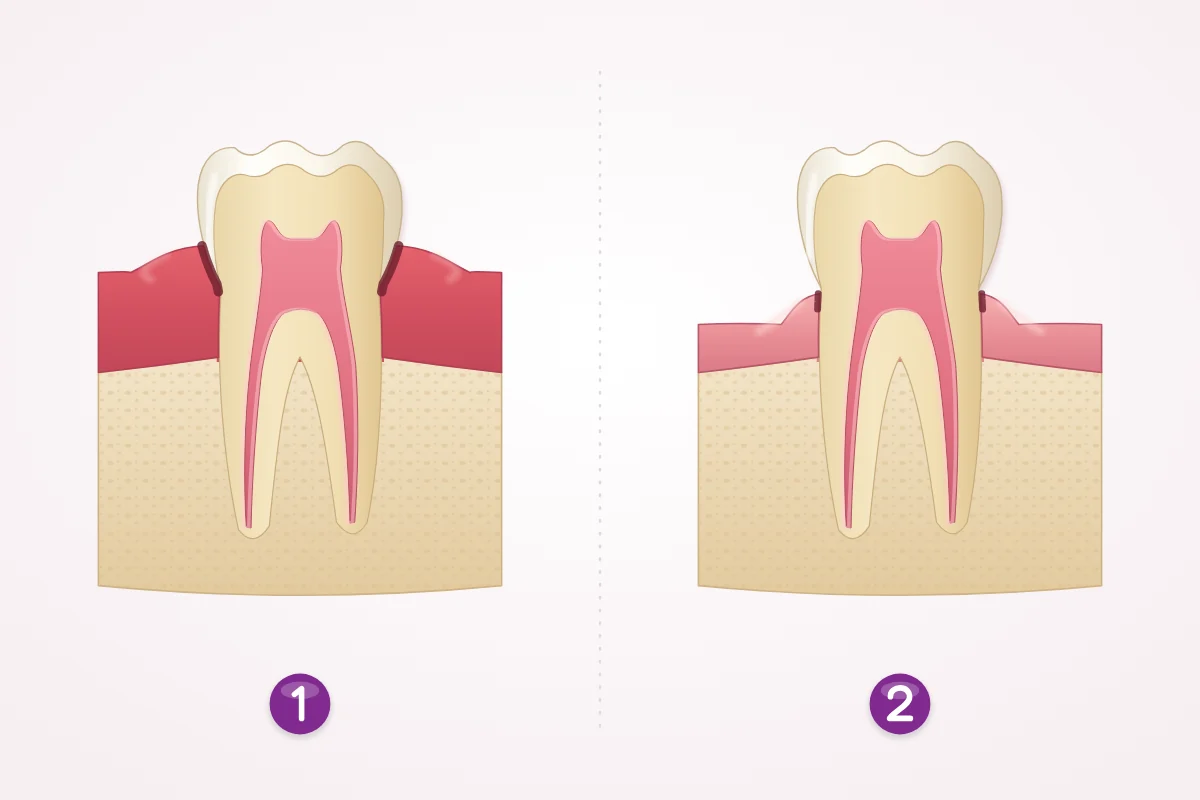
Swollen gums shrink as the inflammation settles. The gum edge then sits a little lower, so teeth can look longer and small gaps between them may show more. This is the gum returning toward its real healthy level, not damage from the cleaning. Teeth may also feel slightly looser for a short time, because the tartar and swollen gum that were holding them are gone. As the gum tightens around the clean root, this usually settles.
If a tooth was already loose because of bone loss, cleaning cannot rebuild the bone, but stopping the inflammation gives the tooth a good chance of becoming firmer. Your dentist will explain what to expect for any tooth that is a concern.
A loose tooth in adults: causes and treatment
What results to expect, according to research
Deep cleaning is the foundation of gum disease treatment, and it has been studied in many trials. Here is what the larger reviews show in plain terms.
- Pockets get shallower: a 2020 review pooled studies and found an average reduction in pocket depth of about 1.4 mm at 6 to 8 months.
- Many pockets close: the same review estimated that about 74 percent of treated pockets closed, meaning they became shallow enough to keep clean.
- Attachment improves a little: an American Dental Association review found an average gain of about 0.5 mm in gum attachment after scaling and root planing.
- Lost bone does not grow back on its own. The aim is to stop the disease, keep the teeth and keep the gums stable.
Pocket depth is measured in millimeters, so a 1 to 2 mm change may sound small. In practice it can turn a 5 mm pocket, which a brush cannot clean, into a 3 or 4 mm groove that daily care can keep healthy. European guidance describes the goal of treatment as no pockets deeper than 4 mm that bleed when measured.
What helps the result last
- Daily cleaning along the gum line and between the teeth, with the tools that fit your gaps.
- Not smoking. The European guideline recommends stop-smoking support for everyone having gum disease treatment.
- Good diabetes control, which the same guideline also recommends alongside treatment.
- Keeping maintenance appointments, so small changes are caught and cleaned early.
Antibiotics, gels, mouthwash and lasers
People often ask whether a pill, a gel or a laser can replace the cleaning. The short answer from the research is no: these can sometimes add a little, but the cleaning itself does the main work.
| Add-on | What the research says | How it is used |
|---|---|---|
| Antibiotic tablets | Can add some benefit, but the European guideline advises against routine use because of side effects and antibiotic resistance | Considered only for selected cases after examination; never take leftover antibiotics on your own |
| Antibiotic or antiseptic placed in the pocket | A 2020 review found a small extra reduction in pocket depth, about 0.4 mm on average, without relevant side effects | May be considered for particular pockets, after the cleaning |
| Antiseptic mouthwash | Helps control plaque above the gums, but cannot reach tartar on the roots | A short course if your dentist suggests it; some types stain teeth with long use |
| Dental laser | Reviews found that a laser on its own does not give better results than mechanical cleaning, and evidence for adding it is limited and varied | Used alongside the cleaning when it suits the case, not instead of it |
At our clinic, your dentist may use the Waterlase dental laser alongside standard gum treatment when it suits your case. It is an addition to deep cleaning, not a replacement for it, and deep pockets may still need conventional treatment or surgery.
Common myths about deep cleaning
| Myth | Fact |
|---|---|
| Deep cleaning is just an upsell of a normal cleaning. | It treats a different problem in a different place: tartar on the roots inside pockets. Ask to see your pocket chart and X-rays, which show why it is recommended. |
| Deep cleaning makes teeth loose. | Bone loss from gum disease is what loosens teeth. Teeth can feel a little looser for a short time as tartar and swelling go, and this usually settles as the gums tighten. |
| It causes receding gums. | Swollen gums shrink back to their real level as they heal. The disease caused the attachment loss; the cleaning reveals it. |
| If my gums do not hurt, I do not need it. | Gum disease often causes no pain until late. Pocket measurements, bleeding and X-rays tell more than pain does. |
| Antibiotics or a strong mouthwash can do the same job. | Neither removes tartar from the roots. They can sometimes support the cleaning but cannot replace it. |
| Once it is done, the problem is solved for good. | Gum disease can return. Daily care and regular maintenance visits are what keep the result. |
| Doing the whole mouth at once is always better. | Reviews found similar results either way, so the choice can follow your comfort, health and schedule. |
When to call the clinic after deep cleaning
Mild soreness, some bleeding when brushing and sensitivity are normal parts of healing. Contact the clinic if you notice any of the following, so your dentist can check and advise.
- Bleeding that does not stop after pressing on it with clean gauze for several minutes.
- Pain that pain relievers do not ease, or pain that grows after the third day instead of fading.
- Swelling of the face or gums that increases, a bad taste with pus, or a fever.
- Sensitivity that is still strong after several weeks, or that wakes you at night.
If you take a blood thinner or antiplatelet medicine, keep taking it as prescribed and tell your dentist before treatment. In some cases the medicine does not need to be stopped; in others, your dentist may first consult the doctor who looks after you. Do not stop it yourself.
Deep cleaning at our clinic, step by step
Gum treatment at Kitcha Dental Clinic is planned by dentists with postgraduate training in periodontics, including an MSc in Periodontology and a PhD.
- Gum examination: your dentist measures the pockets around each tooth, takes X-rays to check the bone and records the results on a gum chart.
- Explanation and plan: the dentist explains what they found and gives you a treatment plan and cost estimate before anything starts.
- Cleaning below the gums: the gums are cleaned below the gum line, area by area, usually under local anesthesia and over more than one visit.
- Comfort afterwards: the gums may feel sore or tender for a few days, and your dentist advises on care and pain relief.
- Re-evaluation: after the gums have had time to heal, they are measured again. Areas that are still deep may need gum surgery.
- Maintenance: regular maintenance cleanings help keep the gums stable. Many people come about every 3 to 6 months, and your dentist suggests the right interval for you.
If radiation worries you: at our clinic, X-rays inside the mouth are digital, taken with phosphor plates and sensors that help lower the dose compared with film. Our Planmeca ProMax CBCT has an Ultra Low Dose mode, your dentist chooses the mode that suits each case, and X-rays are taken only when they are needed.
Dental X-ray radiation: how much is it, and how we keep it low
For maintenance visits, cleaning may use ultrasonic and hand instruments, an Airflow spray, or Guided Biofilm Therapy (GBT), which first colors the plaque so you can see the areas your brush misses. GBT is one of the options for people having gum treatment who need regular maintenance cleaning.
Gum treatment fees depend on how many areas need treatment and how advanced the disease is, and are listed on our prices page. Your dentist gives you a treatment plan and estimate after the gum examination.
If you are pregnant, tell your dentist that you are pregnant, and your dentist will plan your care. If you use Thai Social Security for scaling, you pay at the clinic, the clinic issues a medical certificate and receipt, and you claim the amount yourself.
If this sounds like you: what to do
These are example situations, not patient stories, to help you find the next step that fits.
- Your dentist recommended deep cleaning and you are not sure it is needed: ask to see your pocket chart and X-rays and which teeth are involved. A clear plan makes the decision easier.
- You are nervous about numbing and long sessions: say so at the start. Treatment can be split into shorter visits, and you can ask for breaks.
- You are visiting Chiang Mai for two weeks: ask whether the deep cleaning can be grouped into fewer visits early in your stay, and plan the recheck with a dentist at home or on your next visit.
- You take a blood thinner: keep taking it as prescribed, bring the name and dose, and let your dentist decide whether to consult your doctor first.
- You have diabetes: let both your dentist and your doctor know. Gum treatment and blood sugar control work well together.
- You smoke: deep cleaning still helps, but healing and results are better without tobacco. Ask for support to cut down.
- Your teeth feel sensitive two weeks after treatment: this is common and usually eases. Use a toothpaste for sensitive teeth and mention it at your recheck.
- You have implants as well as natural teeth: tell your dentist, as the gums around implants are checked and cleaned with suitable instruments too.
Frequently asked questions about deep cleaning
Does deep cleaning hurt?
The area is numbed with local anesthesia first, so during treatment most people feel pressure, scraping and vibration rather than pain. Afterwards the gums may be sore or tender for a few days and teeth may be sensitive for some weeks. Your dentist advises on pain relief, and you can ask for a pause at any time.
Is deep cleaning really necessary?
When there is tartar on the roots inside pockets deeper than about 4 mm, yes: a toothbrush and a regular cleaning cannot reach it, and the inflammation continues. If you are unsure, ask to see your pocket chart and X-rays, and which teeth are involved.
How long does deep cleaning take, and how many visits?
It depends on how many teeth need it. The whole mouth can be done in one long session or split into two to four visits, often a quarter or half of the mouth at a time. Research found similar results either way. Then there is a recheck once the gums have healed.
Why do my teeth feel loose after deep cleaning?
Tartar and swollen gum can act like a splint around the teeth. Once they are removed, teeth may feel a little looser for a short time. This usually settles as the gums heal and tighten. Looseness that existed before treatment comes from bone loss, and your dentist explains the outlook for that tooth.
Can I eat after deep cleaning?
Yes, once the numbness has worn off, so you do not bite your cheek or tongue. For a day or two, soft, lukewarm food is more comfortable, and very spicy, sour, hot or cold food may sting.
How often do I need deep cleaning?
Ideally the full deep cleaning is done once as active treatment. After that, maintenance cleanings, often every 3 to 6 months, keep the gums stable. Areas that become deeper again may need cleaning again, which is why the pockets are checked over time.
Can deep cleaning and a regular cleaning be done on the same day?
Often, yes. Scaling above the gums is part of deep cleaning, and when only some areas have deep pockets, the rest of the mouth can have a regular cleaning in the same plan. Your dentist explains which teeth receive which treatment.
What happens if I do not have deep cleaning?
Tartar and bacteria in the pockets stay, so the inflammation usually continues. Over time this can mean more bone loss, receding gums, loose teeth and bad breath. Treating earlier usually keeps the treatment simpler, and your dentist can explain the options and timing that suit you.
Summary
Deep cleaning and a regular cleaning remove the same culprits, plaque and tartar, but deep cleaning reaches the roots inside deeper pockets to treat periodontitis.
- Pocket measurements and X-rays decide which you need; healthy grooves are about 1 to 3 mm.
- It is done under local anesthesia, in one long visit or several, with a recheck after healing.
- Soreness for a few days and sensitivity for some weeks are common; teeth may look longer as swelling goes.
- Antibiotics, gels and lasers can at most support the cleaning; they do not replace it.
- Daily cleaning, not smoking and maintenance visits every 3 to 6 months keep the result.
References
Cleveland Clinic: Tooth Scaling and Root Planing
MedlinePlus (US National Library of Medicine): Periodontitis