

You know it is time for a cleaning. Maybe your gums bleed a little, there is a hard line along the back of your lower front teeth, or it has simply been a long time. And yet the appointment keeps getting pushed back, because of one question: will it hurt? The sound of the scaler, the water spray and memories of an old visit are enough to make many people wait.
Here is the reassuring part. Studies that ask people to rate pain during scaling find that most people report only limited discomfort, and that people who expect it to hurt tend to feel more. What you usually feel is vibration, water, some scraping and short moments of sensitivity, mostly where the gums are inflamed or the roots are exposed. Those moments can be managed: your dentist can slow down, adjust the instrument, use a gentler method or numb the area.
This article walks you through what each step feels like and why, what makes a cleaning more sensitive and what helps, the different cleaning methods, how often you really need one, what to do before and after, common myths, signs to call your dentist, and what happens at our clinic. You will also find example situations and answers to the questions people search for most.
In short: for most people a cleaning feels like vibration, water and brief sensitivity rather than pain. It is more sensitive when the gums are inflamed, the roots are exposed or there is a lot of tartar, and your dentist can numb the area if needed. Most people have a check-up and cleaning about every 6 months; your dentist may suggest more often or less often depending on your gums.
Before you book: what kind of cleaning visit to expect
Tick the statements that fit you. They do not replace an examination, but they give you a realistic idea of how your visit is likely to feel and what to mention when you book.

Likely a routine, comfortable cleaning
- You had a cleaning within the last 6 to 12 months.
- Your gums rarely bleed when you brush or floss.
- Cold drinks do not usually make your teeth sensitive.
- You see only a little tartar, or none, behind the lower front teeth.
Likely more sensitive: mention it when you book
- It has been more than a year or two since your last cleaning, or you cannot remember.
- Your gums bleed easily, look red or feel tender.
- Your teeth are sensitive to cold, or some roots near the gum line are exposed.
- You feel very anxious about dental visits, or a past cleaning was uncomfortable.
Likely needs an examination first, possibly a deeper cleaning
- Your gums have pulled back, your teeth look longer, or a tooth feels loose.
- Bad breath or a bad taste keeps coming back even though you brush.
- You have a swelling on the gum, pus, or a painful spot.
- You have diabetes, smoke, or have implants, crowns or bridges.
If several statements in the last group fit you, a routine cleaning may not be enough on its own. Tartar below the gum line is cleaned with a deeper treatment called scaling and root planing, which is usually done under local anesthesia, so it is planned after your gums are measured.
Why some cleanings feel fine and others feel sensitive
Plaque is a soft, sticky film of bacteria that builds up on teeth every day. When it is not removed, it can harden into tartar, also called calculus. Tartar is firmly attached and rough, it collects more plaque, and a toothbrush or floss cannot remove it. That is why a professional cleaning is needed even for people who brush well. A survey reported by Thailand Department of Health found that more than 7 in 10 Thai working-age adults had tartar that needed to be removed.
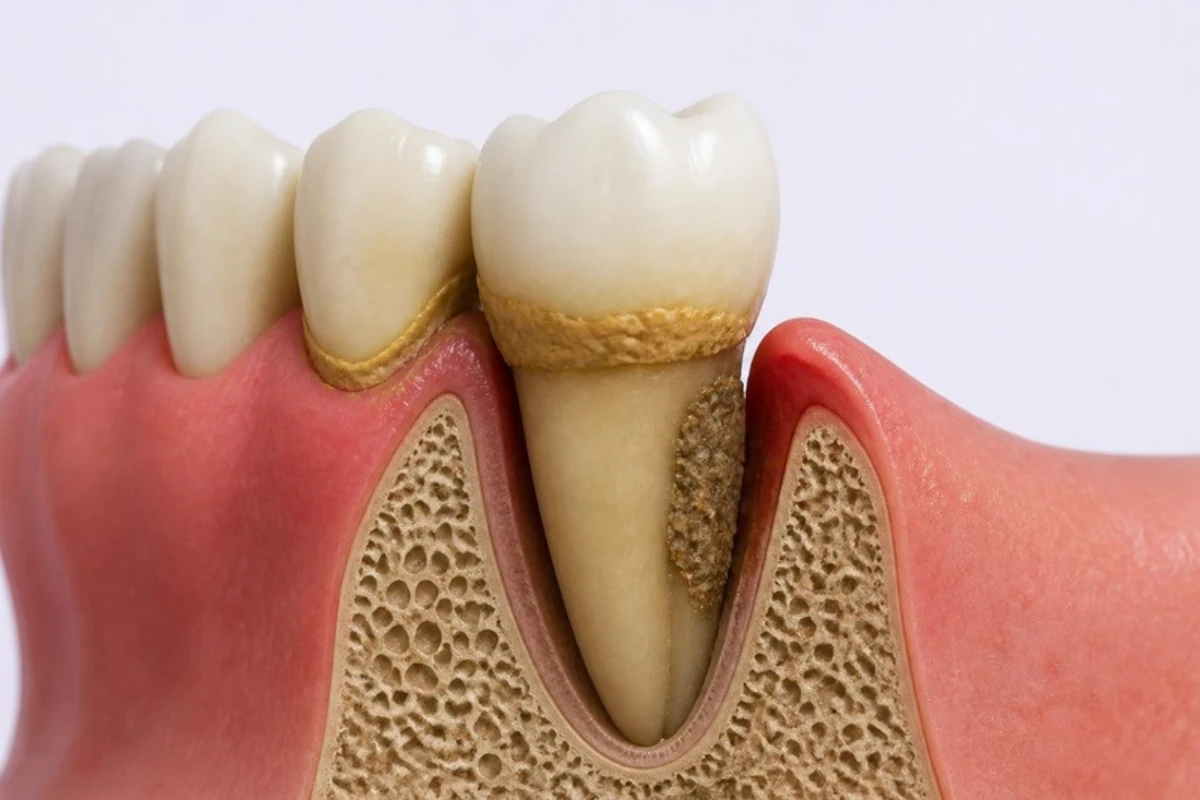
How a cleaning feels depends mostly on three things. The first is the gums: inflamed gums are swollen and full of fragile small blood vessels, so they are tender and bleed when touched. The second is the tooth surface: enamel on the crown is not sensitive, but a root that has been exposed by receding gums has tiny channels that react to cold water and vibration. The third is the amount and position of tartar: thick tartar, or tartar that sits below the gum line, takes longer to remove and needs more work close to the gum.
Expectation matters too. In a study of 100 patients, pain scores after scaling were low on average, and people who felt more anxious beforehand reported more pain. Feeling in control helps, so it is worth agreeing on a hand signal for a pause before you start.
Good news for the next visit: when cleanings are regular, there is less tartar to remove and the gums are calmer, so later cleanings are usually quicker and more comfortable than the first one after a long gap.
What each step of a cleaning feels like
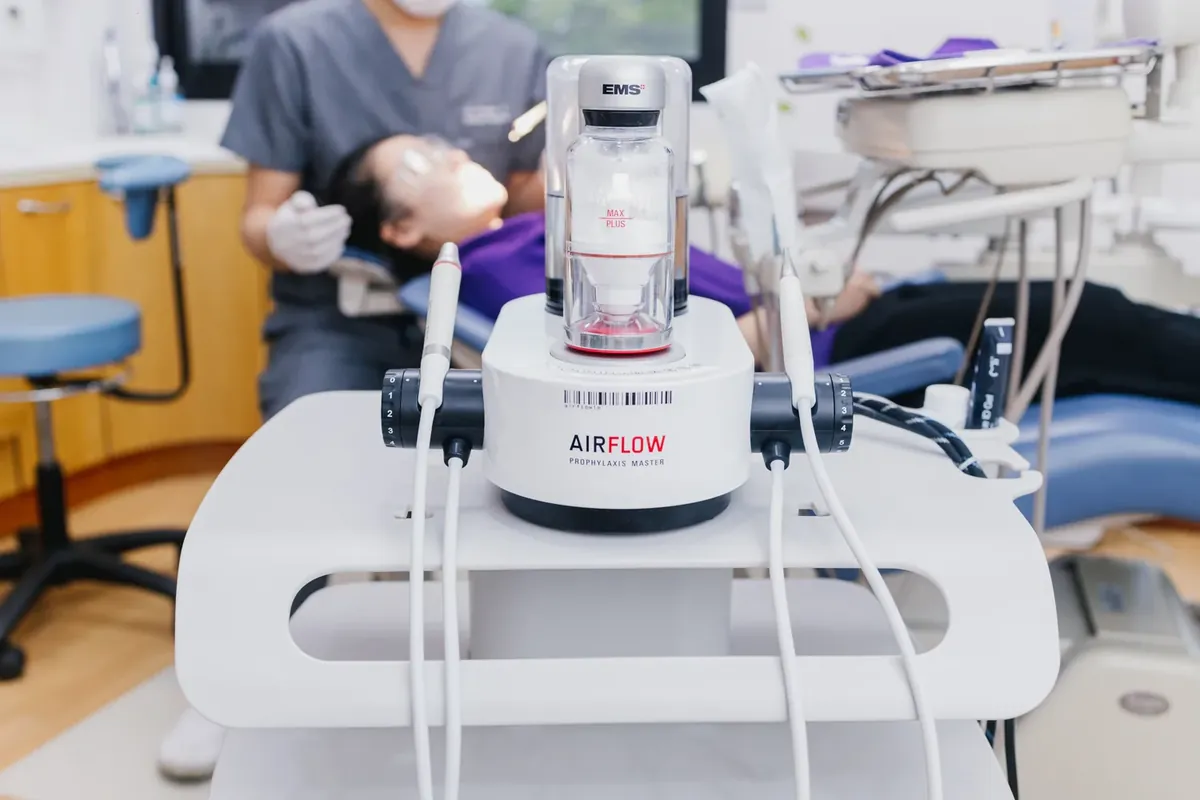
A typical cleaning takes about 30 to 60 minutes, and longer if there is a lot of tartar. This table follows the usual order of a visit.
| Step | What you may feel | What helps during cleaning |
|---|---|---|
| Check-up of teeth and gums | A mirror and a thin probe touching the teeth; mild pressure at the gum edge | Tell the dentist where you feel sensitive before cleaning starts |
| Ultrasonic scaling | Buzzing vibration, a stream of water and a high-pitched sound; brief sensitivity near the gum line | Breathe through your nose, use the hand signal to pause, ask for the power to be lowered |
| Hand instruments | Scraping sound and light pressure in small areas | Short breaks; ask for local anesthetic for a sensitive area |
| Airflow spray | A warm spray of water, air and fine powder; a slightly salty or sweet taste | Keep your lips relaxed; the assistant suctions the water |
| Polishing | A spinning rubber cup with gritty paste; smooth teeth afterwards | Nothing special; most people find this part easy |
| Advice and next visit | The dentist shows the areas to clean better and explains any treatment needed | Ask how often you should come back and why |
A little bleeding during the cleaning is common when the gums are inflamed. It shows where the gums need attention and usually settles as they heal over the following days.
What makes a cleaning more sensitive, and what helps
| Cause | Why it matters | What helps during cleaning |
|---|---|---|
| Inflamed gums | Swollen gums are tender and bleed when touched | Two weeks of gentle brushing and cleaning between the teeth before the visit can calm them |
| Exposed roots | Root surfaces react to cold water and vibration | Ask for warm water, lower power or a numbing option |
| Thick or old tartar | More time and more work close to the gum | Split the cleaning into two visits if that feels easier |
| Tartar below the gum line | Cleaning inside a gum pocket is more than a routine cleaning | Deep cleaning is usually done under local anesthesia, section by section |
| Anxiety | Tension makes every sensation feel stronger | Tell the team, agree a pause signal, ask about relaxing options |
| Recent whitening or acidic food | Teeth may already be more reactive for a while | Mention it when you book so the dentist can plan |
Numbing is an option, not a sign that something is wrong. For deeper cleaning below the gums, a review of clinical trials found that injected local anesthetic controlled pain better than an anesthetic gel placed in the gum pocket, although both options worked for many people. Your dentist suggests what fits the area being cleaned.
Cleaning methods compared: ultrasonic, Airflow, GBT and deep cleaning
Many people picture only metal scrapers, but a cleaning can combine several tools. The right mix depends on how much tartar there is, where it is, and how sensitive your teeth are.
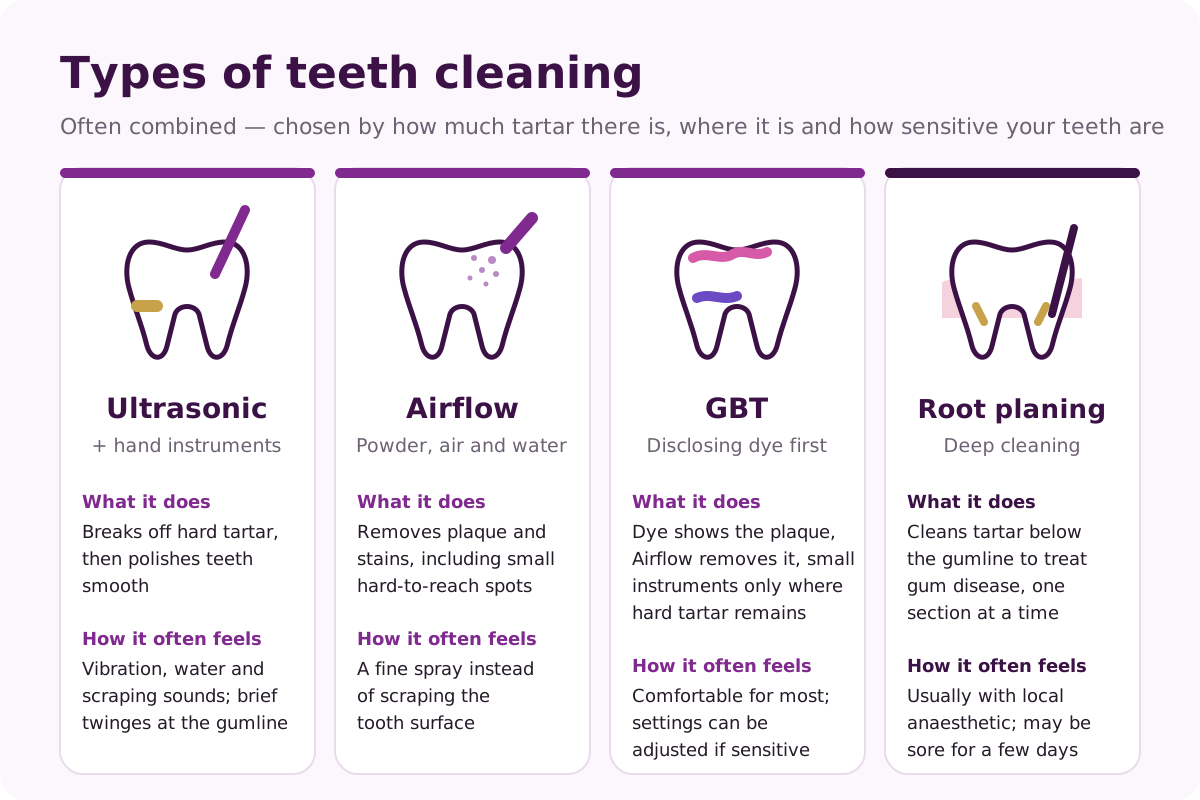
| Method | What it does | How it usually feels |
|---|---|---|
| Ultrasonic and hand instruments | Breaks up and removes hard tartar, then the teeth are polished | Vibration, water and scraping; brief sensitivity at the gum line |
| Airflow | A fine spray of powder, air and water removes plaque and stains, including in small hard-to-reach areas | A soft spray rather than scraping on the tooth surface |
| GBT (Guided Biofilm Therapy) | Colors the plaque first so you can see it, removes it with Airflow, then fine instruments only where hard tartar remains | Most people find it comfortable; settings can be adjusted for sensitive teeth |
| Deep cleaning (scaling and root planing) | Cleans tartar below the gum line to treat gum disease, section by section | Usually done with local anesthesia, over more than one visit; gums may be sore for a few days |
Research on air polishing in people having regular gum maintenance found similar results to traditional instruments, with lower pain scores and higher acceptance. It does not mean every tooth can be cleaned with spray alone: hard tartar still needs instruments, and deep gum pockets may need deep cleaning.
How often should you have a cleaning?
Every 6 months is the familiar answer, and many dental organizations still describe it as the usual interval. The research behind it is more nuanced. A Cochrane review of adults without severe gum disease found that a routine scale and polish every 6 or 12 months made little or no difference to gum inflammation over two to three years compared with no scheduled cleaning, although 6-monthly cleaning removed slightly more tartar. Another Cochrane review found little to no difference between 6-monthly check-ups and check-ups timed according to each person risk.
In practice, this means the right interval is personal. Guidance in the UK, for example, puts the gap between check-ups anywhere from 3 months to 24 months for adults depending on oral health, and no more than 12 months for children. People whose gums are not healthy often need a cleaning every 3 to 4 months. At our clinic, most people come about every 6 months, and your dentist recommends the interval that suits your gums, your tartar build-up and any implants or crowns.
| Your situation | Typical interval | Why |
|---|---|---|
| Healthy gums, little tartar | About every 6 months, or as your dentist advises | Regular checks find decay or a broken filling early |
| Tartar builds up quickly | Often more often than 6 months | Less tartar each time means an easier cleaning |
| After gum disease treatment | Many people come every 3 to 6 months | Maintenance keeps the gums stable |
| You have implants | Cleaning about every 6 months plus a yearly implant check; many people with implants come every 3 to 4 months | The gum around an implant needs regular care too |
| Diabetes, smoking or pregnancy | As your dentist advises, often more often | Gums react more strongly to plaque |
Before and after a cleaning: a simple timeline

In the 2 weeks before your visit
- Brush gently at the gum line for 2 minutes, twice a day, with a soft brush and fluoride toothpaste.
- Clean between your teeth once a day with floss or interdental brushes, even if the gums bleed at first.
- If your teeth are sensitive, use a toothpaste for sensitive teeth every day.
- Write down your medicines and health conditions to tell the dentist.
On the day
- Eat normally beforehand and brush your teeth.
- Tell the dentist about sensitive spots, anxiety, pregnancy and every medicine you take, especially blood thinners.
- Agree a hand signal to pause before the cleaning starts.
- Ask about numbing if an area feels too sensitive; you do not need to wait until the end.
Afterwards
- For about 3 hours after GBT or Airflow, avoid strongly colored food and drinks such as coffee, tea, soft drinks, soy sauce and curry.
- If local anesthetic was used, wait until the numbness wears off before eating, so you do not bite your cheek or lip.
- Mild sensitivity or sore gums for a few days is common. Very hot or very cold food may feel stronger for a while.
- Keep brushing and cleaning between your teeth from the same day, gently.
- Over the next 1 to 2 weeks, bleeding when you brush should reduce as the gums heal.
After deeper cleaning below the gums, root sensitivity is more common. Reviews of the research found that it affects about half of people after scaling and root planing, tends to peak in the first 1 to 3 weeks and then eases. Toothpaste for sensitive teeth and desensitizing treatments may help, although the research on them is still limited. At our clinic, a desensitizing treatment can also be applied in the chair.
Myths about teeth cleaning
| Myth | What is true about cleaning |
|---|---|
| Cleaning makes the gaps between teeth bigger. | Tartar can fill the spaces between teeth. Once it is removed and swollen gums settle, the real spaces become visible. The cleaning did not create them. |
| Cleaning makes teeth loose. | Looseness comes from bone lost to gum disease. Thick tartar can hide it; removing the cause is what protects the remaining bone. |
| If my gums bleed, I should stop brushing until the cleaning. | Bleeding usually means plaque is still there. Gentle, thorough brushing helps the gums calm down before your visit. |
| Whitening toothpaste or baking soda can remove tartar. | Toothpaste can slow new tartar from forming, but hardened tartar needs professional instruments. |
| Scaling wears away the enamel. | A cleaning targets deposits on the tooth, and the instruments and settings are chosen for each surface. If you have worries about wear, ask your dentist to show you what was removed. |
| If nothing hurts, I do not need a cleaning. | Gum inflammation often does not hurt at all. A check-up finds early problems while they are simpler to treat. |
After a cleaning: when to contact your dentist
Most people go home with clean, smooth teeth and perhaps a little sensitivity. Contact the clinic if you notice any of the following, so the dentist can check and advise.
- Bleeding that does not stop after pressing on the area with clean gauze for several minutes.
- Swelling of the gum or face, or pus.
- Pain that gets worse after the first couple of days instead of better.
- A fever after a deep cleaning.
- Sensitivity that is still strong after about 2 weeks, or a single tooth that aches on its own.
Before your visit, tell your dentist about any health condition. Thailand Department of Health has advised people to inform the dentist before every cleaning if they have conditions such as low platelets or leukemia, kidney disease or dialysis, heart valve surgery, heart disease, asthma, epilepsy, high blood pressure or diabetes, or if they take blood thinners, so the dentist can prepare.
What happens at a check-up and cleaning at our clinic
At Kitcha Dental Clinic, a dentist checks your teeth and gums before cleaning them. This is what a visit usually looks like.
- Your story: your concerns, sensitive areas, health conditions, pregnancy and the medicines you take.
- Check-up: the dentist checks your teeth, gums and fillings, and takes X-rays if they are needed.
- Cleaning: tartar, plaque and stains are removed with the method your dentist recommends, using ultrasonic and hand instruments, an Airflow spray, or GBT with EMS equipment, and then the teeth are polished.
- With GBT, the plaque is colored first and the dentist shows you the areas to brush more carefully.
- If your teeth or gums are sensitive, the dentist can adjust the settings or numb the area.
- Advice and next steps: the dentist explains any treatment you may need, such as fillings or gum treatment, and suggests when to come back.
- If there is tartar below the gums, deep cleaning is planned with our gum dentists, usually under local anesthesia and over more than one visit.
If dental visits make you anxious, tell us when you book. Besides breaks and numbing, the clinic offers inhaled sedation and oral sedation, and the dentist assesses whether one of them suits you.
Sedation dentistry in Chiang Mai
The check-up and cleaning fees are listed on our prices page. The cleaning fee depends on the amount of tartar and the method used, and X-rays are charged separately, only if you need them.
Thai Social Security can be used for scaling: you pay at the clinic, the clinic issues a medical certificate and an itemized receipt, and you then claim the amount from Social Security yourself.
If this sounds like you: what to do before your cleaning
These are example situations, not patient stories, to help you find the next step that fits.
- Your last cleaning was years ago and you are embarrassed about the tartar: you are not alone, and the team sees this every day. Tell us when you book; a longer appointment, or two visits, can make it easier.
- Cold water makes your teeth sensitive: use a toothpaste for sensitive teeth for the 2 weeks before the visit, and ask for lower power, warmer water or numbing on the day.
- You are pregnant: cleanings during pregnancy are encouraged by dental and obstetric organizations. Tell your dentist that you are pregnant, and they will plan your care.
- You take a blood thinner or antiplatelet medicine: keep taking it and do not stop it yourself. Tell the dentist the name and dose. In some cases the medicine does not need to be stopped; in others, your dentist may first consult the doctor who looks after you.
- You have implants or crowns: ask for a method suited to those surfaces, such as Airflow or GBT, and keep a yearly implant check alongside your cleanings.
- Your gums bleed a lot and your teeth feel longer: book a check-up rather than a quick cleaning, because the gums may need to be measured and a deep cleaning planned.
- You are very afraid of the dentist: start with a check-up visit only, agree a stop signal, and ask about relaxing options before treatment.
- You are visiting Chiang Mai for a short time: a cleaning usually fits into one visit; if a deep cleaning is needed, ask the team to plan the visits around your dates.
Frequently asked questions about teeth cleaning
Does teeth cleaning hurt, and will I need an injection?
Most people feel vibration, water and brief sensitivity rather than pain, and a routine cleaning usually does not need an injection. If an area is sensitive, the dentist can lower the power, switch method or numb that area. Deep cleaning below the gums is usually done under local anesthesia.
How long does sensitivity last after a cleaning?
After a routine cleaning, mild sensitivity or sore gums usually settle within a few days. After deep cleaning, root sensitivity is more common and may be strongest in the first 1 to 3 weeks before easing. A toothpaste for sensitive teeth can help; if it is still strong after about 2 weeks, contact your dentist.
Does cleaning make teeth loose or gappy?
No. Tartar can fill spaces and hold teeth together like a crust, and swollen gums fill the gaps. When both are removed, the real situation becomes visible. Looseness comes from bone lost to gum disease, which is why removing tartar and treating the gums protects the teeth.
Do I really need a cleaning every 6 months?
About every 6 months suits most people, but the interval is personal. Research suggests timing visits according to your own risk works as well as a fixed 6 months. People who build up tartar quickly, have had gum disease, smoke or have diabetes often need to come more often, and your dentist tells you what fits.
Can I have a cleaning while pregnant?
Yes. The American Dental Association, together with obstetric and pediatric organizations, encourages dental visits during pregnancy, because pregnancy hormones can make the gums swell and bleed more easily. Tell your dentist that you are pregnant, and they will plan your care.
I take a blood thinner. Can I still have my teeth cleaned?
Usually, yes. Do not stop the medicine on your own. Tell your dentist the name and dose before treatment. In some cases the medicine does not need to be stopped; in others, your dentist may first consult the doctor who looks after you.
What can I eat after a cleaning?
You can eat normally. After GBT or Airflow, avoid strongly colored food and drinks for about 3 hours, because freshly cleaned teeth pick up stains more easily. If you had local anesthetic, wait until the numbness wears off. If your teeth feel sensitive, lukewarm food is more comfortable than very hot or very cold food.
How long does a cleaning take?
A routine cleaning usually takes about 30 to 60 minutes, including the check-up. It can take longer if there is a lot of tartar, and deep cleaning below the gums is usually split into more than one visit.
Summary
A teeth cleaning usually feels like vibration, water and brief sensitivity, and the parts that feel sensitive can be managed.
- It is more sensitive when the gums are inflamed, roots are exposed or tartar is thick or below the gums.
- Tell your dentist about sensitive spots and anxiety; the power, method and numbing can all be adjusted.
- About every 6 months suits most people; your dentist may suggest a different interval for your gums.
- Brush gently and clean between your teeth every day; regular cleanings get quicker and easier.
- Always tell the dentist about pregnancy, health conditions and every medicine you take.
References
Cleveland Clinic: Dental Check-Up
MedlinePlus (US National Library of Medicine): Dental care, adult
American Dental Association (MouthHealthy): Plaque
American Dental Association (MouthHealthy): Pregnancy concerns
American Dental Association (MouthHealthy): Brushing Your Teeth
Lamont T et al. Routine scale and polish for periodontal health in adults. Cochrane Review, 2018
Fee PA et al. Recall intervals for oral health in primary care patients. Cochrane Review, 2020