

You brush, spit, and the foam in the sink is pink. Or there is a red streak on the toothbrush or the dental floss. Most people feel a jolt of worry: is something wrong with my blood, am I short of a vitamin, or are my teeth about to loosen?
The reassuring part first: in most people, gums that bleed when brushed are inflamed gums, called gingivitis. It is caused by plaque along the gum line, and at this early stage it can usually return to normal within a few weeks with the right cleaning. A smaller group of causes comes from the body, such as medicines, hormones, diabetes or blood conditions, and these need a different response.
This article helps you work out which group you are in. You will find a one-minute self-check, a table of causes and how to tell them apart, the stages of gum disease, a 2-week home plan with brushing and flossing technique, common myths, the signs that mean you should see a dentist or doctor soon, and what actually happens at a gum check.
In short: keep brushing, gently. Clean between your teeth every day. If the bleeding has not settled after about 2 weeks of careful cleaning, book a gum check. If the bleeding will not stop, or comes with bruising, fever or unusual tiredness, see a doctor promptly.
Is this kind of bleeding normal? A one-minute self-check
Usually not a worry: start the home plan first
- You have just started flossing, or started again after a long break.
- You recently switched to a harder brush, or you know you brush hard.
- It is one small spot after biting something hard or sharp, and it stops quickly.
Book a dental check in the next few weeks
- Your gums bleed almost every time you brush, for more than a few days.
- The gum edges look red, puffy or shiny instead of pale pink and firm.
- You have bad breath or a bad taste that keeps coming back.
- Your teeth look longer, food packs between them more, or a tooth feels loose.
- You have cleaned carefully for about 2 weeks and the bleeding has not settled.
See a doctor or dentist promptly
- The bleeding does not stop after pressing on it with clean gauze.
- Your gums bleed on their own without brushing, or you also bruise easily or have nosebleeds.
- You also feel unusually tired, look pale, have a fever or keep getting infections.
- You have a swelling, pus, or a swollen face, or a tooth has become very loose.
The last group is covered in more detail in the warning signs section below. These signs are not common, but they are worth acting on.
Why gums bleed
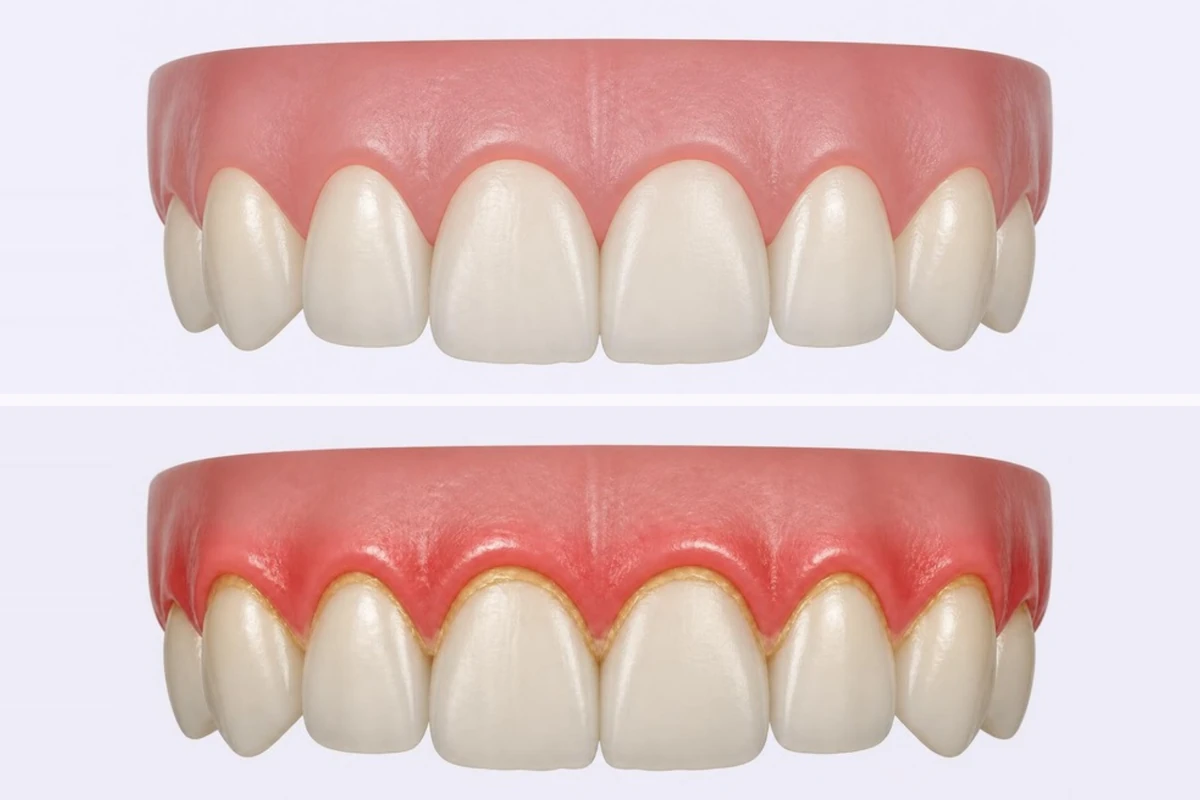
Plaque is a sticky film of bacteria that forms on teeth every day, thickest where the tooth meets the gum. The gum responds to it with inflammation: tiny blood vessels at the gum edge widen and become fragile, so a toothbrush or floss that touches them makes them bleed. That is why bleeding is often a sign that plaque has been left in that spot, not that the brush was the problem.
If plaque stays for several days it hardens into tartar, also called calculus. Tartar is rough and holds even more plaque, and brushing cannot remove it. Only a professional cleaning can.
A classic study showed that this works both ways. When volunteers with healthy gums stopped cleaning their teeth, gingivitis developed within a few weeks. When they started cleaning again, their gums returned to health. Bleeding from a new flossing habit usually settles within about a week, and dental guidance suggests a check if bleeding continues beyond about 2 weeks, which is why the home plan below runs for 2 weeks.
Inflamed gums often do not hurt at all. Bleeding is frequently the only early sign, so it is worth paying attention to.
Causes of bleeding gums and how to tell them apart
Start with the causes in the mouth, which are by far the most frequent. Then check the causes from the rest of the body, especially if your mouth looks clean or the bleeding does not fit the usual pattern.
Causes in the mouth
| Cause | How to tell | What to do |
|---|---|---|
| Gingivitis from plaque (the most frequent cause) | Bleeds when you brush or floss, gum edges red and puffy, usually no pain | Follow the 2-week plan and have a scale and clean |
| Tartar along or under the gums | Hard yellow or brown deposits, often behind the lower front teeth; the same spots keep bleeding | A professional cleaning; brushing cannot remove it |
| Gum disease that has reached the bone (periodontitis) | Receding gums, longer-looking teeth, bad breath, gaps or loose teeth | A gum check with pocket measurements and X-rays |
| Brushing too hard, a hard brush, or a new flossing habit | Light bleeding in the same few spots that eases within about a week | Use a soft brush and a light touch, and keep flossing |
| A filling, crown, denture or brace that rubs or traps food | Bleeding only around that one tooth or appliance | Ask your dentist to check and adjust it |
Causes from medicines and the rest of the body
| Cause | How to tell | What to do |
|---|---|---|
| Pregnancy and other hormone changes (puberty, periods, menopause) | Gums swell and bleed more easily than usual, even with little plaque | Clean gently and thoroughly; if you are pregnant, tell your dentist and they will plan care for you |
| Blood thinners and antiplatelet medicines, such as aspirin or warfarin | Bleeding lasts longer than it used to, and you bruise more easily | Do not stop the medicine yourself and tell your dentist every time. In some cases the medicine does not need to be stopped; in others, your dentist may first consult the doctor who looks after you |
| Diabetes, especially when blood sugar is high | Gum inflammation that keeps returning, slow healing, gum abscesses | Keep your blood sugar under control and have regular gum checks |
| Smoking | Gums may bleed less even when disease is getting worse | Do not take little bleeding as proof of healthy gums; have them checked |
| Low vitamin C (severe deficiency is scurvy) | Swollen gums that bleed all over, slow healing, tiredness; few fruits and vegetables in the diet | Eat fruit and vegetables every day; see a doctor if you suspect a real deficiency |
| Low vitamin K, liver disease, or a bleeding disorder such as low platelets or hemophilia | Bleeding that is slow to stop, bruises, nosebleeds, bleeding in other places | See a doctor for a blood test |
| Dengue fever | Gum or nose bleeding during or just after a high fever, often as the fever goes down | See a doctor the same day |
| Leukemia (uncommon) | Bleeding without brushing, together with paleness, tiredness, fever, bruises or repeated infections | See a doctor soon for a blood test |
A useful rule of thumb: bleeding that is limited to the gum edges, happens when you brush, and improves as you clean better almost always points to a cause in the mouth. Bleeding that happens on its own, comes with signs elsewhere in the body, or does not improve with good cleaning is a reason to see a doctor as well as a dentist.
Gingivitis and periodontitis: the stages
Gum disease is one process with two main stages. In gingivitis only the gum is inflamed. In periodontitis the inflammation has reached the fibers and bone that hold the tooth in place. The difference matters, because the first stage can be fully reversed and the second can be controlled but not fully undone.
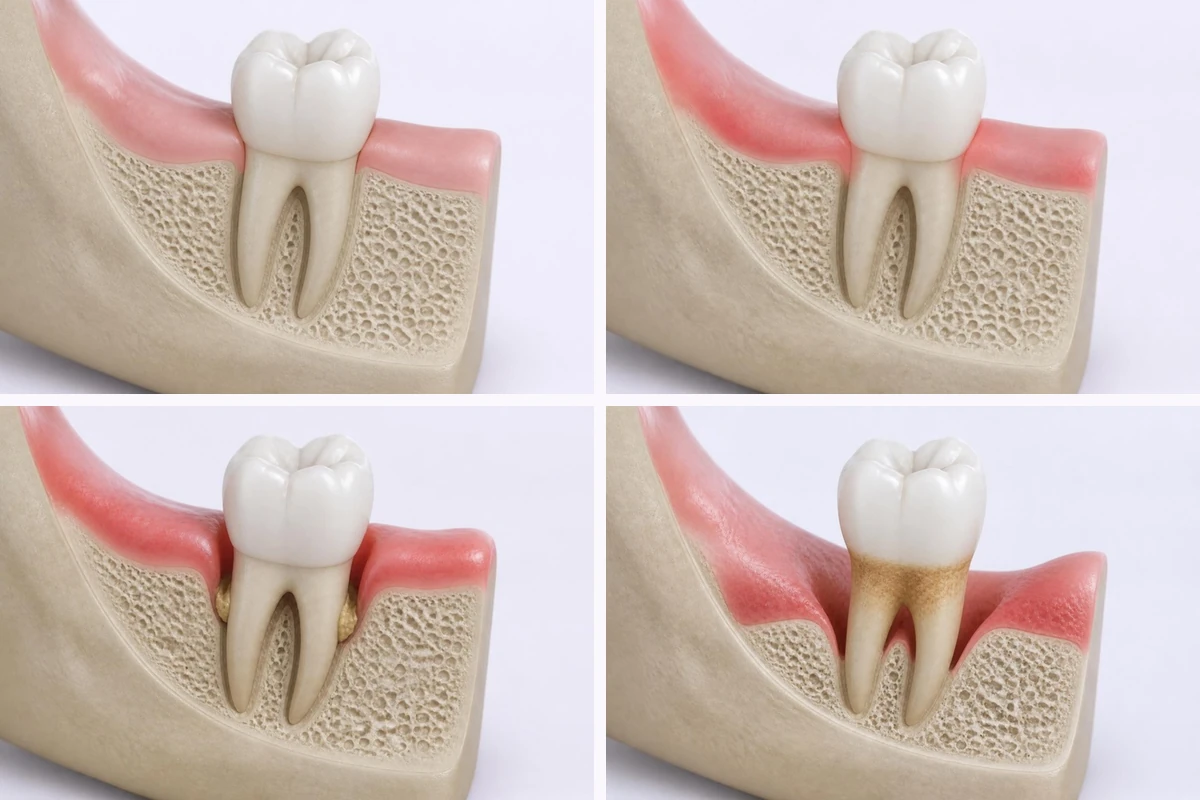
| Stage | What you may notice | Can it return to normal? |
|---|---|---|
| Healthy gums | Pale pink and firm, no bleeding when brushed or measured | Keep it that way with daily cleaning and regular check-ups |
| Gingivitis | Red, puffy gum edges that bleed when brushed; usually no pain; bone is not affected | Yes. Usually back to normal with a professional cleaning and good home care |
| Early periodontitis | Bleeding, pockets forming between gum and tooth, early bone loss seen on X-rays; often still no pain | It can be stopped and kept stable; lost bone does not fully grow back on its own |
| Moderate to severe periodontitis | Receding gums, longer teeth, gaps opening, bad breath, pus, loose teeth, changes in the bite | Treatment and regular maintenance can control it and help keep the teeth |
In the international classification of gum diseases, gingivitis is defined partly by how many spots bleed when the dentist gently measures the gums: bleeding at about one in ten measured sites or more counts as gingivitis. This is why a gum check measures every tooth rather than looking only at the front.
Periodontitis can progress quietly for a long time before it causes symptoms you notice. Large surveys from the US public health agency have found some degree of periodontitis in roughly 4 in 10 adults aged 30 and over, and it becomes more common with age, so regular check-ups matter even when nothing hurts.
A 2-week home plan for bleeding gums
If your answers in the self-check put you in the first two groups, this plan is your first step. It targets the plaque that causes most bleeding. Keep a short note each evening of where the bleeding was, so you can see the change.
What you need
- A soft or extra-soft toothbrush. Replace it every 3 to 4 months, or sooner if the bristles splay.
- A fluoride toothpaste.
- Dental floss for tight contacts, and interdental brushes in sizes that fit the larger gaps. Your dentist can tell you which sizes suit you.
- A mirror in good light, and a 2-minute timer.

Brushing at the gum line, step by step
This is a gentle short-stroke method, often called the modified Bass technique, aimed at the strip of tooth and gum where plaque collects.
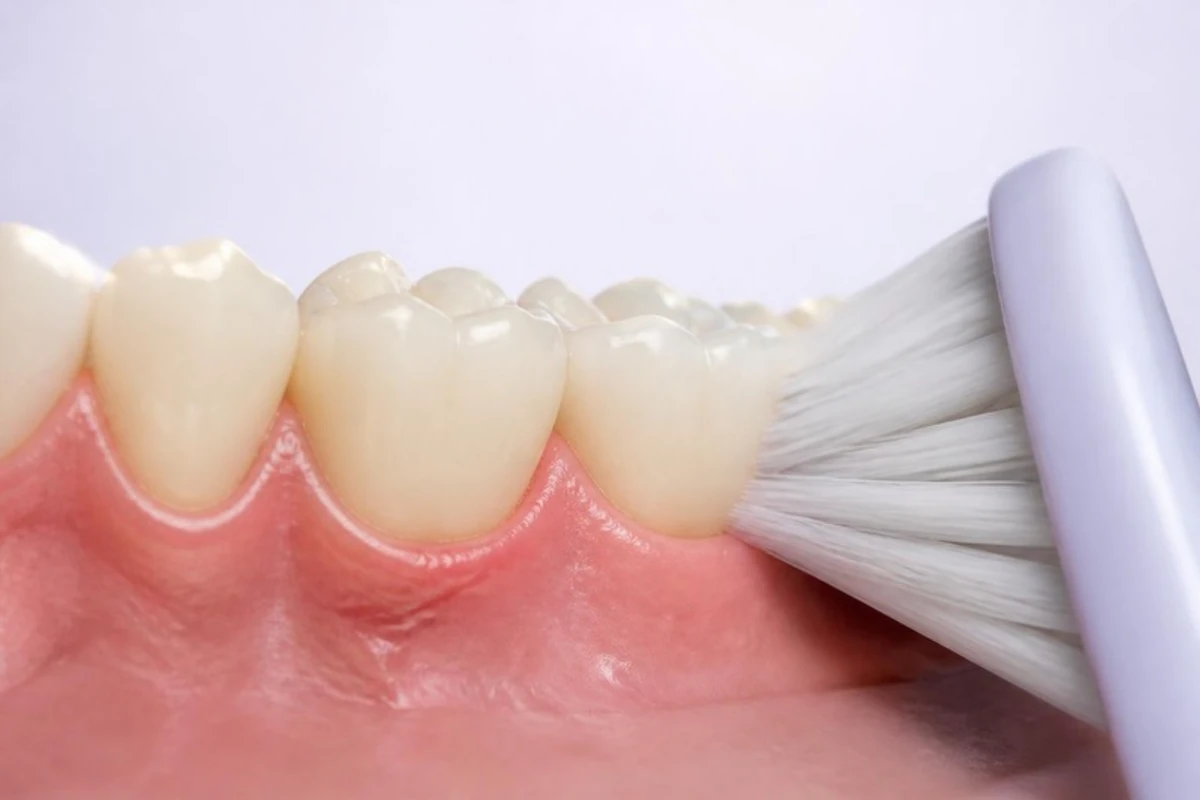
- Place the brush where the tooth meets the gum, with the bristles tilted at about 45 degrees toward the gum.
- Make small, gentle back-and-forth movements about one tooth wide, without scrubbing. The bristle tips should slip just under the gum edge.
- Sweep the brush away from the gum toward the biting edge, then move on to the next one or two teeth.
- Clean the outer, inner and chewing surfaces. For the inside of the front teeth, hold the brush upright and use short up-and-down strokes.
- Brush for at least 2 minutes, twice a day, and make the bedtime brush the most thorough one.
- Spit out the extra toothpaste but do not rinse, so the fluoride stays on the teeth. Try not to eat or drink for about 2 hours after the bedtime brush.
Bleeding spots are where you need to brush more carefully, not less. Use a light touch: if the bristles flatten against the tooth, you are pressing too hard.
Cleaning between the teeth
- Floss: slide it gently between the teeth, curve it into a C shape around one tooth, move it just under the gum edge and up and down a few times, then do the same on the neighboring tooth.
- Interdental brushes: choose a size that fits snugly without forcing. Push it gently through the gap and back a few times. A review of studies found that, where the gaps allow them, interdental brushes may reduce gum inflammation more than floss, although the evidence is limited.
- Do this once a day, every day. Light bleeding in the first days is expected and usually fades within about a week.
Day by day: what to do and what to expect
| Days | Tasks | What you should see |
|---|---|---|
| Days 1 to 3 | Learn the gum-line technique and start cleaning between the teeth every day | Bleeding may stay the same or even increase a little as you reach new spots. This is expected, so keep going |
| Days 4 to 7 | Keep the routine; check in the mirror for spots you keep missing, often behind the lower front teeth and around the back molars | Less bleeding and less redness at the gum edges |
| Days 8 to 14 | Keep going and note any spots that still bleed every time | Most spots stop bleeding. Spots that still bleed often have tartar that only a cleaning can remove |
| Day 14 | Review your notes | Still bleeding? Book a gum check and bring your notes |
Things that help along the way
- Eat fruit and vegetables every day. This supports the gums but does not remove plaque or tartar.
- If you smoke, this is a good time to cut down or stop. Smoking harms the gums and can hide bleeding.
- If you have diabetes, keeping your blood sugar steady helps the gums heal.
- A mouthwash can be an extra, not a replacement. See the myths section below for what it can and cannot do.
If any of the warning signs below appear during these 2 weeks, do not wait for the plan to finish. Contact a dentist or doctor.
Common myths about bleeding gums
| Myth | Fact |
|---|---|
| If your gums bleed, stop brushing that area so it can heal. | The opposite. Plaque left there keeps the gum inflamed. Brush the area gently and more carefully, and it usually settles within days to a couple of weeks. |
| A strong mouthwash will fix bleeding gums. | Mouthwash cannot remove tartar or plaque stuck at the gum line. Antiseptic rinses such as chlorhexidine reduce plaque as an add-on to brushing, but their effect on gum inflammation is modest and they can stain teeth after a few weeks. Use them as your dentist advises. |
| Bleeding gums always mean you are short of vitamin C. | Plaque and gingivitis are far more frequent causes. Vitamin C does matter when intake is low: trials found that extra vitamin C reduced gum bleeding mainly in people whose levels were low. Fruit helps, but it does not replace cleaning. |
| No pain means nothing is wrong. | Gingivitis and early periodontitis often cause no pain. Bleeding may be the only early sign. |
| Gums that do not bleed are healthy gums. | Not always. In people who smoke, gums may bleed less even while gum disease progresses. |
| Bleeding gums in pregnancy are normal, so nothing needs doing. | Pregnancy hormones make the gums react more strongly to plaque, so careful cleaning matters even more. Tell your dentist that you are pregnant and they will plan your care. |

Warning signs: when to see a dentist or doctor soon
Most bleeding gums can be handled calmly with the plan above and a dental visit. A few signs, though, are worth acting on sooner. They do not mean something serious is certain, but they are the reason to have a proper check.
See a dentist soon
- Gums that are very sore and swollen, or a swelling with pus.
- A swollen face or jaw, especially with fever.
- Teeth that have become loose, or a bite that has changed.
- A mouth ulcer, a red patch or a lump in the mouth that does not go away.
Emergency dentist in Chiang Mai
See a doctor promptly
- Bleeding that does not stop after firm pressure with clean gauze.
- Bleeding gums together with bruises you cannot explain, nosebleeds, or bleeding elsewhere.
- Bleeding gums with paleness, unusual tiredness, breathlessness, fever or infections that keep coming back. Leukemia is one uncommon cause of this pattern, and a blood test can check for it.
- Gum or nose bleeding during or after a high fever. In dengue fever, this can appear as the fever comes down, which is exactly when people feel they are recovering.
- You take a blood thinner or antiplatelet medicine and the bleeding is heavier than usual. Contact the doctor who looks after you, and do not stop or change the dose on your own.
If you are unsure which applies to you, a dentist can examine the gums and, when the pattern points to a cause outside the mouth, advise you to see a doctor for blood tests.
Gums, diabetes and the heart
Diabetes and gum disease affect each other in both directions. People with diabetes, especially when blood sugar is high, are more likely to develop gum disease. People with periodontitis tend to have higher long-term blood sugar readings (HbA1c). A joint consensus of the International Diabetes Federation and the European Federation of Periodontology found that gum treatment is safe for people with diabetes and lowered HbA1c by about 0.3 to 0.5 percentage points after 3 months, although longer-term results are less certain.
For the heart, a consensus of the European Federation of Periodontology and the World Heart Federation found that severe periodontitis is linked to cardiovascular disease, independently of other known risk factors. A link is not the same as proof that gum disease causes heart disease, and gum treatment is not a substitute for heart care. It is one more good reason to keep the gums healthy, and a reason to tell your dentist about any heart condition and the medicines you take.
What happens at a gum check, step by step

At Kitcha Dental Clinic, gum treatment is planned by dentists with postgraduate training in periodontics, including an MSc in Periodontology and a PhD in Dental Science. This is what a visit for bleeding gums usually looks like.
- Your story: when the bleeding started, how you clean your teeth, your health conditions, whether you are pregnant or smoke, and every medicine you take, especially blood thinners.
- Gum examination: the dentist measures the gum pockets around each tooth and records the results in a gum chart.
- X-rays to see the level of the bone around the teeth.
- Explanation and plan: the dentist explains what they found and gives you a treatment plan and cost estimate before anything starts.
- For gingivitis: scaling and polishing removes plaque, tartar and stains. Depending on your teeth, this may use ultrasonic and hand instruments, an Airflow spray, or GBT, which first colors the plaque so you can see the spots your brush misses.
- For periodontitis: scaling and root planing cleans below the gum line section by section, usually under local anesthesia and over more than one visit. The gums may feel sore or tender for a few days, and your dentist advises on care and pain relief.
- Re-evaluation: once the gums have had time to heal, the pockets are measured again. Areas that are still deep may need gum surgery.
- Ongoing care: regular maintenance cleanings keep the gums stable. Most people come about every 6 months; after gum disease treatment, many come every 3 to 6 months, and your dentist recommends the interval that suits you.
Your dentist may also use the Waterlase dental laser alongside standard gum treatment when it suits your case. It is an addition to cleaning, not a replacement for it.
Cleaning and gum treatment fees are listed on our prices page. Gum treatment depends on how many areas need care and how advanced the disease is, and you receive a plan and estimate after the gum examination.
You can use Thai Social Security for scaling: you pay at the clinic, the clinic issues a medical certificate and an itemized receipt, and you then claim the amount from Social Security yourself.
If this sounds like you: what to do
These are example situations, not patient stories, to help you find the next step that fits.
- You started flossing last week and now see blood: keep flossing gently every day. It usually eases within about a week. If it has not settled after 2 weeks, book a check.
- You are pregnant and your gums bleed more than before: clean gently but thoroughly, and tell your dentist that you are pregnant so they can plan your care.
- You take a blood thinner or antiplatelet medicine: keep taking it as prescribed and do not stop it yourself. Use a soft brush and tell your dentist the name of the medicine. In some cases the medicine does not need to be stopped; in others, your dentist may first consult the doctor who looks after you.
- You smoke and your gums hardly ever bleed: that is not proof of healthy gums. A gum check with pocket measurements gives a clearer answer.
- You recently quit smoking and your gums bleed more: this can happen in the first months as blood flow to the gums returns. Keep cleaning well and keep the gum check appointment.
- You have diabetes and your gums keep flaring up: have a gum check, keep up regular maintenance visits, and let your doctor know too.
- You have implants and a gum around one bleeds: book a check. Many people with implants have a cleaning every 3 to 4 months.
- You had a high fever a few days ago and now your gums bleed: see a doctor the same day.
Frequently asked questions
Will bleeding gums go away on their own?
Bleeding from a new flossing habit or a hard brush often settles within about a week. Bleeding from gingivitis improves once the plaque is cleaned away every day, and tartar needs a professional cleaning. If it has not settled after about 2 weeks of careful cleaning, have your gums checked.
Which vitamin deficiency causes bleeding gums?
Mainly vitamin C, and less often vitamin K. Low vitamin C makes small blood vessels fragile, and severe deficiency is called scurvy. Low vitamin K affects blood clotting. Both are much less frequent causes than gingivitis, so clean well first, eat fruit and vegetables, and see a doctor if you suspect a real deficiency.
Can bleeding gums be a sign of leukemia?
It can be one sign, but it is an uncommon cause. The pattern to watch for is bleeding without brushing together with other signs such as paleness, unusual tiredness, fever, bruises or repeated infections. In that case, see a doctor for a blood test. Bleeding only when you brush, with no other symptoms, is far more likely to come from the gums.
My gums bleed during pregnancy. What should I do?
This is common, because pregnancy hormones make the gums react more strongly to plaque. Keep brushing gently at the gum line and cleaning between your teeth every day. Tell your dentist that you are pregnant, and they will plan your check-up and cleaning for you.
Which toothpaste or mouthwash helps bleeding gums?
Technique matters more than the product. A fluoride toothpaste with a soft brush at the gum line, plus daily cleaning between the teeth, does most of the work. An antiseptic mouthwash can help reduce plaque as an extra, but it cannot remove tartar, and some can stain teeth with long use. Ask your dentist whether a rinse suits you.
Do swollen, bleeding gums need antibiotics?
Usually not. Gingivitis is treated by removing plaque and tartar, and antibiotics do not do that. Dentists sometimes add antibiotics for specific situations, such as some infections or advanced gum disease, but that is a decision made after an examination. Avoid taking leftover antibiotics on your own.
Is some bleeding during or after a cleaning normal?
If the gums are inflamed, a little bleeding during and shortly after a cleaning is common. As the gums heal over the following days and you keep cleaning well, bleeding when you brush should reduce. After deeper cleaning below the gums, the gums may feel sore for a few days, and your dentist explains how to look after them.
I take a blood thinner or antiplatelet medicine. Can I still have a cleaning?
Usually, yes. Do not stop the medicine on your own, because the reason you take it matters more. Tell your dentist the name and dose before treatment. In some cases the medicine does not need to be stopped; in others, your dentist may first consult the doctor who looks after you.
Summary
Bleeding gums are usually gingivitis caused by plaque at the gum line, and at that stage the gums can return to normal.
- Do not stop brushing. Brush gently at the gum line for 2 minutes, twice a day, and clean between your teeth every day.
- Give it about 2 weeks. If the bleeding has not settled, book a gum check, because tartar or periodontitis may need professional treatment.
- Mouthwash and vitamins can support, but they do not replace cleaning.
- See a doctor promptly if the bleeding will not stop, happens on its own, or comes with bruises, fever, paleness or unusual tiredness.
- Tell your dentist about pregnancy, diabetes, heart conditions and every medicine you take.
References
American Dental Association (MouthHealthy): Bleeding Gums
American Dental Association (MouthHealthy): Brushing Your Teeth
CDC (US): About Periodontal (Gum) Disease
Cleveland Clinic: Bleeding Gums
MedlinePlus (US National Library of Medicine): Bleeding gums
NHS (UK): Acute myeloid leukaemia, symptoms
World Health Organization: Dengue and severe dengue
King Chulalongkorn Memorial Hospital, Thai Red Cross Society: Bleeding gums as a warning sign
Department of Health, Thailand (Anamai Media): The 2-2-2 brushing rule
Loe H, Theilade E, Jensen SB. Experimental gingivitis in man. J Periodontol, 1965
Ramseier CA et al. Bleeding on probing as it relates to smoking status. J Clin Periodontol, 2015
Worthington HV et al. Home use of interdental cleaning devices. Cochrane Review, 2019
Hujoel PP et al. Bleeding tendency and ascorbic acid requirements. Nutrition Reviews, 2021
Sanz M et al. Periodontal diseases and diabetes: IDF and EFP consensus. J Clin Periodontol, 2018
Sanz M et al. Periodontitis and cardiovascular diseases: consensus report. J Clin Periodontol, 2020