

Maybe you have stopped smiling with your teeth in photos. Maybe your lips do not close easily over your front teeth, or someone made a joke years ago that you still remember. For a parent, it may be watching a child with front teeth that stick out and wondering whether a fall could break them. Buck teeth are common, and the worry around them is real.
The reassuring part: buck teeth can be corrected at almost any age. In children, treatment can guide the teeth and jaws while they grow. In adults, braces or clear aligners can move the teeth, and when the jaw position itself is the main cause, jaw surgery combined with braces is an option. The key is to find out whether the cause is mostly the teeth, the jaws or a habit, because that decides which option fits.
This article walks you through it: a quick self-check, what causes buck teeth, how dentists tell a tooth problem from a jaw problem, the treatment options for children and adults in one table, what research says about early treatment and injury risk, common myths, how a consultation works, and answers to the questions people ask most.
In short: buck teeth means the upper front teeth sit too far forward of the lower ones. The cause can be the teeth, the jaws, habits such as thumb sucking, or a mix. Braces or clear aligners correct most cases. Children can be checked early, and when the jaw position is the main cause in adults, braces with jaw surgery may be suggested. Veneers can change the look of the teeth but cannot correct the bite.
Are my teeth buck teeth? A quick self-check
Look side-on in a mirror with your back teeth together. In a typical bite, the upper front teeth sit a little in front of the lower ones, around 2 millimeters according to Cleveland Clinic. Buck teeth, called an increased overjet, means that gap from front to back is larger.
Mild: mainly about how it looks
- The upper front teeth stick out a little, and your lips close easily over them.
- Only one or two front teeth are angled forward, while the rest line up.
- Chewing and speech are comfortable.
Worth an orthodontic consultation
- Your lips need effort to close over your teeth, or rest apart.
- Your lower front teeth bite into the gum behind the upper teeth.
- Your teeth are also crowded or have gaps.
- Your chin looks set back, or your profile looks convex from the side.
- A child still sucks a thumb, finger or pacifier after about age 4.
Good to check soon
- A child of around age 7 to 11 has front teeth that stick out a lot and plays active sports. The teeth are more exposed to knocks.
- A front tooth has already been chipped or knocked.
- Jaw pain, clicking or headaches together with the bite problem.
- The front teeth seem to be moving forward or spreading, especially with gum problems in an adult.
A forward-moving front tooth in an adult can be a sign of gum disease and bone loss rather than a bite problem alone. In that case the gums are treated first.
What causes buck teeth
Buck teeth usually come from more than one factor. Cleveland Clinic notes that most bite problems are inherited. A Cochrane review notes that prominent upper front teeth develop as the adult teeth come through, and affect about a quarter of 12-year-old children in the UK. These are the main causes and how they show.
| Cause | How to tell | What it means for treatment |
|---|---|---|
| Family pattern of jaw size and position | A parent or sibling has a similar bite. The lower jaw may look small or set back. | Growth can be guided in children. In adults, larger jaw differences may need surgery with braces. |
| Teeth tipped forward | The jaws look balanced, but the upper front teeth fan forward or have gaps. | Usually corrected with braces or clear aligners alone. |
| Thumb, finger or pacifier sucking | Habit continuing after about age 4. Front teeth pushed forward, sometimes an open bite. | Stopping the habit comes first. Some changes improve after it stops. |
| Tongue pushing forward when swallowing | The tongue touches the front teeth each time you swallow, instead of the roof of the mouth. | Swallowing practice may be advised alongside orthodontic treatment. |
| Crowding or missing teeth | Lack of space pushes teeth out of line, or gaps let teeth drift. | The plan includes making or closing space. |
| Gum disease in adults | Front teeth that were straight start to fan out, with bleeding gums. | Gum treatment comes first, then tooth movement if suitable. |
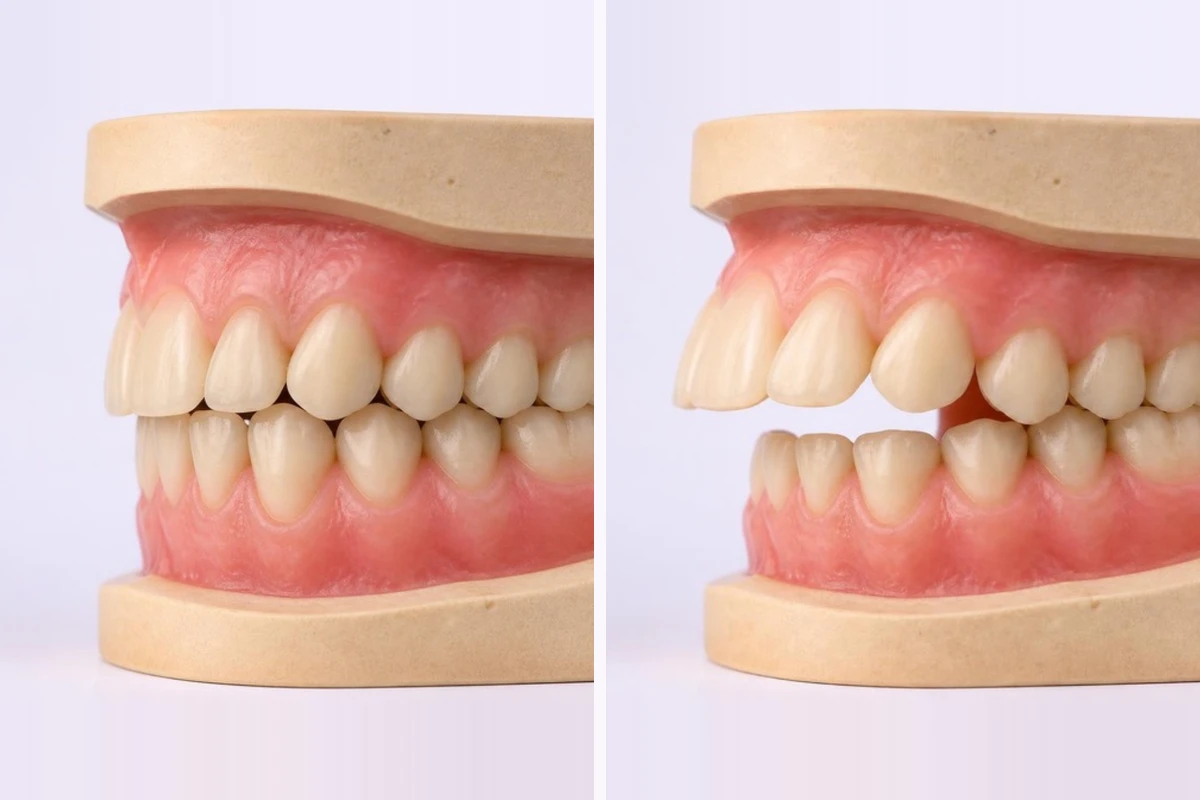
Habits matter most in young children. A study of more than 1,000 children aged 2 to 5 in Hong Kong found that daily thumb or finger sucking for more than a year was linked with front teeth that stick out further and a bite where the front teeth do not meet. Cleveland Clinic advises limiting thumb sucking and pacifier use, especially after age 4. A Ramathibodi Hospital orthodontist adds that some children who used a bottle for a long time or suck a thumb learn to swallow with the tongue pressing the front teeth, which over thousands of swallows a day can push them forward.
Read about orthodontics at the clinic
Do buck teeth affect health, or only looks?
For many people, the main reason to treat buck teeth is confidence, and that is a valid reason on its own. There are also practical effects. Cleveland Clinic lists harder cleaning, which raises the risk of decay and gum disease, trouble closing the lips, chewing difficulty, and in some people jaw pain or headaches. The research link that is clearest is injury: prominent front teeth are more exposed when a child falls or is hit by a ball.
| Effect | Why it occurs | What helps now |
|---|---|---|
| Front teeth injury | Teeth sit in front of the lip, with less protection. | Mouthguard for sport, and an early orthodontic check for children. |
| Dry lips and gums at the front | Lips that rest apart let the front gums dry out. | Sip water, use lip balm, and keep the gum line very clean. |
| Harder cleaning | Angled or overlapping teeth trap plaque. | Brush 2 minutes twice a day and clean between teeth daily. |
| Lower teeth biting the gum | A deep bite lets the lower teeth reach the gum behind the upper teeth. | Mention soreness at your consultation. |
| Confidence | Many people hide their smile. | A consultation gives clear options without any commitment. |
Treatment is not always urgent. For adults with mild buck teeth and healthy gums, it is a choice you can make when the timing suits you. The exceptions are children with very prominent teeth who are active, and adults whose teeth are moving because of gum disease.
Teeth or jaws? How the cause is found
Two people can have front teeth that stick out by the same amount for different reasons. In one, the jaws are balanced and only the teeth are tipped forward. In another, the upper teeth are fairly upright, but the lower jaw is small or set back, so the upper teeth look prominent. The treatment that suits each is different, which is why records come before any decision.
| Check | What it shows | Why it is important |
|---|---|---|
| Examination of teeth, bite and face | How far the teeth stick out, lip closure, crowding, the profile | Gives the overall picture |
| Panoramic X-ray | All teeth and roots, teeth still to come through, missing teeth | Checks that every tooth can be moved safely |
| Cephalometric X-ray (side view of the skull) | The relationship of the jaws and the angle of the teeth | Separates a tooth problem from a jaw problem |
| Digital scan or study model | Space available, tooth sizes, how the teeth meet | Used to plan movements and, for aligners, the digital plan |
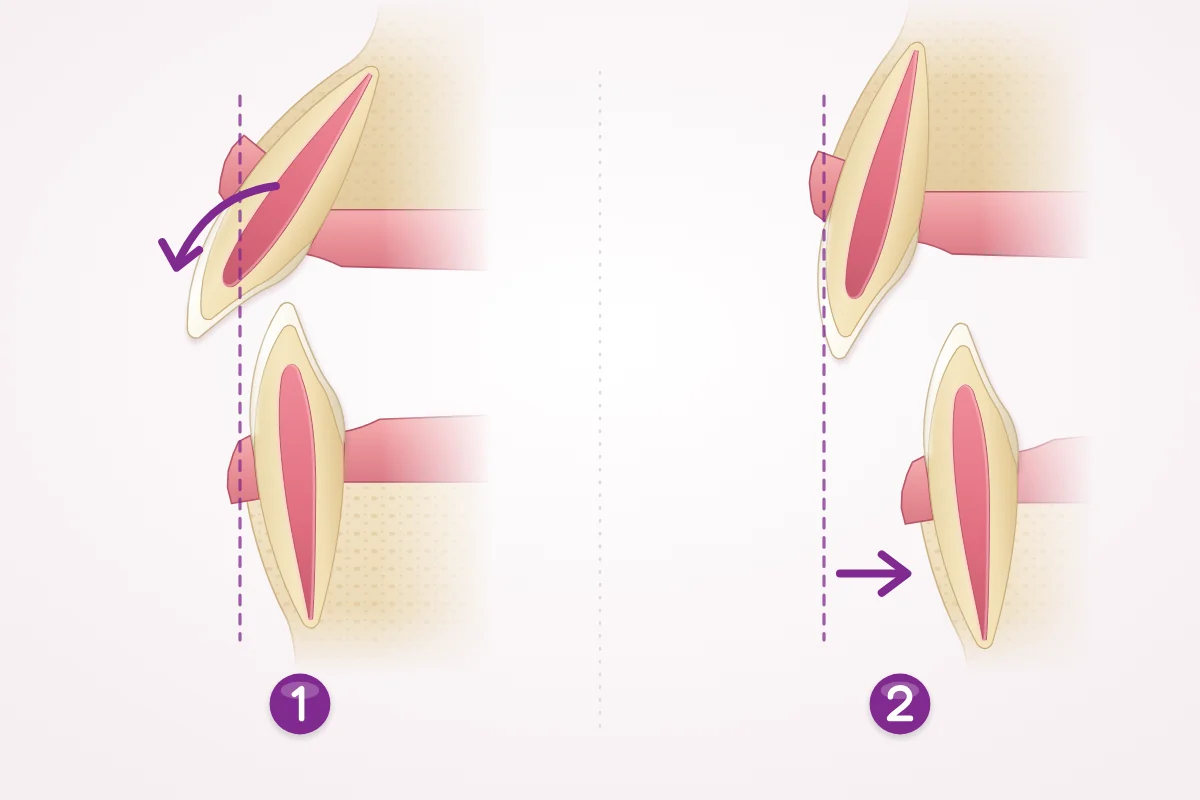
Cleveland Clinic describes a severe overjet, often around 8 to 10 millimeters or more, as the range where jaw surgery may be needed alongside orthodontics in adults. That is a general guide, not a rule. Your orthodontist looks at your measurements, your face and what you want to change.
Treatment options for buck teeth
| Option | Suits | Good to know |
|---|---|---|
| Early treatment for children (for example braces on a few teeth, or a palatal expander) | Growing children whose teeth or jaws are developing out of line | Guides teeth and jaws while growing. A second phase with braces may follow later. |
| Metal braces | Most teenagers and adults, including bigger tooth movements | The standard fixed braces. Elastics may be used to correct the bite. |
| Clear (ceramic) or Damon self-ligating braces | People who want fixed braces that show less | Work like metal braces. Your orthodontist explains which suits your bite. |
| Invisalign clear aligners | Many cases where the teeth, rather than the jaws, are the main cause | Removable trays planned digitally. They work only when worn as instructed. |
| Braces with tooth removal | Crowding, or front teeth that need room to move back | Decided from the records, not by default. |
| Braces with jaw surgery | Adults whose jaw position is the main cause | Planned with a maxillofacial surgery consultant. Surgery in a hospital, braces before and after at the clinic. |
| Veneers or bonding | Small changes in shape when the bite is otherwise fine | Change how teeth look, but do not correct the bite. |
Every orthodontic case at the clinic is treated by an orthodontist, a dentist with postgraduate training in orthodontics. There is no upper age limit for braces, and many patients are adults. Because adults are no longer growing, some bite problems are corrected differently, and your orthodontist explains what is possible in your case.
Adults: what is different
- Growth can no longer be guided, so corrections come from moving teeth, making space, or for larger jaw differences, surgery.
- Gums and teeth are checked first, and any gum treatment or fillings are done before braces go on.
- Old crowns, bridges or implants can affect how teeth move, so bring any records you have.
- Many adults choose clear braces or Invisalign because they show less at work.
- Retainers matter just as much, because adult teeth also tend to move back.
Children: is early treatment worth it?
The American Association of Orthodontists recommends a first orthodontic check by about age 7, because some problems are easier to address while the jaws are still growing, and many children only need monitoring at that visit.
What does early treatment achieve for buck teeth? A Cochrane review of 27 trials compared starting treatment at around age 7 to 11 in two phases with a single course in the early teens. By the end of treatment, the final position of the teeth was similar in both groups. The clear difference was injury: children who had early treatment had fewer new knocks to the front teeth, about 19 in 100 compared with about 30 in 100 when treatment started later.
A separate review of 41 studies confirmed that a larger overjet is linked with more dental injuries at every age, and suggested that in children with adult teeth coming through, an overjet of 5 millimeters or more is a level where the risk rises. So for a child with very prominent front teeth who is active, an early check is mainly about protection. For others, waiting and treating in the teens works just as well for the final result.
What parents can do now
- Help your child stop thumb, finger or pacifier sucking gently, with praise and reminders rather than punishment.
- Book an orthodontic check around age 7, or sooner if the front teeth stick out a lot.
- Use a mouthguard for contact sports to protect prominent front teeth. A review of athletes found fewer dental injuries among mouthguard users.
- If a front tooth is knocked out or broken, contact a dentist straight away.
- Keep regular dental check-ups so decay is treated before any braces.
A knocked or broken front tooth: contact the clinic
What treatment looks like, step by step
| Stage | What to do | What you can expect |
|---|---|---|
| Consultation and records | Examination, panoramic and cephalometric X-rays, digital scan or study model | The orthodontist explains the options, likely treatment time and fee before you decide. |
| Treatment before braces | Cleaning, fillings or extractions that the plan needs | Healthy teeth and gums make tooth movement safer. |
| Fitting | Braces are fitted, or the first aligners are given | Soreness for a few days is common, as the NHS notes. |
| Adjustments | About every 4 to 6 weeks with braces, or 6 to 8 weeks with Invisalign | If you live outside Chiang Mai, tell the clinic before you start. |
| Finishing and retainers | Braces removed, final X-rays, removable or fixed retainers made | Teeth tend to move back, so wear retainers as instructed. |
How long does it take? It depends on how complex your bite is and on the type of braces or aligners. Your orthodontist gives you an estimate before treatment starts. Treatment that includes jaw surgery usually takes longer than braces alone, because there is orthodontic treatment before and after surgery, plus recovery.
Looking after your teeth during treatment
- Brush with fluoride toothpaste in the morning, at night and after meals, as the NHS suggests.
- Clean between the teeth and under the wire daily with an interdental brush.
- Cut down sugary food and drinks, and avoid hard, crunchy or sticky food that can break braces.
- Wear elastics or aligners exactly as instructed. They are what corrects the bite.
- Contact the clinic if pain lasts more than a few days, the gums are very swollen, or something breaks.
Common myths about buck teeth
| Myth | Fact |
|---|---|
| Adults are too old to fix buck teeth. | There is no upper age limit for braces. The approach may differ because adults are no longer growing. |
| Veneers can fix buck teeth quickly. | Veneers change how teeth look but do not correct the bite. Cleveland Clinic notes that only orthodontics or surgery fix overjet. |
| Buck teeth always need teeth taken out. | Extraction is decided from the records. Many cases are treated without it. |
| Thumb sucking does no harm to teeth. | Daily sucking for more than a year is linked with front teeth that stick out further. |
| Clear aligners cannot treat buck teeth. | Many cases where the teeth are the main cause can be treated with aligners. Your orthodontist explains whether yours is one. |
| Once braces come off, the teeth stay straight by themselves. | A Cochrane review notes that without retainers teeth tend to return toward where they started. |
| Early treatment always shortens treatment later. | Research shows the final result is similar. The main benefit of early treatment is fewer front-tooth injuries. |
When to see a dentist soon
- A front tooth is knocked out, pushed out of place or broken: contact a dentist straight away.
- Front teeth that were straight start to fan out or loosen in an adult, especially with bleeding gums.
- The lower teeth bite into the gum behind the upper teeth and it is sore.
- Jaw pain, clicking or locking together with the bite problem.
- During braces: pain that lasts more than a few days, very swollen gums, or a broken bracket or wire that pokes.
An orthodontic consultation at the clinic, step by step
- Tell the coordinator what you would like to change, and send a photo of your smile if you like. A time is booked with an orthodontist.
- Your orthodontist examines your teeth, bite and face, and takes panoramic and cephalometric X-rays and a digital scan or study model.
- You hear whether the cause is mainly the teeth, the jaws or a habit, and which options suit you, with the likely treatment time and fee.
- Any cleaning, fillings or extractions the plan needs are done first, then the braces or aligners are fitted.
- If the jaw position is the main cause and surgery is chosen, a 3D CT scan is used to plan the case with a maxillofacial surgery consultant. The surgery takes place in a hospital, and the braces before and after surgery are done at the clinic.
- At the end, retainers are made to keep the result, and you bring them to your check-ups.
If radiation worries you: at our clinic, X-rays inside the mouth are digital, taken with phosphor plates and sensors that help lower the dose compared with film. Our Planmeca ProMax CBCT has an Ultra Low Dose mode, your dentist chooses the mode that suits each case, and X-rays are taken only when they are needed.
Dental X-ray radiation: how much is it, and how we keep it low
Orthodontic fees are per case and depend on the type of braces or aligners and how complex your bite is. When jaw surgery is part of the plan, there are two parts: the orthodontic fee paid to the clinic, and the surgical and hospital fees paid to the hospital. Your orthodontist explains both once the plan is agreed.
If this sounds like you: what to do
These are example situations, not patient stories, to help you find the next step that fits.
- Your child is 8, still sucks a thumb at night and has prominent front teeth: start gently helping with the habit, and book an orthodontic check. Early treatment may be suggested mainly to lower the risk of injury.
- You are a teenager with front teeth that stick out and some crowding: braces or clear aligners are often suitable. The records show whether extractions are needed.
- You are an adult with buck teeth and a chin that looks set back: ask whether the cause is mainly the jaws. If it is, braces with jaw surgery may be discussed alongside braces alone.
- You want a quick fix with veneers before an event: veneers can change the look, but not the bite. Ask what veneers can and cannot do for your teeth.
- Your front teeth have slowly started to stick out in your forties, and your gums bleed: have your gums checked first. Gum treatment comes before any tooth movement.
- You live outside Chiang Mai and want braces: tell the clinic before you start, so the regular visits can be planned.
- You had braces as a teenager and your front teeth have moved forward again: retainers or a short course of treatment may help. Bring your old retainer if you still have it.
Frequently asked questions about buck teeth
Can buck teeth be fixed without braces?
Clear aligners are one way without fixed braces, for suitable cases. Veneers or bonding can change the look of mildly prominent teeth but do not correct the bite. Large jaw differences in adults may need surgery with braces.
How long does it take to fix buck teeth?
It depends on the cause, how complex the bite is and the type of braces or aligners. Your orthodontist gives you an estimate after the records, before you decide.
At what age should a child with buck teeth be checked?
The AAO suggests a first orthodontic check by about age 7. Come sooner if the front teeth stick out a lot or have already been knocked.
Do buck teeth need teeth to be taken out?
Not always. It depends on crowding and how far the front teeth need to move back. The decision is made from your X-rays and scan.
Can clear aligners fix buck teeth?
In many cases where the teeth are the main cause, yes. Some tooth movements are planned differently with aligners and braces, and your orthodontist explains which suits your bite.
Will fixing buck teeth change my face?
Moving the front teeth back can change how the lips sit and close, and jaw surgery can change the profile more. Your orthodontist explains the likely change for your case during planning.
Is jaw surgery needed for buck teeth?
Most people do not need it. Surgery is considered when the jaw position is the main cause and braces alone cannot fully correct the bite. The surgery is done in a hospital under general anesthesia, and the surgeon explains the steps and recovery before you decide.
Do I need a retainer after fixing buck teeth?
Yes. Teeth tend to move back after treatment, so a removable or fixed retainer is made when the braces come off. Wear it as your orthodontist instructs.
Summary
Buck teeth can be corrected at almost any age. The cause, whether teeth, jaws or habits, decides which option fits.
- X-rays and a scan separate a tooth problem from a jaw problem before any decision.
- Braces or clear aligners correct most cases. Jaw surgery with braces is for adults whose jaw position is the main cause.
- For children, an early check around age 7 helps, and early treatment mainly lowers the risk of front-tooth injury.
- Help children stop thumb or pacifier sucking gently, and use a mouthguard for sport.
- Veneers change the look but not the bite, and retainers keep the result after braces.
References
Cleveland Clinic: Overjet (Buck Teeth)
NHS (UK): Braces and orthodontics
American Association of Orthodontists: When should my child see an orthodontist?