
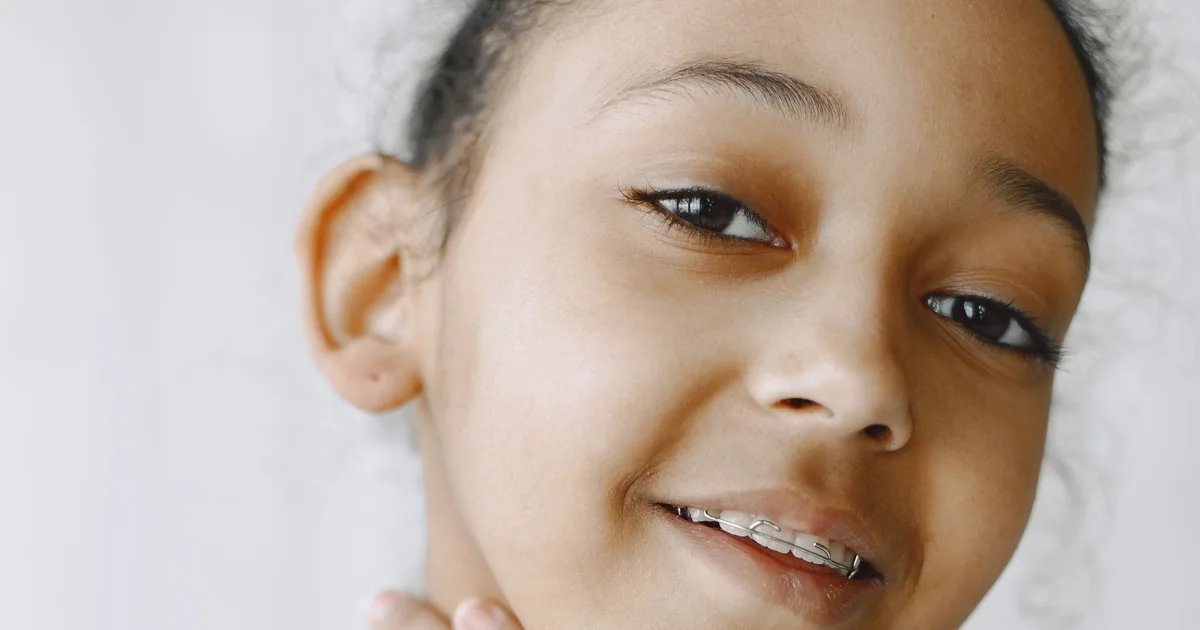
Your child is seven or eight. The new front teeth look big and a little crooked, the bite does not seem to line up, or the child of a friend is already wearing a plate. You start to wonder: is it too early for braces, or too late to fix something while my child is still growing?
The reassuring news is that most children do not need treatment at this age, and many crooked-looking teeth settle as the rest of the adult teeth come in. A smaller group of children have problems that are easier to correct while the jaws are still growing, such as a narrow upper jaw with a crossbite. For them, a short phase of early treatment can make a real difference.
This guide explains what is happening in the mouth from age 6 to 13, the signs worth showing a dentist, which problems benefit from early treatment and which can wait, how a palatal expander works and what daily life is like with one, how to help a child stop thumb sucking, and what happens at an orthodontic check.
In short: the American Association of Orthodontists suggests a first orthodontic check by about age 7, and most children are simply monitored at that visit. Early treatment helps specific problems, such as a crossbite from a narrow upper jaw, a front tooth caught behind the lower teeth, or very prominent front teeth that are at risk of injury. A palatal expander widens the upper jaw while the midline joint in the palate is still open, which is why timing matters. At our clinic, orthodontists provide early treatment and jaw expansion for children aged 8 to 12.
Signs worth showing a dentist
You can check a few things at home with your child smiling and biting together in front of a mirror. These are not a diagnosis, but they help you decide how soon to book.
Mention it at the next regular check-up
- Slight crowding of the new lower front teeth.
- A small gap between the upper front teeth.
- Baby teeth falling out a little earlier or later than friends of the same age.
Book an orthodontic assessment
- Some upper back teeth bite inside the lower ones, or the lower jaw shifts to one side when your child closes.
- An upper front tooth sits behind the lower front teeth when biting.
- The lower front teeth bite in front of the upper teeth.
- The upper front teeth stick out a long way past the lower teeth.
- The front teeth do not meet at all when the back teeth bite together.
- Thumb or finger sucking continues after the adult front teeth come in.
- A baby back tooth was lost early, or an adult tooth is very late or comes in out of line.
Contact the dentist soon
- A knock to the front teeth, especially if a tooth is chipped, loose or pushed out of place.
- Pain, swelling or a broken appliance during treatment.
Snoring, mouth breathing or pauses in breathing at night are worth raising with the doctor who looks after your child. Dentists and doctors can look at these together, because the causes are often in the nose and throat rather than the teeth.
Baby teeth: when they come in and fall out
Why age matters: growth and the mixed teeth years
From about age 6 to 12, children have a mix of baby and adult teeth. The jaws are still growing, and the upper jaw is made of two halves joined by a seam down the middle of the palate. In younger children this seam is flexible, so gentle steady pressure can widen the upper jaw itself, not just tip the teeth. As children reach their teens, the seam gradually interlocks and fuses.
Research supports this. A CBCT study of the palate seam found that the early, more open stages were typically seen up to about age 13, and that fusion could start after age 11 in girls. A study of rapid expansion in the Angle Orthodontist found more widening of the jaw bone itself in children treated before their pubertal growth spurt than in those treated during or after it. This is the reason orthodontists like to assess children before their teens, and why our clinic provides jaw expansion for children aged 8 to 12.
| Age | What is happening in the mouth | What the dentist looks for |
|---|---|---|
| About 6 to 7 | First adult molars and lower front teeth come in. | Crossbites, habits, early loss of baby teeth, space for the front teeth. |
| About 8 to 10 | Upper front teeth and side teeth come in. The jaws grow steadily. | Narrow upper jaw, prominent or trapped front teeth, how the jaws relate. |
| About 10 to 12 | Baby back teeth are replaced. The growth spurt approaches. | Space for the canines and premolars, timing of expansion and growth guidance. |
| About 12 and over | Most adult teeth are in. | Full braces or aligners when needed. |
A Thai orthodontic question-and-answer guide from the Faculty of Dentistry at Chulalongkorn University gives the same picture: most braces start between about 12 and 16, once most adult teeth are in, while some children start earlier, at about 7 to 10, when a problem with jaw growth or tooth position is found early.
Early treatment or wait? What the evidence shows
Early treatment, sometimes called phase one or interceptive treatment, is a short course while a child still has some baby teeth. Many children then need a second phase with braces or aligners when the adult teeth are in. Orthodontists recommend it when it solves a specific problem better now than later, not as a routine.
| Problem | What early treatment can do |
|---|---|
| Crossbite of the back teeth from a narrow upper jaw | A Cochrane review found that, for children aged 7 to 11, fixed and removable expanders corrected posterior crossbites far more often than waiting. Correcting a crossbite with a sideways jaw shift also helps the jaw grow evenly. |
| An upper front tooth caught behind the lower teeth | Guidelines from the American Academy of Pediatric Dentistry note that a simple front-tooth crossbite can be aligned as soon as it is noticed, for example with a small appliance, to protect the teeth and gum. |
| Very prominent upper front teeth | A Cochrane review found that early treatment reduced new injuries to the front teeth (about 19% compared with 30% with later treatment), but brought no other clear advantage over treating in the early teens. |
| Lower front teeth in front of the upper teeth (underbite) | A systematic review found moderate evidence that early treatment with a facemask improves the bite and jaw relationship in the short term, with limited long-term evidence. Some children still need treatment later. |
| Thumb sucking with an open bite | Stopping the habit comes first. A Cochrane review found low-quality evidence that habit appliances and reward-based approaches help children stop. |
| Mild crowding | Often monitored. Some space appears as baby teeth are replaced, and braces later can finish the job. |
Two-phase treatment usually takes longer in total than a single course in the teens, so the benefit has to be worth it. A good orthodontist will tell you plainly when waiting is the better choice.
Crowded or crooked teeth: which braces suit you?
Buck teeth (protruding front teeth): treatment options
How a palatal expander works
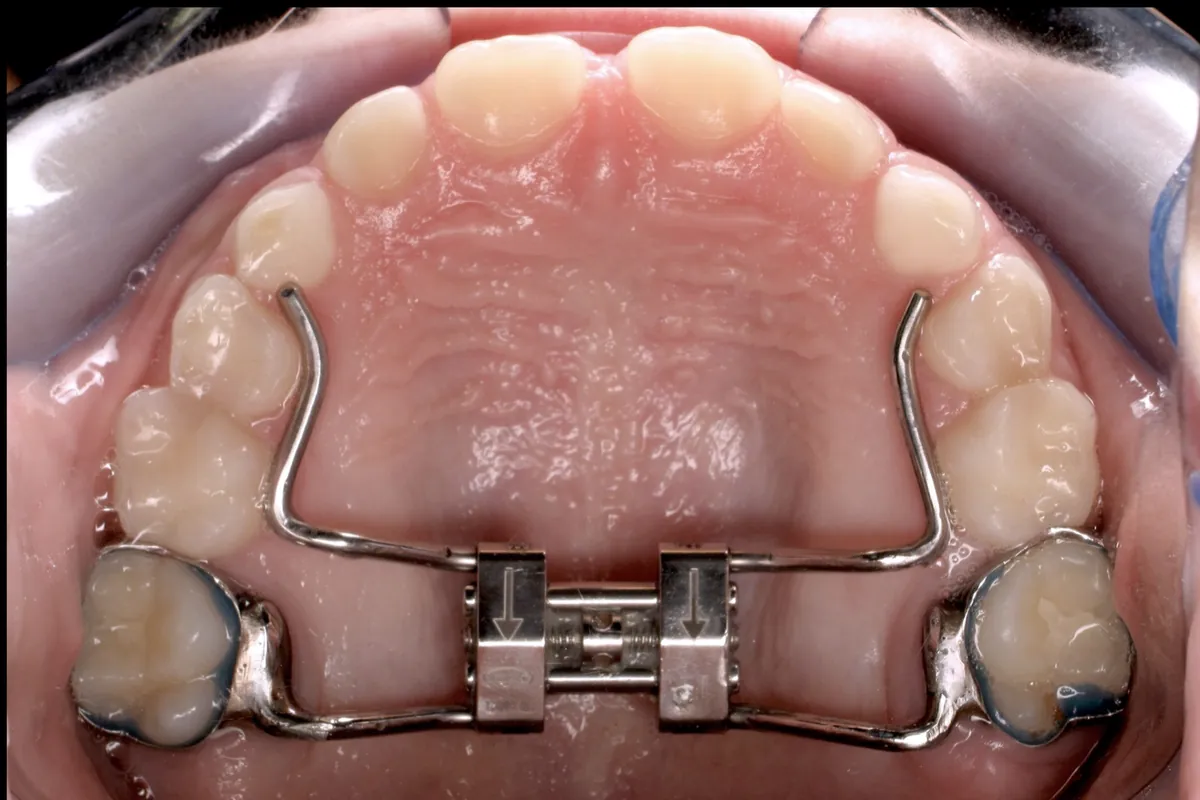
A palatal expander, also called a jaw expander, widens a narrow upper jaw. The most common fixed type is held on the upper back teeth with metal bands and has a small screw in the middle of the palate. Turning the screw with a small key pushes the two halves of the upper jaw apart a tiny amount at a time, and new bone fills the widened seam.
What a typical course looks like
- Records first: a check of the teeth and bite, X-rays and a scan or impression to make the appliance.
- Fitting: the expander is cemented to the back teeth, and the orthodontist shows you how to turn the screw.
- Widening phase: a parent turns the screw at home on the schedule the orthodontist gives. Cleveland Clinic describes rapid expanders widening by about 0.5 mm a day, and most children reaching the planned width in about two to three months.
- Holding phase: once the width is right, the expander stays in place for several more months while the new bone firms up. Cleveland Clinic describes about four to six months.
- Removal and next steps: some children need nothing more for now; others continue with a short phase of braces or are monitored until the adult teeth are in.
What your child may notice
- Mild pressure or discomfort, mostly in the first few days, sometimes with a headache. The pain relief your dentist suggests can help.
- A gap opening between the upper front teeth. This is a normal sign that the jaw is widening, and it usually closes on its own or with braces later.
- Extra saliva and a slight lisp at first, while the tongue gets used to the appliance.
- Severe pain is not expected. If it happens, contact the orthodontist.
A systematic review in the Angle Orthodontist found that part of the expansion is in the bone and part comes from the teeth tipping outwards, and that results in the bone are better in children who are less skeletally mature. This is another reason expansion is planned while a child is still growing.
Appliances our orthodontists use in early treatment
| Appliance | When it is used |
|---|---|
| Fixed rapid palatal expander | A narrow upper jaw, crossbites and lack of space, while the palate seam is still open. |
| Partial braces on four front teeth and two molars | Lining up front teeth, or freeing a front tooth caught behind the lower teeth. |
| Habit appliance | A reminder for thumb sucking or tongue thrusting when encouragement alone has not worked. |
| Space maintainer | Holding the gap when a baby back tooth is lost early, so the adult tooth has room. |
These are the early-treatment appliances provided at our clinic. Research on early treatment also describes other designs, such as a wire expander or a facemask for some underbites. The orthodontist chooses the approach from the records and explains why, and many children do not need an appliance at all.
Thumb sucking and other habits
Sucking a thumb or a dummy is normal for babies and toddlers. The American Dental Association notes that most children stop between the ages of 2 and 4, and that problems with the growth of the mouth and the position of the teeth are more likely when sucking continues after the adult teeth come in, especially vigorous sucking. Guidelines from the American Academy of Pediatric Dentistry encourage helping children stop by about age 3.
Gentle ways to help
- Praise your child for the times they do not suck, rather than scolding when they do.
- Notice when it happens, for example when tired or worried, and offer comfort in another way.
- Let an older child choose a reminder, such as a plaster on the thumb or a sock on the hand at night.
- Ask the dentist to talk with your child. Hearing it from the dentist often helps.
- If the habit continues once the adult front teeth are in, ask about a habit appliance.
Daily life with an expander or early appliance
Food and plaque collect around bands and wires, so cleaning matters more than usual. Children this age still need help: most brush well with a parent checking afterwards.

- Brush twice a day with fluoride toothpaste, paying attention to the bands and the gumline around them.
- Rinse with water after meals to flush food from under the expander, and use a small brush across the palate area.
- Follow the food advice from the orthodontist. Sticky sweets and very hard foods can loosen bands or bend wires.
- For contact sports, ask about a mouthguard that fits over the appliance.
- Keep the key and the turning chart in a safe place, and note each turn.
Sports mouthguards for Muay Thai: custom-made or ready-made?
Common myths and the facts
| Myth | Fact |
|---|---|
| Braces should wait until all the adult teeth are in. | Most treatment does start then, but a few problems are easier to correct earlier, while the jaws are growing. |
| Every child who sees an orthodontist at 7 will start treatment. | Most children are simply monitored. The visit is to catch the few problems that benefit from early care. |
| Baby teeth do not matter because they fall out. | Baby teeth hold space for the adult teeth. Losing one early can let neighbouring teeth drift into the gap. |
| An expander changes the shape of the face dramatically. | It widens the upper jaw and dental arch. The face itself changes very little. |
| Early treatment means no braces later. | Many children still need a shorter second phase. Early treatment makes the first problem easier to fix, not the whole bite. |
During treatment: when to contact the orthodontist
- A band or the expander feels loose, or a wire is poking the cheek or tongue.
- The screw will not turn, or a turn was missed or doubled.
- Soreness that lasts beyond a few days, or swelling of the gum or palate.
- The appliance is broken or has come out.
Keep the broken piece and bring it to the visit. Most problems are quick to fix.
An orthodontic check for your child, step by step
At Kitcha Dental Clinic, check-ups for children start from the first tooth. For bite and jaw problems, our orthodontists, dentists with further training in orthodontics, provide early treatment and jaw expansion for children aged 8 to 12. Younger children are followed at their regular check-ups, and older children are offered the type of braces or aligners that suits them.
- The orthodontist talks with you and your child, and checks the teeth, the bite, habits and how the jaws close.
- Records when needed: panoramic and cephalometric X-rays, and a digital scan or impressions. X-rays are taken only when needed, using low-dose digital imaging.
- The orthodontist explains what was found: monitor and recheck, early treatment now, or wait for braces later, with the reasons for each.
- If treatment is recommended, you receive the plan, the expected time and the cost before deciding.
- During treatment, visits are spaced to suit the appliance, and the orthodontist explains how to look after it.
Orthodontics and braces in Chiang Mai
If this sounds like you: what to do
These are example situations, not patient stories, to help you find the next step that fits.
- Your 7-year-old has slightly crowded new lower front teeth and no other concerns: mention it at the next check-up. This often improves as the other teeth come in.
- In your 9-year-old, the upper back teeth bite inside the lower ones on one side, and the jaw shifts when closing: book an orthodontic assessment. This is a typical case for expansion.
- Your 8-year-old has one upper front tooth behind the lower teeth: book an assessment soon. A small appliance can often correct it.
- Your 10-year-old has prominent upper front teeth and plays football: ask about the risk of injury, early treatment and a mouthguard.
- Your 6-year-old still sucks a thumb every night: try the gentle steps above and mention it at the next check-up.
- Your 13-year-old has crowded teeth and most adult teeth are in: an orthodontic consultation can plan braces or aligners now.
Frequently asked questions about early orthodontics
At what age should my child first see an orthodontist?
The American Association of Orthodontists suggests a first check by about age 7. Regular dental check-ups from the first tooth also let the dentist notice bite problems early. At our clinic, early treatment and expansion are provided for children aged 8 to 12.
Does a palatal expander hurt?
Most children feel mild pressure or discomfort rather than pain, mainly in the first few days. The pain relief your dentist suggests can help. Severe or ongoing pain is a reason to contact the orthodontist.
How long does a child wear an expander?
There are two phases. First the widening phase, which Cleveland Clinic describes as about two to three months for most children. Then the expander stays in place for about four to six more months while the new bone firms up. Your orthodontist gives the timeline for your child.
Is the gap between the front teeth normal?
Yes. A gap between the upper front teeth is the expected sign that the upper jaw is widening. It usually closes on its own or later with braces.
Will my child need braces again later?
Often, yes, but usually a simpler and shorter course. Early treatment fixes the problem that cannot wait, and the final alignment of the adult teeth comes later if it is needed.
My child is older than 12. Is expansion still possible?
As children grow, the palate seam gradually fuses, so the options change. In the teens, the orthodontist assesses growth and plans braces or aligners, sometimes with other ways of gaining space. Adults with a very narrow upper jaw may need expansion combined with surgery. An orthodontic consultation explains what suits your child.
Can an expander help snoring or mouth breathing?
Expansion is planned for the bite and the jaw. Snoring and mouth breathing have many causes, often in the nose and throat, so they should be checked by the doctor who looks after your child. Dentists and doctors can work together when both are involved.
My child has crooked baby teeth. Does that mean braces?
Usually not at that stage. Crooked baby teeth are often followed by adult teeth that need more space, so the dentist watches the space as the adult teeth come in. A crossbite or a jaw that shifts to one side is the exception worth assessing early.
Summary
Most children only need monitoring, but a few bite problems are easier to correct while the jaws are still growing.
- A first orthodontic check by about age 7 is suggested; regular check-ups start from the first tooth.
- Crossbites, trapped front teeth and very prominent front teeth are the main reasons for early treatment.
- An expander widens the upper jaw while the palate seam is open; results in the bone are better before the growth spurt.
- Help children stop thumb sucking gently, ideally by about age 3, and ask about an appliance if it continues.
- At our clinic, orthodontists provide early treatment and expansion for children aged 8 to 12.
References
American Association of Orthodontists: When should my child see an orthodontist?
American Academy of Pediatric Dentistry: Management of the developing dentition and occlusion (PDF)
Ugolini A et al. Orthodontic treatment for posterior crossbites. Cochrane Review, 2021
Baccetti T et al. Treatment timing for rapid maxillary expansion. Angle Orthod, 2001
Cleveland Clinic: Palate Expander
American Dental Association (MouthHealthy): Thumbsucking
NHS (UK): Braces and orthodontics
Faculty of Dentistry, Chulalongkorn University: Orthodontic questions and answers (Thai, PDF)