

You catch your smile in a photo and one front tooth looks greyer than the rest. Maybe you remember a knock years ago, a fall from a bike or a ball to the face, or maybe nothing comes to mind at all. It does not hurt, so you wonder: is this tooth dead, is it dangerous to leave it, and will it ever look normal again?
The reassuring part first: a dark tooth can almost always be treated so that you keep it, and the color can usually be improved. When the soft tissue inside a tooth, called the pulp, has died, root canal treatment cleans the inside and seals it. After that, the tooth can often be whitened from the inside, or covered with a crown or veneer. And not every dark tooth is dead. Some teeth turn yellow after a knock while the pulp is still alive, and many dark spots are simply stains, tartar or an old filling.
This article helps you work out what your dark tooth is likely to be and what to do next. You will find a one-minute self-check, a table of tooth colors and what they may mean, how dentists test whether a tooth is alive, the treatment options side by side, a step-by-step plan from the first visit to the final color, common myths, calm warning signs, and what happens at the clinic.
In short: a tooth that turns grey or dark, especially after a knock or deep decay, often has a damaged or dead pulp. A dead pulp does not heal on its own, even when it does not hurt, so have the tooth checked with an X-ray. Root canal treatment lets you keep the tooth, and the color can then be improved by whitening from the inside, a crown or a veneer.
Is my dark tooth dead? A one-minute self-check
Look at the tooth in daylight, compare it with the teeth next to it, and think back over the past months and years. Then see which group sounds most like you.
Probably a surface stain: start with a cleaning
- Several teeth have brown or dark marks, mostly along the gum line or between the teeth.
- You drink coffee, tea or red wine often, or you smoke.
- The color sits on the surface and the tooth itself feels completely normal.
Book a check in the next few weeks
- One tooth has turned grey, dark yellow, brown or pinkish, and its neighbors have not.
- That tooth had a knock, a fall or a sports injury, even long ago.
- It has a deep cavity or a large old filling, or it once ached and then stopped.
- It no longer feels cold drinks the way the other teeth do.
- It had root canal treatment before and has slowly turned darker.
Contact a dentist soon
- The gum near the tooth has a small pimple or bump that may release a salty or bad-tasting fluid.
- It hurts to bite or tap on the tooth, or it throbs on its own.
- The gum or face near the tooth is swollen.
- The tooth was knocked recently and has become loose or moved out of place.
The last group usually points to an infection or a recent injury, and both are easier to manage when they are seen early. The warning signs section below explains which situations need a hospital instead of a dental appointment.
What a dead tooth is and why it turns dark
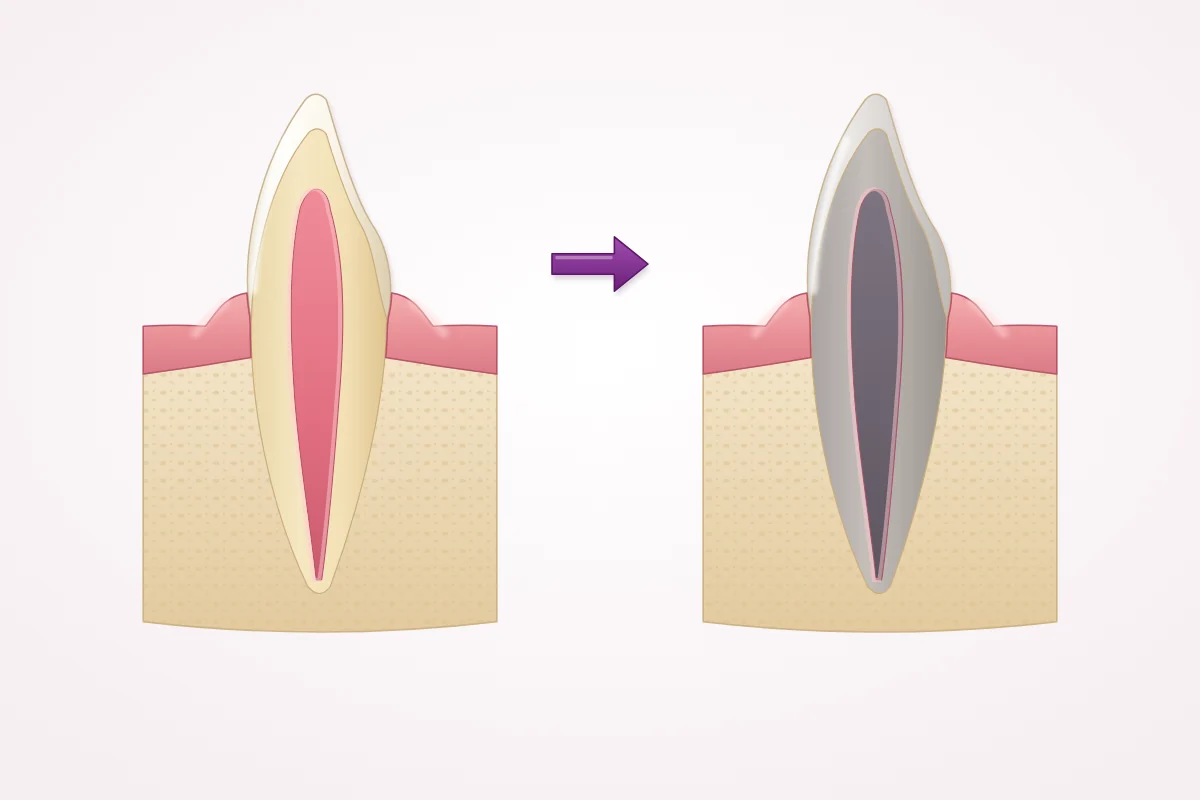
Inside every tooth is the pulp, a soft tissue with nerves and blood vessels that runs from the crown down to the tip of each root. A tooth is called dead, or non-vital, when this tissue has lost its blood supply and died. The hard outer layers, enamel and dentin, are still there, so the tooth still looks like a tooth and can still be used for chewing.
Two main routes to a dead pulp
- A knock or injury. A blow to the mouth can tear the small blood vessels where they enter the root tip, so the pulp loses its supply suddenly, even when the tooth does not crack or chip. The color change may appear weeks, months or much longer after the injury.
- Deep decay or a crack. Bacteria travel through a cavity or a crack into the pulp. The pulp first becomes inflamed, which often causes lingering pain with hot or cold, and if the cause is not removed, the inflammation can progress until the pulp dies.
Dentists describe this as a path with stages. In the early stage, called reversible pulpitis, a short sharp twinge with cold or sweets fades quickly, and the pulp can recover once the cavity is filled. In irreversible pulpitis, the pain lingers for 30 seconds or more, and the pulp can no longer heal on its own. In pulp necrosis, the pulp has died. Hot and cold may no longer be felt at all, yet the tooth may hurt when tapped.
Why the tooth turns grey or black
When the vessels inside the tooth tear, blood seeps into the tiny tubes that run through the dentin. As the red blood cells break down, they release iron-containing pigments that darken over time, much like a bruise that turns from red to grey and brown. A pulp that dies without bleeding also changes color as the tissue breaks down. Because enamel is translucent, this darker dentin shows through and the whole tooth looks greyer.
A useful detail for treatment: dentists who study bleaching of dead teeth note that color caused by bleeding inside the pulp tends to respond well to internal whitening, while color that has been there for a long time is harder to lift. This is one reason to have a dark tooth checked sooner rather than later.
A dead pulp cannot heal or come back to life. Once the inflammation has reached that stage, the dead tissue has to be removed, either by root canal treatment or by taking the tooth out, so that bacteria do not keep growing inside it.
Causes of a dark tooth and how to tell them apart
A dark tooth is not always a dead tooth. The table starts with the causes that come from inside one tooth, then moves to stains and other causes that usually affect several teeth.
| Cause | How to tell | What to do |
|---|---|---|
| Dead pulp after a knock | One front tooth turns grey, dark or brownish, sometimes long after the injury; often no pain | Dental check with tests and an X-ray; root canal treatment if the pulp has died |
| Dead pulp after deep decay or a crack | A deep cavity or large filling, past aching that stopped, pain when biting | X-ray and root canal treatment, then a crown or onlay for a back tooth |
| A tooth that already had root canal treatment | Slowly turns darker over months or years after treatment | Check the root filling on an X-ray, then whiten from the inside or cover it |
| Calcified pulp after a knock (pulp canal obliteration) | The tooth turns a deeper yellow, not grey; often no symptoms; the pulp may still be alive | Regular checks with X-rays; treatment only if signs of infection appear |
| Decay | A brown or black spot or hole, often in grooves or between teeth; may be sensitive to sweets | A filling; root canal treatment if the decay has reached the pulp |
| An old filling | A grey or dark area around an old metal filling, or a tooth-colored filling that has yellowed | Replace the filling if needed; whitening does not change filling color |
| Surface stains and tartar | Several teeth, brown or black along the gum line or between teeth; coffee, tea, wine or smoking | A professional cleaning and polishing |
| Medicines or tooth development (for example tetracycline before about age 8, or too much fluoride) | Many teeth, often in bands or patches of yellow, grey or brown, present since the teeth came in | Talk with your dentist about whitening, bonding or veneers |
Two quick rules help here. A single tooth that has changed color, while its neighbors have not, points to something inside that tooth. Color that sits on the surface of several teeth and comes off, at least partly, with a cleaning points to stains. Your dentist confirms which it is.
Yellow teeth: causes and ways to brighten them
Tooth colors and what they may mean
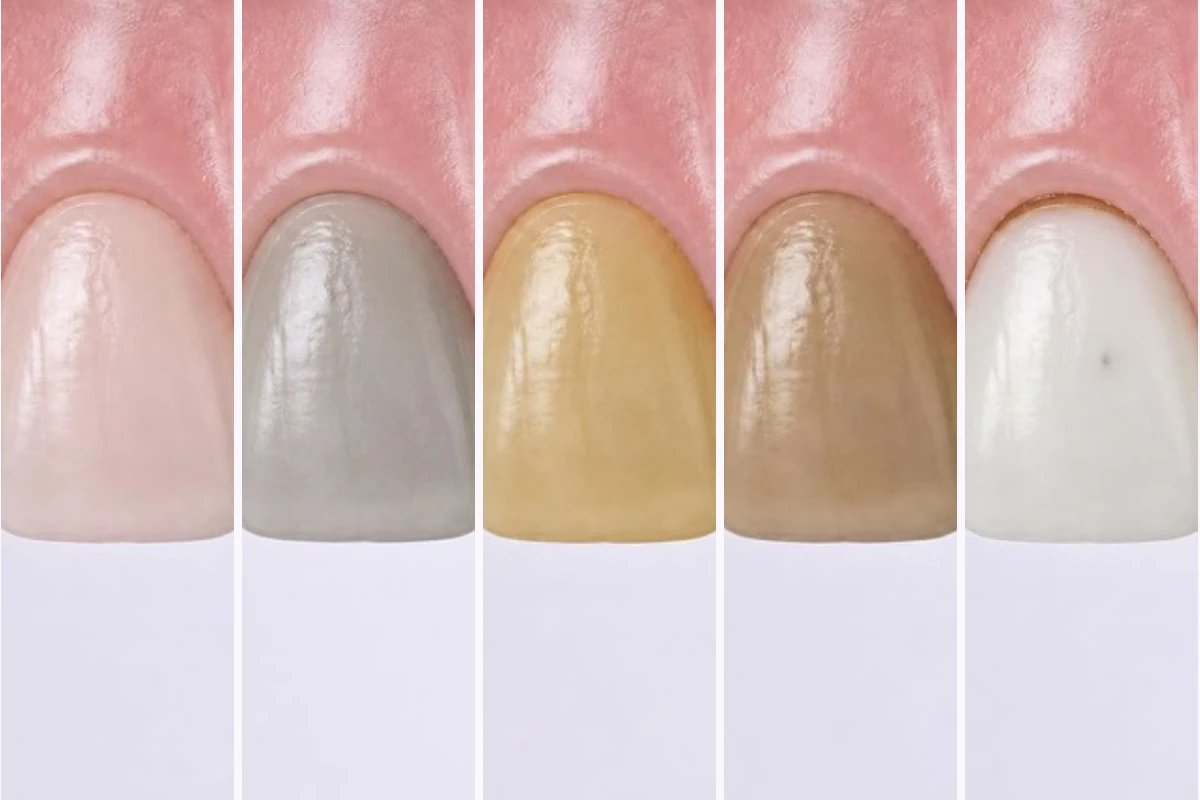
Color alone cannot confirm whether a tooth is alive, because researchers who followed injured teeth for many years found that a change in color can be a sign of healing as well as a sign of pulp death. Still, the shade gives your dentist useful clues.
| What you see | What it may mean | Next step |
|---|---|---|
| Pink or reddish soon after a knock | Bleeding inside the pulp; in some teeth this fades as the pulp recovers | A check soon, then follow-up visits to see which way it goes |
| Grey, dark grey or bluish | Often a pulp that has died, especially if it appears or deepens weeks to months after an injury | Tests and an X-ray; root canal treatment if the pulp has died |
| Dark yellow or amber, one tooth after a knock | Often a pulp that is narrowing with new hard tissue; many of these teeth stay alive | Monitoring with X-rays; whitening or bonding if you want a better match |
| Brown or black, darker over months, after a root canal | Pigment from the old pulp or materials left in the crown of the tooth | Check the root filling, then whiten from the inside or cover it |
| Black spots or lines on the surface | Stain, tartar or decay rather than a dead pulp | A check and cleaning; a filling if it is decay |
One more point about the yellow type. Reviews of injured front teeth report that roughly 4 to 24 out of 100 develop this narrowing of the pulp space, and that most of them never cause symptoms. Only a minority go on to develop a dead pulp with infection, so these teeth are usually watched with X-rays rather than treated straight away.
How a dentist checks whether a tooth is dead

There is no single test that answers the question on its own. Your dentist puts several clues together, and compares the dark tooth with healthy teeth on the same and the other side.
- History: when the color changed, any past knock, pain, swelling, or earlier treatment on that tooth.
- Looking and feeling: the gum around the tooth, any small bump on the gum, cracks, and whether the tooth is loose.
- Tapping and biting: a tooth that is tender to tapping often has inflammation around the root tip.
- Pulp tests: a cold test, and sometimes an electric test, check whether the nerve in the tooth still responds. When needed, these simple tests help show whether the pulp is still alive.
- X-rays: show the root, the root canal and the bone around the root tip. A dark area at the tip can be a sign of infection, sometimes with no symptoms at all.
- A 3D scan when needed: for unusual root shapes, suspected cracks or retreatment, a CBCT scan of one or two teeth gives a closer look.
Pulp tests have limits. They measure whether the nerve responds, not whether blood is still flowing, and reviews of their accuracy find that no single test is perfect. A recently injured tooth may not respond for a while even though it later recovers, and a yellowed tooth with a narrowed pulp often gives no response even when it is alive. This is why, after an injury, your dentist may suggest watching the tooth over several visits instead of starting treatment on day one.
Treatment options for a dead tooth
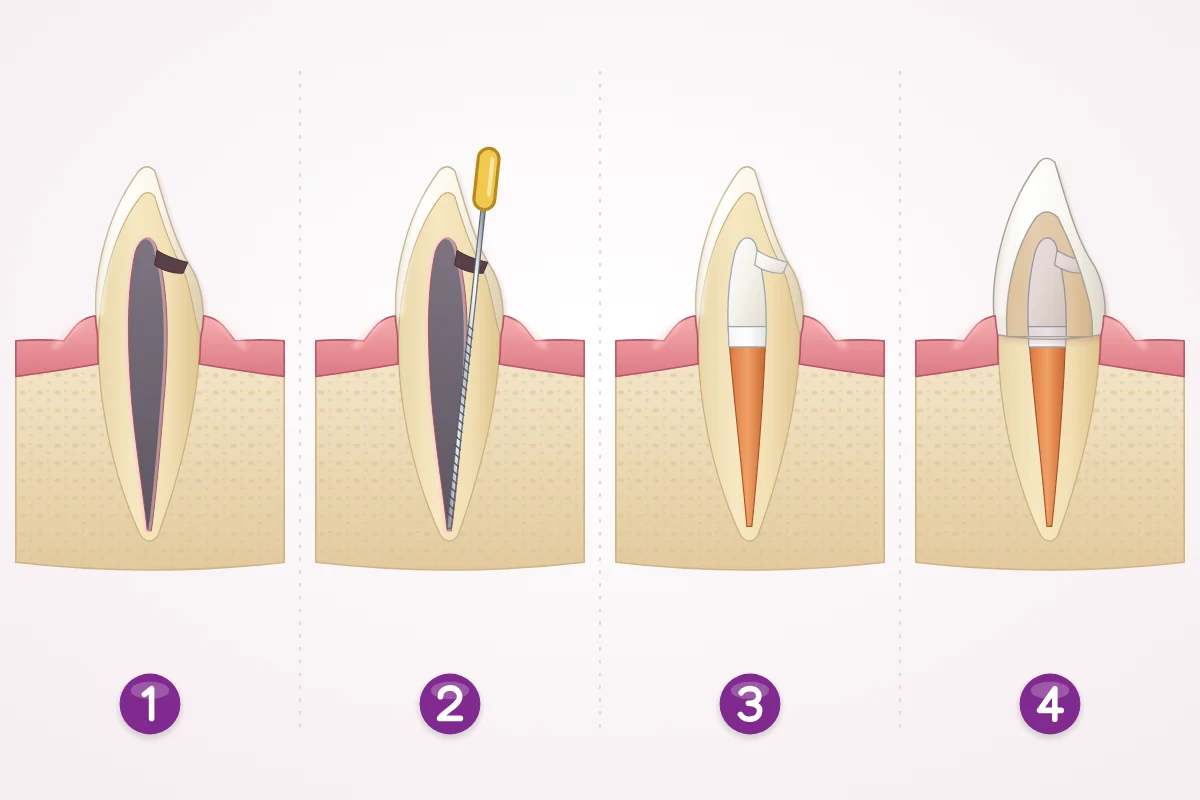
A dead tooth needs treatment for the inside first, and then for the color. The table shows the main options for the inside of the tooth. Your dentist explains which suit your tooth after the examination.
| Option | When it suits | Good to know |
|---|---|---|
| Watch and recheck | A recently injured tooth, or a yellowed tooth, with no sign of infection on the X-ray | Not doing nothing: it means planned checks with tests and X-rays, and treatment if signs change |
| Root canal treatment | The pulp has died or is infected, and the tooth can be restored | Keeps your own tooth; one or more visits; a back tooth usually needs a crown or onlay afterward |
| Root canal retreatment (treating the tooth again) | A tooth treated before that is dark, sore or infected again | The old root filling is removed and the canals cleaned and sealed again |
| Root-end surgery (apicoectomy) | Infection at the root tip continues after treatment, or a crown and post make retreatment impractical | A small procedure under local anesthesia that removes the root tip and seals the root end |
| Removing the tooth and replacing it | The tooth is badly broken or cracked, or there is too little tooth left to restore | The gap is usually filled later with an implant, a bridge or a denture |
Antibiotics are not a treatment for a dead tooth on their own. They cannot reach dead tissue inside a tooth, and doctors use them only in specific situations, for example when an infection is spreading. The dead tissue still has to be removed.
From dark tooth to a natural color: step by step
This is the usual order for a front tooth that has died and darkened. Back teeth follow the same first steps and usually finish with a crown or onlay instead of whitening.
| When | What happens | Good to know |
|---|---|---|
| First visit | Examination, pulp tests and X-rays; your dentist explains the findings, the options and the cost | Bring any old X-rays and the date of any injury you remember |
| Root canal visits | The tooth is numbed, the dead pulp removed, the canals cleaned and shaped, then filled and sealed | Some teeth finish in one visit, others need two or more, with medication inside between visits |
| The next few days | The tooth may feel tender when you chew | This usually settles within two to three days; contact the clinic if it gets worse or swells |
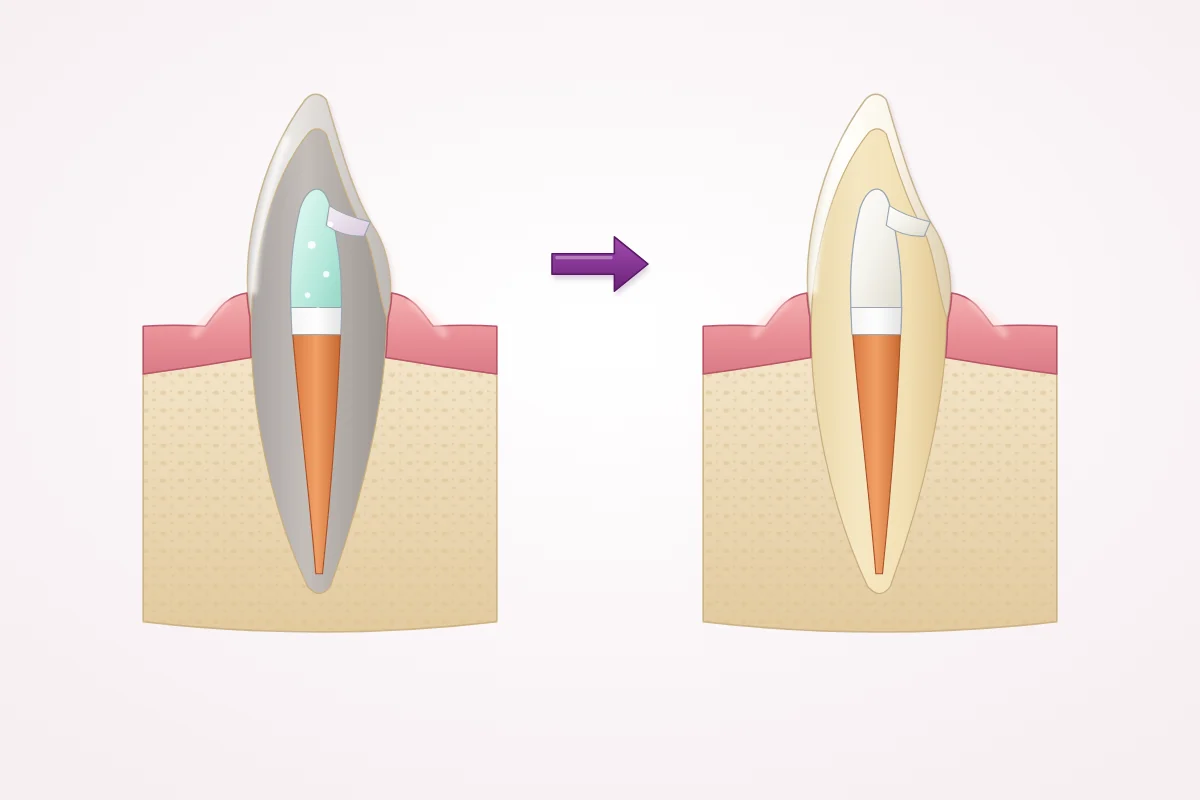
| Improving the color | Whitening from the inside, often over 1 to 3 visits; or a crown or veneer | Whitening first means any new crown or veneer can be matched to the lighter shade |
| Later checks | X-rays at later check-ups show how the bone around the root is healing | Brush, clean between your teeth and keep regular dental visits |
Choosing how to improve the color
| Option | When it suits | Good to know |
|---|---|---|
| Whitening from the inside (internal bleaching) | A single front tooth that darkened after root canal treatment, with enough healthy tooth left | Keeps the most natural tooth; the color may darken again over time and can be touched up |
| A crown | A back tooth after root canal treatment, or a front tooth that is heavily filled or broken | Covers and protects the whole tooth; needs two visits, usually a few days apart |
| A porcelain or composite veneer | A front tooth that is mostly intact but stays darker than its neighbors after whitening | Covers the front surface; a very dark tooth may need a more opaque material or a crown |
A review that pooled the clinical studies found that the common internal whitening agents all lighten root-treated teeth by a clear amount. Results still vary from tooth to tooth. Dentists who wrote about bleaching dead teeth advise telling patients that the outcome is hard to predict exactly and that the color can return. They also note a small risk of a type of root resorption near the gum line, which is linked with past injury and with heat or very strong agents, so the root filling is first sealed at the gum level and gentle methods are used.
For porcelain veneers, our clinic usually recommends a single trip of about 10 to 14 days in Chiang Mai, and less time is possible depending on the case and how complex it is. Crowns are usually fitted 3 to 5 days after the tooth is prepared. If you are traveling, tell us your dates when you book.
A tooth that was just knocked: what to do
Many dark teeth start with an injury that seemed minor at the time. If a tooth has just been knocked, what you do in the following days and months shapes how it turns out.
- If an adult tooth is knocked out, pick it up by the crown, not the root, rinse briefly if dirty, and either put it gently back or keep it in milk. Contact a dentist straight away, because time matters.
- If the tooth is loose or has moved, see a dentist soon. It may need to be repositioned and held with a thin splint while it settles.
- Even if the tooth looks fine, have a check with an X-ray, so there is a starting point to compare with later.
- Keep the follow-up visits. Dental trauma guidelines recommend repeated checks over the following weeks, months and years, because changes in the pulp and root can appear late.
- Watch for changes at home: a new grey shade, a bump on the gum, pain on biting or swelling, and tell your dentist if you notice any.
In children whose roots are still growing, the pulp has a better chance of healing after an injury, and young teeth may not need root canal treatment at all. In a baby tooth, research on front teeth that turned dark grey after a knock found that most of them had a dead pulp when they were opened, even without other symptoms. A dentist checks baby teeth too, with the aim of protecting the adult tooth growing underneath.
Common myths about dead and dark teeth
| Myth | Fact |
|---|---|
| If it does not hurt, it is fine. | A dead pulp has no working nerve, so it often does not hurt, yet infection can still build up at the root tip. |
| A dead tooth has to be pulled out. | Most dead teeth can be kept with root canal treatment. Removal is for teeth that are too broken or cracked to restore. |
| Whitening toothpaste or regular whitening will fix a dark tooth. | The color of a dead tooth comes from inside, so surface whitening has little effect. Whitening from the inside of that one tooth is the method designed for it. |
| Antibiotics can cure a dead tooth. | Antibiotics cannot reach dead tissue inside the tooth. The tissue has to be removed by root canal treatment or extraction. |
| Every tooth that changes color after a knock is dead. | Some teeth turn pink and recover, and many that turn yellow stay alive. Planned checks show which way a tooth is going. |
| A root-treated tooth is as strong as before. | Without its pulp, a tooth can become more brittle. In one study, root-treated teeth without a crown were lost at about 6 times the rate of crowned ones, which is why back teeth are usually crowned. |
Warning signs: when to see a dentist soon
A dark tooth on its own is not an emergency, and it is fine to book a regular appointment. These signs suggest infection and are worth a prompt visit:
- A small pimple or bump on the gum near the tooth, sometimes with a salty or bad taste.
- Pain when you bite, or pain that throbs on its own.
- Swelling of the gum or face around the tooth.
- A bad smell or taste that keeps coming from one area.
For a swollen gum or face, a cold compress on the outside of the cheek for 15 to 20 minutes at a time can help until you are seen. Do not use heat. Go to a hospital emergency department, rather than waiting for a dental appointment, if swelling spreads toward the eye, neck or under the tongue, if you have difficulty breathing or swallowing, or a high fever with facial swelling.
Emergency dentist in Chiang Mai
What happens at the clinic, step by step
- Examination: your dentist looks at the tooth and gum, checks how the tooth reacts to tapping and biting, and asks about your symptoms and any past injury.
- Tests and imaging: digital X-rays show the roots and the bone around the root tips, a pulp test is added when needed, and a CBCT 3D scan of one or two teeth is used for curved or extra canals, suspected cracks or retreatment.
- Your options: your dentist explains what they found and your choices, which may include root canal treatment, retreatment, root-end surgery, or removing the tooth and replacing it, together with the cost, before any treatment starts.
- Root canal treatment: the tooth is numbed with local anesthesia, and a rubber dam, a thin rubber sheet around the tooth, is used for every root canal treatment to keep the tooth clean and dry. An electronic apex locator and X-rays help measure each root.
- Visits: some teeth are finished in one visit and others need two or more, with medication inside the tooth between visits. Your dentist tells you the plan at the first visit.
- Color and protection: a single tooth that darkened after root canal treatment can be whitened from the inside, usually over 1 to 3 visits, or protected and covered with a crown or veneer.
- Follow-up: X-rays at later check-ups show how the bone around the root is healing.
If radiation worries you: at our clinic, X-rays inside the mouth are digital, taken with phosphor plates and sensors that help lower the dose compared with film. Our Planmeca ProMax CBCT has an Ultra Low Dose mode, your dentist chooses the mode that suits each case, and X-rays are taken only when they are needed.
Dental X-ray radiation: how much is it, and how we keep it low
When your dentist judges that it will help, a dental operating microscope gives magnification and focused light inside the tooth, for example for narrow or hidden canals, old filling material or fine cracks. Root canal treatment is carried out by dentists with postgraduate training in endodontics, including an American Board-certified endodontist, and a consultant endodontist with the Thai Board advises on complex cases. If your treatment was started at another clinic or abroad, it can be continued here; bring any X-rays or records you have.
Root canal treatment in Chiang Mai
Root canal treatment, whitening of a root-treated tooth, crowns and veneers are listed on our prices page. Your dentist gives you an estimate after the examination, and anything extra, such as a microscope or a CBCT scan, is added only when your tooth needs it and is explained before treatment.
See root canal treatment prices
If this sounds like you: what to do
These are example situations, not patient stories, to help you find the next step that fits.
- Your front tooth turned grey a few months after a fall, and it does not hurt: book a check with an X-ray. If the pulp has died, root canal treatment followed by whitening from the inside is often the most natural way back to a matching color.
- You took a ball to the mouth last week and the tooth looks slightly pink: see a dentist for a baseline X-ray and keep the follow-up visits. Some teeth like this recover, and the checks show which way it goes.
- An injured front tooth has slowly turned darker yellow and feels normal: this is often a narrowing pulp that stays alive. Regular X-ray checks are usually enough, and whitening or bonding can even out the color if it bothers you.
- A tooth that had root canal treatment years ago is now much darker than its neighbors: ask about whitening from the inside, after your dentist checks the root filling on an X-ray. If the tooth is heavily filled, a crown may suit it better.
- A back tooth with a big old filling once ached badly, then went quiet, and now hurts when you bite: book soon. This pattern often means the pulp has died and the root tip is inflamed.
- You notice a small bump on the gum above a dark tooth: book a visit soon, because a bump like this is often a drainage point for an infection at the root tip.
- Your child knocked a baby front tooth and it turned grey: bring your child for a check. Our dentists see children from the first tooth, and the aim is to protect the adult tooth growing underneath.
- Your teeth have brown marks along the gum line and between the teeth: start with a cleaning. These are usually stains or tartar, not dead teeth.
Questions people ask about dead and dark teeth
Can a dead tooth heal or come back to life?
No. Once the pulp has died, it cannot recover, and this is true even if the tooth does not hurt. What can recover is a tooth that has only been injured: some knocked teeth change color for a while and then settle as the pulp heals. Your dentist tells the two apart with tests, X-rays and follow-up visits.
Does a dead tooth have to be pulled out?
Usually not. Root canal treatment removes the dead tissue and seals the tooth, so you keep your own tooth and keep chewing with it. Removal is considered when the tooth is badly broken or cracked, or too little of it is left to restore, and the gap can then be filled with an implant, a bridge or a denture.
Is it dangerous to leave a dead tooth untreated?
A dead pulp is a place where bacteria can grow, and infection can spread to the bone around the root tip, forming an abscess. Many people feel nothing for a long time, which is why it is worth treating calmly but not leaving it. In rare cases a dental infection spreads further into the face or neck, which is the reason for the hospital warning signs above.
Can a dead or dark tooth be whitened?
Yes, usually from the inside. After root canal treatment, a whitening agent is placed inside the crown of the tooth and changed over 1 to 3 visits, while the root filling is sealed off. Regular whitening on the outside works on natural teeth but has little effect on color that comes from inside a dead tooth, and it does not change crowns, veneers or fillings. If whitening cannot lift the color enough, a veneer or crown can cover it.
My tooth is dark but does not hurt. Does it still need treatment?
It needs a check first. A dark tooth without pain can be a dead pulp, a yellowed but living tooth after an injury, or just a stain. An X-ray and pulp tests show which. If the pulp has died, treatment is advised even without pain, because a dead pulp does not heal and infection can develop quietly at the root tip.
How long does a root-treated tooth last?
It depends on how much healthy tooth is left, the final restoration, your bite and your care at home, so your dentist discusses the outlook for your own tooth. Two things help the most: a good seal on top of the tooth and, for back teeth, a crown or onlay. In one study of root-treated teeth, those without a crown were lost at about 6 times the rate of crowned teeth.
My tooth changed color after a knock. Will it go back to normal?
Sometimes. A pink or slightly grey shade soon after an injury can fade if the pulp heals, and a yellow shade often means the pulp is narrowing but still alive. A grey shade that deepens over weeks or months points more toward a dead pulp. Follow-up visits with X-rays are the way to find out, and they also catch changes in the root that can appear late.
Are black spots on my teeth a sign of a dead tooth?
Usually not. Black or brown spots in the grooves, along the gum line or between the teeth are most often stains, tartar or decay. A dead tooth tends to change color as a whole, from the inside. Have the spots checked: stains and tartar come off with a cleaning, and decay is repaired with a filling before it reaches the pulp.
Summary
A dark tooth can usually be kept and made to look natural again. The key is finding out whether the pulp inside has died.
- One tooth that turns grey or dark, especially after a knock or deep decay, often has a dead pulp, and a dead pulp does not heal on its own, even without pain.
- Not every dark tooth is dead: yellowed teeth after an injury often stay alive, and surface spots are usually stains, tartar or decay.
- A dentist checks with tapping, pulp tests and X-rays, and may watch a recently injured tooth over several visits.
- Root canal treatment keeps the tooth; back teeth usually need a crown or onlay afterward.
- The color can then be improved by whitening from the inside, or covered with a veneer or crown.
References
Cleveland Clinic: Pulp Necrosis
American Dental Association (MouthHealthy): Root Canals
NHS (UK): Root canal treatment
American Association of Endodontists: Traumatic Dental Injuries
MedlinePlus (US National Library of Medicine): Tooth, abnormal colors
Phumipattarakom P et al. Bleaching of non-vital teeth (in Thai). Songklanakarin Dental Journal, 2019