

You have been told you need a root canal, and the questions come quickly. How many times will I have to come? Will it hurt? Can I eat normally in between? And why does the dentist keep talking about a crown afterwards, which sounds like a second big treatment?
The short version is this. Most root canals take one to two visits for the canal work itself, according to the American Association of Endodontists and the American Dental Association, and the NHS says two or more. The treatment is done under local anesthesia, soreness is usually mild and fades within days, and the crown or onlay is the step that protects the tooth for the long run, not an optional extra.
Below you will find a visit-by-visit timeline, a table of what makes a tooth need more visits, a day-by-day guide to how it should feel afterwards, how to look after a temporary filling, and a clear explanation of when a crown, an onlay or a filling is the right finish for each type of tooth.
In short: expect one to two visits for the canal work, then a separate visit for the crown or onlay. Mild soreness that eases in 3 to 5 days is common. Contact the clinic if the pain or swelling gets worse, or if the temporary filling comes out completely.
What root canal treatment does
Inside every tooth is the pulp, soft tissue with nerves and blood vessels that runs from the crown down to the tip of each root. Deep decay, a crack or an injury can let bacteria reach it, and it becomes inflamed or infected. Root canal treatment removes this tissue, cleans and shapes the canals inside the roots, then fills and seals them so the tooth can stay in your mouth. The American Dental Association describes it as treating and saving a tooth that would otherwise need to be removed.
Root canal treatment in Chiang Mai
Signs that a tooth may need it
- A toothache that lingers after something hot or cold.
- Pain when you bite or chew on one tooth.
- Swelling in the gum, or a small pimple on the gum near a tooth.
- A tooth that has turned darker than its neighbors.
- Your dentist has seen a change around the root tip on an X-ray, sometimes with no symptoms at all.
Any of these can have other causes, so your dentist examines the tooth before suggesting treatment.
How many visits?
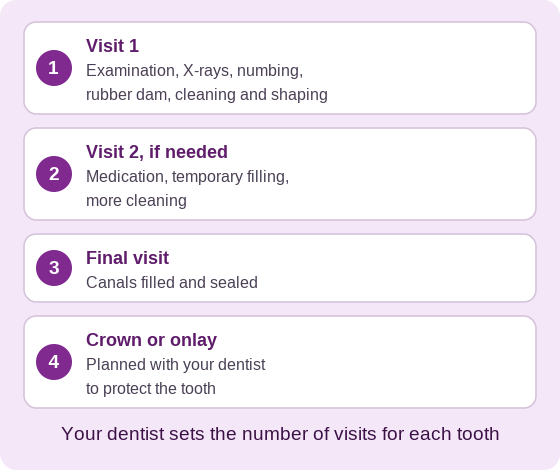
The honest answer is that it depends on the tooth. Some teeth are finished in one visit; others need two or more, especially molars with several canals or teeth with an infection that needs medication between visits. Your dentist tells you the plan at the first visit. The root canal fee covers the first two cleaning visits; if your tooth needs more cleaning and medication visits after that, each additional visit has its own fee, which your dentist explains in advance.
Research has compared doing the canal work in one visit with spreading it over several. A large Cochrane review found no difference in whether the tooth healed on X-rays, and it did not find that one approach is better. Some pain in the first week was reported more often after single-visit treatment, mainly in teeth whose nerve was still alive. So neither schedule is better in general; your dentist chooses the one that suits your tooth.
What makes a tooth need more visits
| Factor | Why it can add a visit | What your dentist does |
|---|---|---|
| Several canals, or curved or narrow canals | Each canal needs to be found, cleaned and shaped, which takes time | Plans enough time, may use the microscope or a 3D scan |
| Infection that needs medication between visits | Medication inside the tooth works over days, then the canals are filled | Places medication, closes the tooth with a temporary filling |
| A tooth that was treated before | Old filling material, and sometimes a post, must come out first | Treats it as retreatment; see the companion article |
| Pain or swelling that makes a long session hard | A shorter first visit can be kinder to you | Splits the work into shorter visits if you ask |
Root canal retreatment or apicoectomy: how dentists decide
Inside a visit, step by step
- Examination and X-rays, so your dentist can see the roots and the bone around them.
- The tooth is numbed with local anesthesia. A rubber dam, a thin rubber sheet placed around the tooth, keeps it clean and dry while your dentist works. It is used for every root canal treatment.
- A small opening is made through the crown of the tooth, the pulp is removed, and each canal is cleaned and shaped. An electronic apex locator and X-rays help measure the length of each root.
- If the canals need more time, medication is placed inside the tooth and the opening is closed with a temporary filling until your next visit.
- When the tooth is ready, the canals are filled and sealed, and your dentist plans the final restoration.
If radiation worries you: at our clinic, X-rays inside the mouth are digital, taken with phosphor plates and sensors that help lower the dose compared with film. Our Planmeca ProMax CBCT has an Ultra Low Dose mode, your dentist chooses the mode that suits each case, and X-rays are taken only when they are needed.
Dental X-ray radiation: how much is it, and how we keep it low
What you feel during and after treatment
The tooth is numbed with local anesthesia before treatment, so most people feel only pressure and movement. Tell your dentist if you feel anything sharp, because more anesthesia can be given. A review of dozens of studies found that pain is common before root canal treatment, much less common a day afterwards, and low by the end of the first week, which fits what many patients say: the toothache that sent them to the dentist is usually worse than the treatment.
| When | What is usual | When to call the clinic |
|---|---|---|
| The first hours | The area stays numb for a few hours, so avoid chewing and very hot drinks until it wears off. | A rash or itching after medicine |
| Day 1 to 3 | The tooth may feel tender when you chew and your jaw may feel tired from keeping your mouth open, usually for two to three days. | Pain that is getting worse instead of easing |
| Day 3 to 7 | Most discomfort eases within 3 to 5 days, according to the American Association of Endodontists. | Swelling inside or outside the mouth |
| Any time before the crown | A thin layer of the temporary filling may wear away; this is normal. | The temporary filling comes out completely, or the bite feels high |
For discomfort, use the pain medicine your dentist advises; the NHS and the American Association of Endodontists both mention common over-the-counter pain relievers taken as directed. Until the permanent restoration is in place, chew mainly on the other side and avoid hard or sticky food on that tooth.
CBCT 3D X-ray: when it is needed
Between visits: looking after the temporary filling
A temporary filling is a short-term seal, not a finished repair. Studies on root canal failure point to saliva leaking into the tooth through a poor seal as one of the ways treatment can fail, which is why the permanent restoration should not be left for long once the canals are filled. Keep brushing as normal, clean gently around the tooth and floss carefully, pulling the floss out sideways rather than snapping it upward.
- If a thin layer wears away, that is common. If the whole filling comes out, contact the clinic.
- Avoid biting hard foods, ice or sticky sweets on that tooth until it is restored.
- Keep your next appointment even if the tooth feels fine, because feeling fine does not mean the work is finished.
Why a crown after root canal treatment?
After treatment the tooth works without its pulp. It stays firmly in the jaw, supported by the bone and gum around it, but it has usually lost a good deal of structure to decay, to the old filling and to the opening made for the treatment, so it can be more likely to break. This is why most treated back teeth should have a crown or onlay to protect them, and some teeth also need a post for extra support. The American Association of Endodontists says back teeth usually need a crown because they take heavy chewing forces, while front teeth do not always need one.
The research points the same way. In a study that followed 203 teeth after root canal treatment, teeth that were not given a crown were lost at a much higher rate than crowned teeth. A systematic review ranked having a crown as the strongest factor in whether a root-treated tooth survives. A Thai study of molars left without a crown found that survival fell steadily over the first few years. These figures come from different groups and cannot be added together, but all point to the same advice.
| Type of tooth | Usual finish | Reason |
|---|---|---|
| Back teeth: molars and premolars | A crown or onlay covering the cusps | They take the heaviest chewing forces |
| Front teeth with a lot of tooth left | A bonded filling may be enough; your dentist decides | The chewing load is lighter, and little structure was lost |
| Front teeth with a large filling or a dark color | A crown, or whitening from inside for a darkened tooth | Protects the tooth and can restore its appearance |
| A tooth with very little structure left | A post and core with a crown, or another plan | The crown needs something to hold onto |
Whether your tooth needs a crown, an onlay or a filling depends on how much tooth is left and where it is in your mouth. Your dentist assesses each tooth and explains the choice. Do not worry that a crown means the root canal was not enough: the root canal treats the inside, the crown protects the outside, and both are needed for a back tooth.
Which crown material suits which tooth: zirconia, ceramic or metal
When a case needs more
Curved or narrow canals, extra canals, or a tooth that was treated before can take longer. Your dentist may use a dental operating microscope, a CBCT 3D scan or bioceramic materials when the tooth needs them, and may ask a colleague with endodontic specialty training to treat or advise. These are explained with a written estimate after the examination.
If your root canal was started at another clinic or in your home country, we can continue it here. Bring any X-rays or records you have.
Microscope root canal treatment

Myths and facts
| Common belief | What dentists and research say |
|---|---|
| Root canal treatment is the painful part of dentistry. | The tooth is numbed first. Pain is typically at its worst before the treatment, and falls a lot by the next day. |
| A root canal must be done in a single visit, or in many. | Neither schedule heals better on average. The plan follows the tooth. |
| Once it feels fine, I can skip the crown. | The comfort comes from the inside being treated. The outside still needs protection, especially on back teeth. |
| A treated tooth will turn black. | Some teeth darken over time. If yours does, a single dark tooth can be whitened from the inside, or covered with a crown or veneer. |
Signs to call the clinic
- Pain or pressure that is getting worse after the first few days instead of easing.
- Swelling inside or outside the mouth, or a fever.
- A rash, hives or itching after a medicine.
- The bite feels too high, or the temporary filling or crown has come out.
- The symptoms you had before treatment come back.
If you cannot swallow or breathe easily, or the swelling is spreading quickly, seek urgent medical care.
Emergency dentist in Chiang Mai
What happens at the clinic
- Tell the coordinator which tooth bothers you and for how long, or send a recent X-ray. A coordinator replies in English or Thai and books a time with a dentist.
- At the first visit your dentist examines the tooth, takes X-rays and explains your options before any treatment starts.
- Root canal treatment is carried out by dentists with postgraduate training in endodontics, and the plan for the number of visits is explained at the first visit.
- If you feel anxious, ask about sedation options for suitable cases before you book.
- After the canal work, your dentist plans the crown or onlay with you, and you receive aftercare advice and a follow-up plan.
The crown or onlay afterward is a separate treatment. Current price ranges for root canal treatment are on the prices page, and your dentist gives you a written estimate after the examination.
See root canal treatment prices
If this sounds like you: what to do
These are example situations, not patient stories, to help you find the next step that fits.
| If you are… | Usually the next step | Worth asking |
|---|---|---|
| A visitor with a toothache and a short trip | Tell the coordinator your travel dates; the dentist plans the visits around them where the tooth allows | How many visits are likely, and can the crown wait until I am home? |
| Someone with a molar that had a large old filling | Plan the crown or onlay together with the root canal | Is an onlay or a full crown better for this tooth? |
| Someone who is afraid of the treatment | Say so when you book; ask about sedation options and shorter visits | Can we agree a signal to pause? |
| Someone whose treated tooth hurt again months later | Examination and X-rays; it may be a case for retreatment | What is the cause, and what are my options? |
Questions people ask about root canal visits and crowns
How many visits does a root canal take?
For the canal work itself, one to two visits is typical according to the American Association of Endodontists and the American Dental Association, and the NHS says two or more. Some teeth are finished in one visit; molars and infected teeth often need more. A crown or onlay needs its own visits afterwards.
How long is each appointment?
How long each visit takes depends on the tooth and how many canals it has. Your dentist tells you when explaining your plan.
Does a root canal hurt?
The tooth is numbed with local anesthesia, so you feel pressure and movement while your dentist works. Afterwards the tooth may feel tender when you chew; this usually settles within two to three days. If you feel anxious, ask about sedation options for suitable cases.
Do I need a crown after root canal treatment?
Often, yes, especially for back teeth. A treated tooth has usually lost structure and can break more easily, and a crown or onlay helps protect it. Front teeth with plenty of tooth left may not need one. Your dentist recommends the restoration that suits how much of the tooth remains.
How soon should the crown be made?
As soon as your dentist advises. The American Association of Endodontists stresses placing the permanent restoration promptly, because a temporary filling is only a short-term seal. There is no single number of days that fits every tooth, so follow the timing your dentist gives you.
Why does my tooth still feel tender when I chew?
The tissue around the root tip is often inflamed from the infection, and it takes some days to settle after the canal is cleaned. Tenderness for a few days is common. If it is getting worse, the bite feels high, or you notice swelling, contact the clinic.
Can a root-treated tooth get infected again?
It can, for example when a canal was missed, the seal leaks or new decay reaches the root. It does not mean the tooth is lost; retreatment or root-end surgery may be possible. The companion article explains how dentists decide.
Root canal retreatment or apicoectomy: how dentists decide
Should I have a root canal or have the tooth removed?
Root canal treatment aims to keep your own tooth; extraction removes it, and the gap is usually filled later with an implant, a bridge or a denture. Studies comparing the two find long-term survival for both options to be high, so the decision rests on the condition of the tooth and your own priorities. Your dentist explains how likely the tooth is to last after treatment, compared with removing and replacing it.
Root canal treatment or an implant: keep the tooth or replace it?
Summary
Most root canals need one to two visits for the canal work, followed by a separate visit for the crown or onlay that protects the tooth.
- The number of visits depends on the tooth, the number of canals and the infection; one visit or several heal about equally well.
- Soreness is usually mild and eases in 3 to 5 days; call the clinic if it gets worse, if there is swelling, or if the temporary filling comes out.
- A temporary filling is a short-term seal, so do not leave the permanent restoration for long.
- Back teeth usually need a crown or onlay; front teeth with plenty of tooth left may not.
- If the tooth hurts again later, retreatment or root-end surgery may still save it.
See root canal treatment prices
References
American Association of Endodontists: What Is a Root Canal?
American Association of Endodontists: Post-Treatment Care
American Association of Endodontists: Root Canal FAQs
NHS (UK): Root canal treatment
American Dental Association (MouthHealthy): Root Canals
Naoum HJ, Chandler NP. Temporization for endodontics. Int Endod J, 2002