

Your dentist has found a badly damaged or infected tooth and says there are two ways forward: root canal treatment to keep it, or taking it out and placing an implant. Friends tell you an implant is the modern choice. Others say you should never give up a natural tooth. Both sound convincing, and the decision feels permanent.
The reassuring part is that both are well-studied treatments with good long-term results. Systematic reviews that compare a restored root canal treated tooth with a single implant find that the long-term survival of the two is similar. So the real question is not which treatment is better in general, but which one fits this particular tooth, your health and your plans.
This guide compares the two side by side: how each works, what the research says, which teeth can usually be saved and which cannot, how long each takes, what can go wrong later, and how to care for the result. It also covers the middle path, retreatment and root-end surgery, and the questions worth asking before you decide.
In short: if a tooth can be restored, with enough sound structure, healthy gum and bone support and no crack running down the root, root canal treatment followed by a crown or onlay keeps your own tooth and usually takes less time. If the tooth cannot be restored predictably, an extraction followed by an implant is a reliable way to replace it, provided there is enough bone and your health allows. Research finds similar long-term survival for both, so the condition of the tooth decides.
Which way does your tooth lean? A quick checklist
Only an examination and X-rays can decide, but these points show which way a tooth usually leans. Bring the list to your consultation.
Points that lean toward keeping the tooth
- Plenty of the tooth is left above the gum after the decay is removed.
- The tooth is firm, and the gum and bone around it are healthy.
- The infection is at the root tip, and there is no crack running down the root.
- You would like to keep your own tooth, or you prefer to avoid surgery.
- You need the tooth working again within a few weeks.
Points that lean toward an extraction and implant
- A crack runs down the root, or the root has split.
- Decay reaches below the bone level, so there is too little tooth left to hold a crown.
- The gum and bone around the tooth have been lost and the tooth is very loose.
- The tooth has already been treated more than once and the outlook for another attempt is poor.
- There is enough bone where the tooth sits, and your general health allows minor surgery.
Points to talk through with your dentist first
- You smoke, or your diabetes is not well controlled.
- You take medicines that affect bone or bleeding, or you have had radiotherapy to the head and neck.
- You grind or clench your teeth.
- The tooth is a front tooth and appearance matters a lot to you.
How each option works
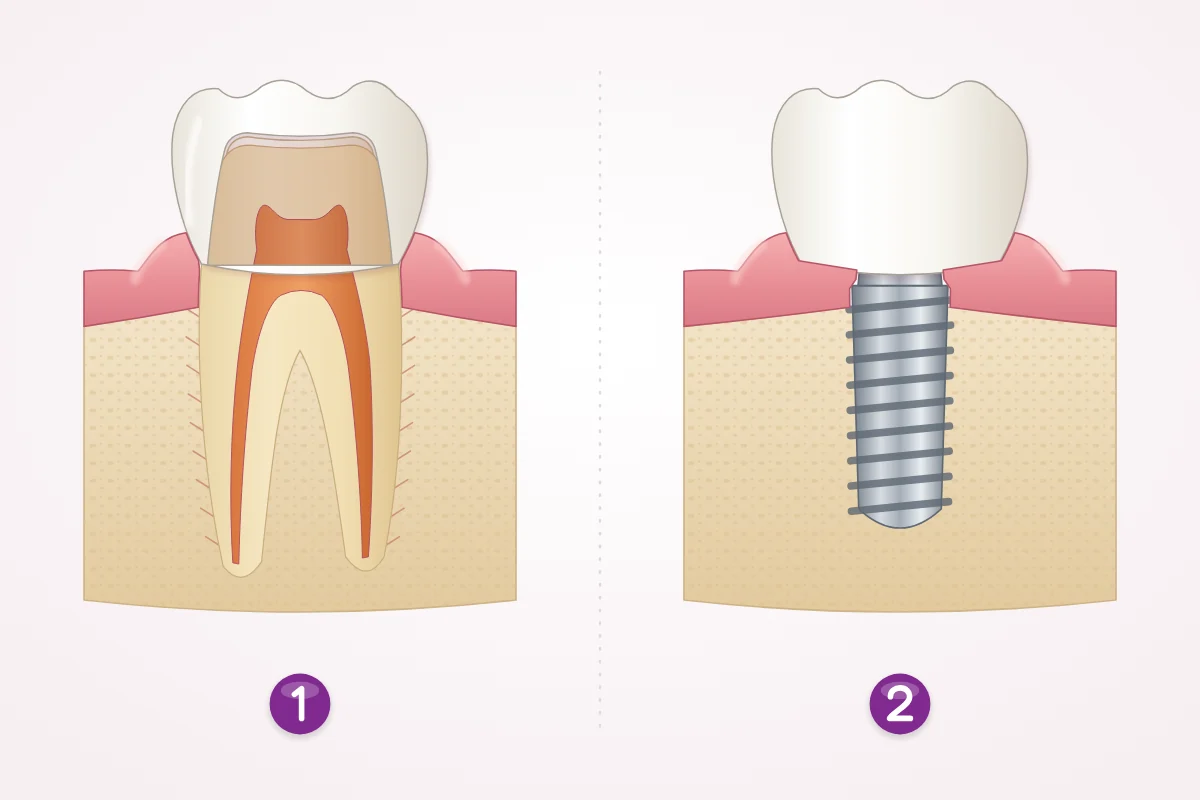
Root canal treatment cleans the inside of the tooth. The dentist removes the inflamed or infected pulp, cleans and shapes the canals inside each root, and seals them. The tooth stays in its socket, held by the ligament and bone around the root, so it still feels pressure when you bite. Because a root canal treated back tooth can become more brittle, it usually needs a crown or onlay afterwards.
An implant replaces the whole tooth. After the tooth is taken out, a small titanium or ceramic post is placed in the jawbone. Over the following months the bone bonds directly to its surface. A connector called an abutment is then attached, and a crown is fitted on top. There is no ligament around an implant, so it is anchored firmly in the bone and cannot get decay, but the gum and bone around it need careful cleaning.
What the research says
A large systematic review in the Journal of Prosthetic Dentistry compared root canal treatment with restoration, single implant crowns, bridges and extraction without replacement. It found that the long-term survival of root canal treated teeth and single implants was similar, and better than for bridges. The authors also warned that the studies defined success very differently, so comparing headline success rates between the two is not meaningful.
Another review, prepared for an international implant consensus conference, pooled 55 implant studies and 13 studies of restored root canal treated teeth. The survival estimates overlapped at every follow-up period, and the authors concluded that the choice should be based on other factors, because both are excellent treatments. A matched comparison of 196 implants and 196 root canal treated teeth in the Journal of Endodontics found the same failure rate in both groups. The implant group took longer to reach function and more often needed further treatment after placement.
Research on root canal treated teeth also shows what helps them last. A systematic review from University College London found four factors linked with better tooth survival: a crown after treatment, teeth on both sides of the tooth, the tooth not being used as a support for a bridge or partial denture, and front teeth doing better than molars. In a study from the University of Iowa, root canal treated teeth that were not crowned were lost at about six times the rate of crowned teeth.
What this means for you: when a tooth is a good candidate for root canal treatment, keeping it with a proper crown or onlay gives results comparable with an implant. When a tooth is a poor candidate, an implant is not a step down. It is the more predictable option.
Root canal or implant: a side-by-side comparison
| Point | Root canal treatment | Extraction and implant |
|---|---|---|
| What stays in your mouth | Your own tooth and root, with its ligament. | A new root in the bone with a crown on top. |
| Surgery | Not needed. Treatment is done through the top of the tooth. | An extraction, then minor surgery to place the implant. Some need a bone graft. |
| Visits and time | Often one or two visits for the root canal, then a crown or onlay. Done within weeks. | Two stages a few months apart: placing the implant, then the crown. |
| Healing time | Little downtime. Some soreness for a few days. | Usually 2 to 6 months for the bone to bond, longer with a graft. |
| Time without a tooth | None. The tooth is in use throughout, protected by a temporary filling. | Possible while healing. A temporary tooth can be made in some cases. |
| Feeling when you bite | Natural. The ligament still senses pressure. | Firm and comfortable, but without a ligament the feel is slightly different. |
| Problems that can happen later | A crack or fracture, new decay under the crown, or infection returning. | Inflammation of the gum and bone around the implant, or a loose screw or chipped crown. |
| If it needs more treatment later | Retreatment or root-end surgery, and an implant is still possible afterwards. | Treatment of the tissues around it, or removal, bone repair and a new implant. |
| Health factors | Suitable for most people, including many who cannot have surgery. | Smoking and poorly controlled diabetes are linked with more problems around implants. |
| Cost | Root canal plus a crown or onlay. | Extraction, implant, abutment and crown, plus a graft if needed. |
Compare the total plan, not one line item. A root canal without a crown on a back tooth is not the full cost of keeping it, and an implant price without the extraction, any graft and the crown is not the full cost of replacing it. Your dentist gives you an estimate for each option before you decide.
See root canal treatment prices
Which teeth can usually be saved?
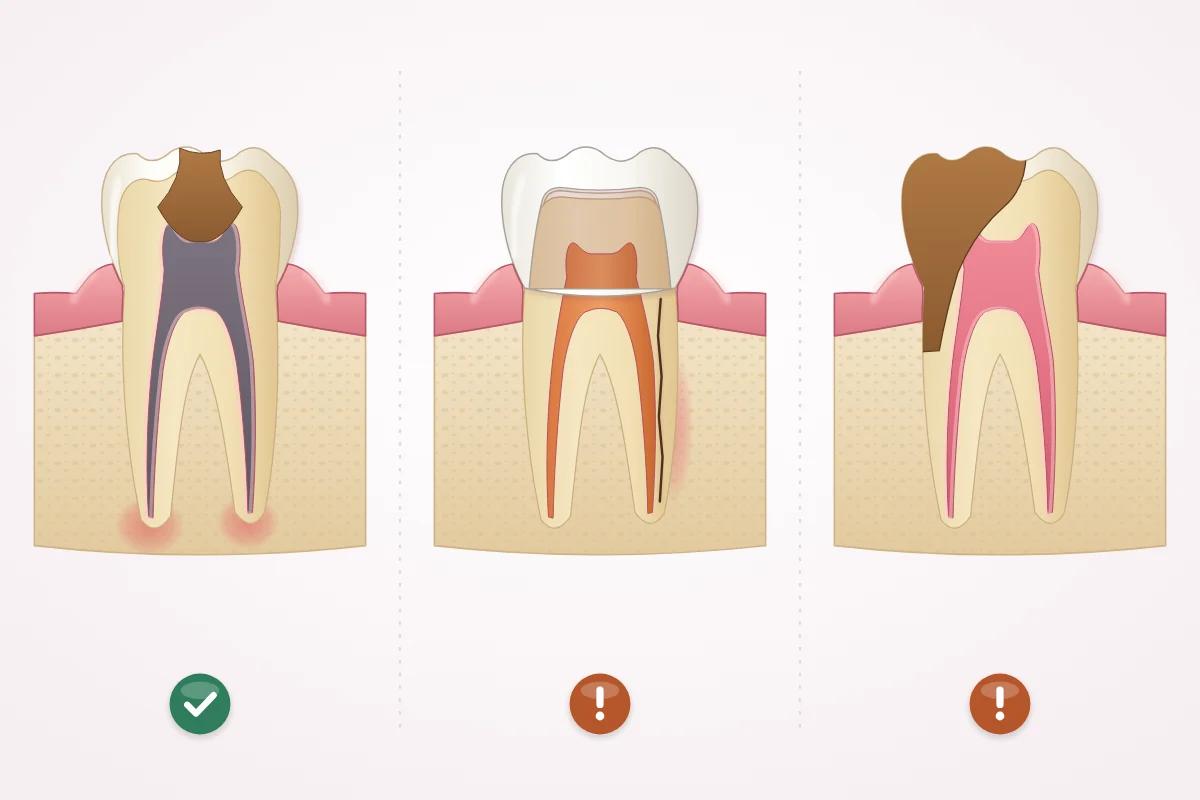
Root canal treatment removes the infection, but the tooth still has to be rebuilt and to stay strong for years. So dentists look at two questions together: can the canals be treated, and can the tooth be restored? The American Association of Endodontists notes that most teeth can be treated, but severe damage, extensive decay, fractures below the gumline or too little bone support can make a tooth impossible to save.
| Tooth condition | What it usually means |
|---|---|
| Deep decay or infection, with plenty of tooth left | Root canal treatment and a crown or onlay usually work well. |
| A crack that stays in the crown of the tooth | Often saved with a crown, sometimes with a root canal first. |
| A crack running down the root, or a split tooth | Usually cannot be saved. An implant or bridge is planned instead. |
| Decay below the bone level | Sometimes saved with extra procedures to expose more tooth; often replacement is more predictable. |
| Severe gum disease with a very loose tooth | Depends on the bone left. Gum treatment comes first, whatever is decided. |
| A previous root canal that has failed | Retreatment or root-end surgery is often possible before thinking of extraction. |
Front and back teeth differ, too. Front teeth have one root and take less biting force, so a root canal treated front tooth often does well with a smaller restoration. Molars carry the heaviest load, which is why a crown or onlay matters so much for them.
Cracked tooth or broken molar: symptoms and treatment
Before extraction: retreatment and root-end surgery
A tooth that already had a root canal and is infected again is not automatically lost. Common reasons are a canal that was missed, a filling or crown that leaks, or new decay. Retreatment removes the old root filling, cleans the canals again and seals them. When the infection stays around the root tip, or the tooth has a crown and post that make retreatment through the tooth difficult, root-end surgery (apicoectomy) treats the tip of the root from the side, through the gum.
A systematic review in the Journal of Endodontics found high survival rates for both endodontic microsurgery and single implants, with implants somewhat higher in the medium-term follow-up. The two were never compared directly in the same patients. In practice, a tooth with good structure and bone support is often worth this step; a tooth that is cracked or has little structure left usually is not.
Root canal retreatment or apicoectomy: how dentists decide
Root-end surgery (apicoectomy)
How long each takes, visit by visit
Keeping the tooth: root canal and crown
- Examination and X-rays to check the canals, the bone around the root tip and any cracks. A 3D scan of one or two teeth is added when the canals are complex or a crack is suspected.
- Root canal treatment under local anaesthetic, with a rubber dam around the tooth. Some teeth are finished in one visit, others need two or more, with medicine placed inside between visits.
- The canals are sealed and the tooth is closed with a temporary or permanent filling.
- A crown or onlay to protect the tooth, especially a back tooth. Chew mainly on the other side until it is fitted.
- A follow-up X-ray at later check-ups to see the bone around the root tip healing.
Replacing the tooth: extraction and implant
- Examination and a 3D (CBCT) scan to measure the bone and plan the implant position, with a written cost estimate.
- Extraction. In suitable cases the implant is placed at the same visit (an immediate implant after extraction); otherwise the socket heals first, sometimes with a bone graft.
- Implant placement under local anaesthetic. Most people can travel 2 to 3 days later, as the dentist confirms.
- Healing while the bone bonds to the implant, usually 2 to 6 months, and longer after a graft. A temporary tooth can be made in some cases.
- A scan or impression, then the abutment and crown are fitted.
If you live abroad or far from Chiang Mai, these timelines matter. Root canal treatment and a crown usually fit into one stay. An implant normally needs two trips a few months apart: one for the examination and implant placement, and one for the crown.
Common myths and the facts
| Myth | Fact |
|---|---|
| An implant is always the better, more modern choice. | Reviews find similar long-term survival. Which is better depends on the tooth. |
| A root canal treated tooth is dead and will soon break. | The tooth stays in the bone with its ligament, and a crown or onlay protects it from fracture. |
| Implants cannot get problems because they cannot decay. | Implants do not decay, but the gum and bone around them can become inflamed. They need daily cleaning and regular checks. |
| Root canal treatment is very painful. | It is done under local anaesthetic. The pain people remember is usually the toothache before treatment. |
| If I keep the tooth now, I cannot have an implant later. | If the tooth fails years later, an implant is usually still possible. Keeping a tooth while it is healthy also helps keep the bone. |
| After a root canal, the crown can wait as long as I like. | A temporary filling protects the tooth for a short time only. A back tooth should be crowned soon to prevent a fracture. |
Signs to have the tooth or implant checked
Most treated teeth and implants settle quietly. These signs are a reason to book a check, so a small problem is treated while it is still small.
- Pain when biting on a root canal treated tooth that continues beyond the first week.
- A small bump or pimple on the gum near the tooth or implant.
- Bleeding, swelling or pus from the gum around an implant.
- A temporary filling or crown that comes loose, or a tooth or crown that feels rough or chipped.
- An implant crown that feels loose or moves.
What happens when you come in to decide
At Kitcha Dental Clinic, root canal treatment is done by dentists with further training in endodontics, and implant treatment is planned by dentists with further training in implant dentistry, prosthodontics and oral surgery. Both teams work in the same clinic, so you hear about both options from the people who provide them.
- The dentist examines the tooth, the gum and the bite, and takes digital X-rays.
- A 3D scan is added when it helps the decision, for example to look for a crack, an extra canal or the bone available for an implant. X-rays are taken only when they are needed, using low-dose settings.
- The dentist explains what was found and the options, which may be root canal treatment, retreatment, root-end surgery, or extraction with a replacement such as an implant, bridge or denture.
- You receive a cost estimate for the options you are considering, and time to decide.
If you are abroad, you can send a recent X-ray or photo by email, WhatsApp or LINE before you travel. A dentist can give a first opinion, and the final plan is confirmed after an examination.
Root canal treatment in Chiang Mai
Microscope root canal treatment
Replacing a single missing tooth
If this sounds like you: what to do
These are example situations, not patient stories, to help you find the next step that fits.
- A back tooth with deep decay and a toothache, but plenty of tooth left: ask about root canal treatment followed by a crown or onlay.
- A crowned tooth that had a root canal years ago and now has a small bump on the gum: ask whether retreatment or root-end surgery is possible before extraction.
- A sharp pain when biting, and the X-ray suggests a crack down the root: ask about extraction and the replacement options, including an implant or a bridge.
- You smoke and your diabetes is not well controlled, and the tooth can be restored: keeping it may be the simpler path. Ask how your health affects each option.
- You are visiting Chiang Mai for two weeks: root canal treatment and a crown can usually be completed in one stay; an implant needs a second trip.
- The tooth is loose because of gum disease: ask for a gum assessment first. The health of the gum decides what is possible for both options.
Frequently asked questions about root canals and implants
Which is better, a root canal or an implant?
Neither is better for everyone. Reviews find similar long-term survival, so the decision depends on whether the tooth can be restored predictably, the bone and gum around it, your health and your timeline.
Is it better to save the tooth or pull it?
When a tooth can be restored, keeping it is usually quicker, avoids surgery and keeps the bone and ligament around it. When it cannot, extraction with a good replacement is the more reliable path. Leaving a gap without any replacement can let neighbouring teeth tilt and the bone shrink over time.
Can I get an implant later if the root canal fails?
Usually, yes. If a root canal treated tooth fails years later, retreatment or root-end surgery may still be possible, and an implant is an option after extraction. Your dentist checks the bone at that time.
Does a root canal treated tooth always need a crown?
Most back teeth do, because they carry heavy biting forces and can become brittle. A crown or onlay protects them from fracture. Some front teeth with plenty of structure left can be restored with a filling. Your dentist recommends the restoration that suits the tooth.
Which hurts more, a root canal or an implant?
Both are done under local anaesthetic, so most people feel pressure rather than pain during treatment. After a root canal, the tooth may be tender for a few days. After implant surgery, soreness and swelling usually settle within a few days to a week.
How long does each one last?
It depends mainly on the condition of the tooth or bone at the start, a proper crown, daily cleaning, regular checks, smoking and grinding, rather than a fixed number. Treated teeth most often run into trouble through fractures or new decay; implants through inflammation of the tissues around them.
Can an implant be placed on the same day as the extraction?
In suitable cases, yes. This is called an immediate implant after extraction. It depends on infection, the bone around the socket and the position of the tooth, which the dentist checks on a 3D scan. A temporary tooth can be fitted in some cases.
I am older. Is keeping the tooth or an implant safer?
Age alone does not rule out either option. Your general health, medicines and how easily you can clean matter more. Root canal treatment avoids surgery, which can make it simpler for some people; many older adults also have implants successfully.
Summary
Root canal treatment and implants both have good long-term results. The condition of the tooth, not the treatment, decides which one makes sense.
- Restorable tooth, healthy support, no root crack: root canal treatment plus a crown or onlay keeps your own tooth.
- Cracked root, decay below the bone, or little tooth left: extraction and an implant is often more predictable.
- A failed root canal can often be retreated or treated with root-end surgery first.
- Keeping the tooth is usually faster; an implant needs a few months and often two trips.
- Compare full plans and costs, and ask your dentist what they would expect for this particular tooth.
References
American Association of Endodontists: Root canal vs. dental implant, which is right for you?
NHS (UK): Root canal treatment