
You would like whiter teeth, maybe because coffee and tea have taken their toll, or a wedding or a new job is coming up. A search for teeth whitening brings up strips, charcoal powders, clinic offers and gels in trays, and it is hard to tell what is safe, what works, and what will make your teeth hurt.
Home whitening with custom-made clear trays and a professional gel such as Opalescence PF is one of the options a dentist can offer. It works gradually, over days to weeks, at your own pace, and your dentist checks your teeth first, chooses the strength and tells you how long to wear the trays. This article explains how it works, how to use it step by step, why teeth can become sensitive and what helps, how it compares with in-office whitening, and how to make the result last.
One honest note first: how white your teeth become depends on your natural tooth color and the reason they look dull, and nobody can promise a particular shade. What a dentist can do is match the method to your teeth and tell you what to expect.
In short: home whitening is a gradual, dentist-guided option for natural teeth. Expect it to take one to four weeks, expect some people to feel temporary sensitivity, and expect the color to fade slowly with coffee, tea, red wine and smoking. It does not change crowns, veneers or fillings.
Is home whitening right for you? A quick check
Often suitable, after a dentist checks
- Your natural teeth have become yellow or darker over time.
- You would like a lighter shade before a special event, or before new crowns or veneers are made so they can be matched.
- You prefer a gradual approach you can do at home.
Treat or discuss first
- Tooth decay, gum disease or gum bleeding. Your dentist treats these first or suggests another option.
- Teeth that are already very sensitive, gum recession, or worn spots near the gum line.
- Crowns, veneers or large fillings on front teeth, because they will not lighten and may look different afterwards.
- Pregnancy or breastfeeding: tell your dentist that you are pregnant, and your dentist plans it for you.
- A single tooth that has darkened after a root canal: this is treated differently, from the inside.
Dead or dark tooth: why it changes color, is it dangerous, and how it is treated
What Opalescence PF is, and how whitening works
Opalescence PF is a water-based gel that contains carbamide peroxide and comes in several strengths. The high water content helps keep the teeth moist during whitening. According to the reference guide from the manufacturer, the PF gels carry potassium nitrate and fluoride in the formula. Your dentist chooses the strength that suits your teeth.
Whitening works by chemistry rather than by paint. Carbamide peroxide breaks down into hydrogen peroxide, roughly a third of its strength according to the American Dental Association. The peroxide passes through the enamel into the dentin and reacts with the color molecules that make teeth look yellow or dull, breaking them into smaller, paler pieces. This is why whitening changes the color inside the tooth, while polishing and normal toothpaste only remove surface stain.
Whitening works on natural teeth only. It does not change the color of crowns, veneers or fillings.
Why teeth look yellow or dull
| Cause | Examples | Usually helped by |
|---|---|---|
| Stain on the surface | Coffee, tea, red wine, cola, dark foods, tobacco, poor cleaning | A professional cleaning first; whitening if the color is still dull |
| Color inside the tooth that changes with age | Enamel becomes thinner over the years, so the yellower dentin shows through | Whitening, and sometimes veneers if the shade is deep |
| Medicines, fluorosis and injury | Tetracycline-type antibiotics during tooth formation, fluorosis, a knock to a tooth | Responds more slowly; may need a longer course, or another treatment |
| A tooth that has lost its nerve | A single dark tooth, often after a root canal or an injury | Whitening from the inside, usually over 1 to 3 visits |
Yellow teeth: causes, ways to brighten them and which one suits you
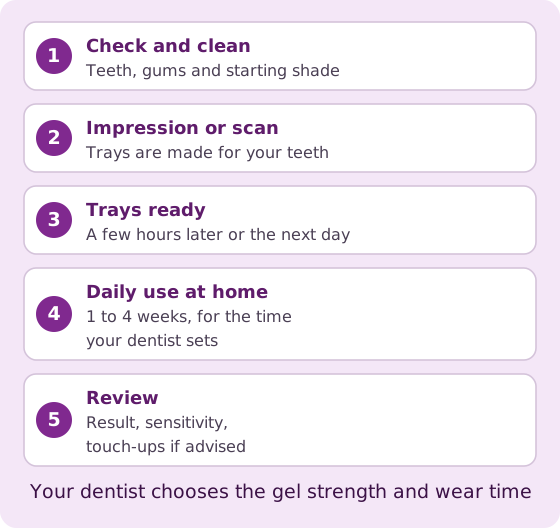
How home whitening starts at the clinic
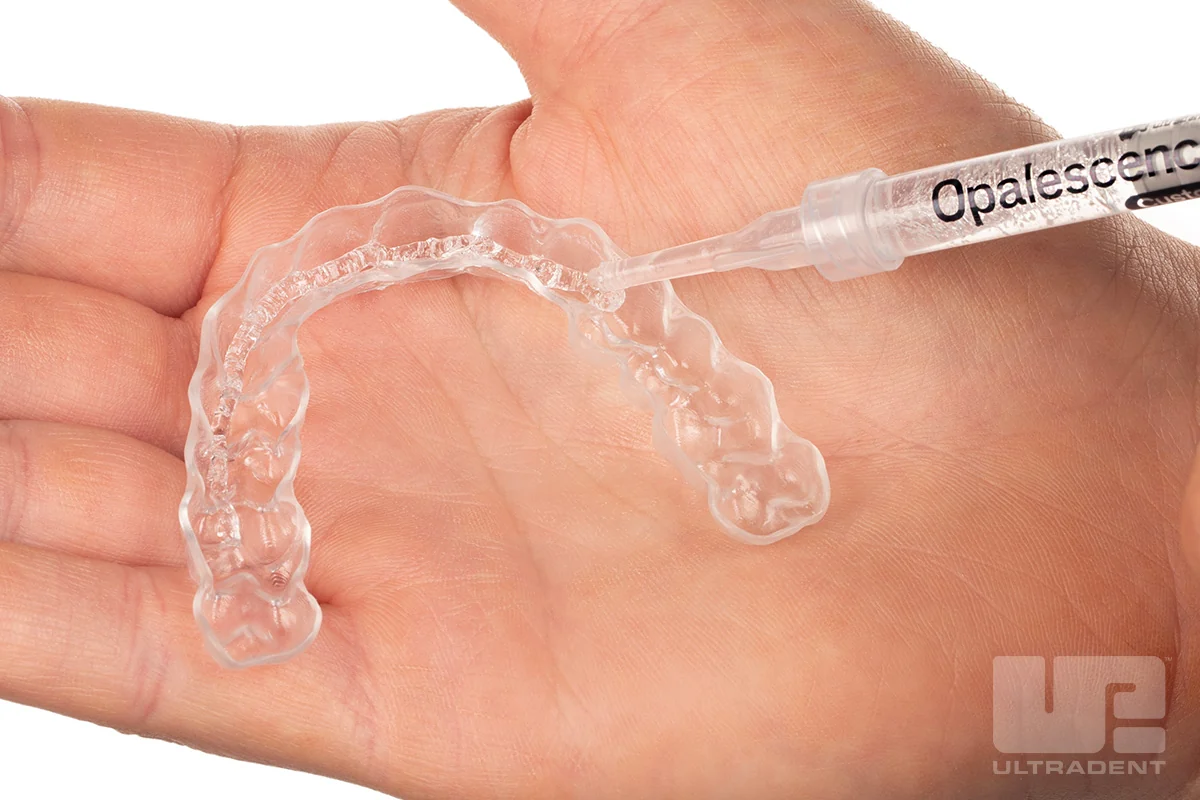
- Your dentist checks your teeth and gums, cleans the teeth, and records your starting shade.
- An impression or digital scan of your teeth is taken to make clear trays.
- The trays are usually ready a couple of hours later or the next day.
- You receive the gel and clear instructions, and use it at home for the time your dentist advises, usually over 1 to 4 weeks.
- If you wish, you return for a short review of the result and any sensitivity.
The trays are made for your teeth, which matters. A tray that fits well keeps the gel on the teeth and off the gums, and gel on the gums is the main reason for irritation.
How to use the gel, step by step
- Brush and clean between your teeth before each use.
- Put a small drop of gel into the tray for each tooth to be whitened, on the side that faces the front of the teeth.
- Seat the tray gently. Pressing hard pushes the gel out onto the gums.
- Wear the tray for the time your dentist advises. Do not eat, drink or smoke while wearing it.
- Remove the tray, rinse your mouth and brush off any gel left on the teeth. Rinse and clean the tray. Try not to swallow the gel.
How long to wear the trays
Manufacturers publish suggested wear times that get shorter as a gel gets stronger. These are product details, not a plan: your dentist tells you the strength, the time per day and the number of days that suit your teeth. More time in the tray is not better, and studies show that shortening the time lowers sensitivity but also lowers the whitening effect.
Does whitening make teeth sensitive?
Some people have sensitive teeth for a short time during or after whitening, and the gums can feel irritated if gel touches them. This is the most common side effect. The American Dental Association notes that mild to moderate sensitivity can affect up to two in three people early in a course, typically beginning in the first couple of days and fading within a few days after stopping. The peroxide reaches the inner part of the tooth within minutes, which is why teeth can twinge to cold or air.
| If you notice this | What eases it | What the evidence says |
|---|---|---|
| Teeth twinge to cold or air | Skip a day or shorten the time, and tell your dentist; a toothpaste for sensitive teeth can help | A shorter time lowers sensitivity and also lowers the whitening effect; a Thai dentist advises a pause of a few days |
| You already have sensitive teeth | Tell your dentist before you start, so the plan can take it into account | Reviews found 10 percent carbamide peroxide to give similar color change with less sensitivity than stronger gels |
| Gum feels sore or looks white | Wipe off the gel on the gums, check the tray fit, and tell your dentist | Gum irritation usually comes from a tray that does not fit or from too much gel |
| Sensitivity that is strong or does not settle | Stop and contact the clinic; a desensitizing agent can be applied at the clinic | Gel that contains potassium nitrate did not clearly lower sensitivity in a combined analysis, so the guidance from your dentist on time and strength matters most |
Tell your dentist if this happens, especially if you already have sensitive teeth. Your dentist may change how long you wear the trays, suggest a toothpaste for sensitive teeth, or prescribe a relief gel.
Sensitive teeth: causes, whether it goes away, and what helps
Downsides and limits of whitening
- Results vary from person to person, depending on your natural tooth color and the cause of the staining.
- Crowns, veneers and fillings do not change color, so they may need replacing to match.
- Coffee, tea, red wine and smoking can bring staining back over time.
- Whitening can make teeth sensitive for a short time.
- The result is not permanent. Studies that followed people for 18 months to two years found the color fades gradually, although teeth were still lighter than before treatment.
Does whitening thin or damage the enamel?
The research we could read did not measure enamel thickness directly. A review of laboratory and in-mouth studies found that the surface can lose some mineral, become slightly rougher or softer for a short time, and then recover within about one to two weeks as saliva restores it. One small follow-up of 18 months did not show changes under the electron microscope. A review in a dental journal notes a risk of a rougher surface, and the ADA mentions studies where the surface became rougher and bonding strength fell. So the honest summary is: no lasting thinning has been shown in the sources we read, short-lived surface changes have, and the long-term effect of repeated or very strong whitening is not fully known.
When whitening should wait
- If you are pregnant or breastfeeding, tell your dentist before you start.
- If you have tooth decay, gum disease or very sensitive teeth. Your dentist treats these first or suggests another option.
- If you have reacted to a whitening product before, tell your dentist before you start.
- For young children with baby or mixed teeth, whitening for looks is not generally supported, and for teenagers your dentist decides case by case.
Home whitening or in-office whitening?
In-office whitening with Philips Zoom is done by the dentist in one visit of about one and a half hours. Home whitening takes 1 to 4 weeks at your own pace, and the trays can be used again for touch-ups when your dentist advises. Some people use both: in-office whitening first, then home whitening to keep the result.
| Aspect | In-office whitening | Home whitening with trays |
|---|---|---|
| Time | One visit of about one and a half hours with Philips Zoom | 1 to 4 weeks at your own pace |
| Who does it | The dentist, with the gums protected | You, at home, with trays made for your teeth and a gel your dentist chooses |
| Color result | Combined analyses found similar color change to home whitening | Similar color change when used as directed; it needs steady daily use |
| Sensitivity | Can occur; tell your dentist and relief gel can be prescribed | Can occur; the same combined analyses found it no more frequent but milder with home use, in studies of low quality |
| Keeping the result | Home trays can be used afterwards for touch-ups | The same trays can be reused for touch-ups when your dentist advises |
A two-year trial found that combining an in-office session with trays used at home between sessions gave a more lasting result than in-office whitening alone. Neither route is better for everyone: the right one depends on your schedule, how sensitive your teeth are and how much steady effort you want to put in.
Making the color last
No method makes teeth stay one shade forever. Studies that followed people found the color fades slowly, with teeth still lighter after 18 months than before treatment; the NHS says a result can last up to about three years if you follow the advice, which is at the long end of what other sources suggest. Habits make a difference more than a number of months.
- Coffee, tea, red wine, cola and smoking are the usual causes of new staining. Cut back, rinse with water after them, or use a straw.
- Evidence on strictly avoiding dark food and drink in the first days is mixed: a combined analysis found no difference in the result, while one trial found coffee soon after in-office whitening reduced brightness. Many dentists suggest being careful with dark drinks and tobacco early on.
- Brush and clean between your teeth as usual, and have a professional cleaning about every 6 months to remove surface stain.
- Home whitening trays can be used for touch-ups when your dentist advises.
Does teeth cleaning hurt? What it feels like and how often to go
Storing the gel
Keep the gel in a cool place, ideally in the refrigerator, as instructed on the box. Do not freeze it, and close the cap tightly after each use.
What about strips, whitening toothpaste and charcoal?
| Product type | What research and dental bodies say | Practical note |
|---|---|---|
| Whitening toothpaste | Mostly removes surface stain through mild abrasives; it does not change the color inside the tooth | Fine as an everyday toothpaste; do not expect the effect of a gel |
| Store-bought strips and kits | Short-term results are reported, but the quality of evidence is low and there is no dentist check beforehand; the NHS does not advise buying kits for yourself | Ask a dentist first, especially if you have crowns, fillings or sensitive teeth |
| Charcoal powder, coconut oil pulling, lemon and baking soda | No evidence that they whiten in a measurable way, and charcoal and gritty mixtures can wear the tooth surface | Not recommended |
What happens at the clinic
- Book a visit and tell the coordinator whether you are interested in in-office or home whitening. A coordinator replies in English or Thai and books a time.
- Your dentist checks your teeth and gums first, then explains the options and what result to expect.
- If cleaning, a filling or gum treatment is needed first, this is done before whitening begins.
- For home whitening you receive trays made for your teeth, the gel and written instructions. For in-office whitening, the gums are protected and the gel is applied in cycles while you are monitored.
- Tell your dentist about any sensitivity; relief gel can be prescribed, and a desensitizing agent can be applied at the clinic.
Prices for Philips Zoom in-office whitening and home whitening with trays are listed on our prices page. Your dentist confirms the fee after checking your teeth.
Myths and facts
| Common belief | What the evidence says |
|---|---|
| Whitening is the same as cleaning. | Cleaning removes surface stain and tartar. Whitening changes the color inside the tooth. Cleaning first often helps whitening look more even. |
| Whitening gives paper-white teeth. | Natural teeth always have some yellow in them, and how far they lighten varies. A dentist aims for a natural look, not a fixed shade. |
| The result is permanent. | It fades slowly, faster with coffee, tea, red wine and tobacco. Touch-ups with the same trays are possible. |
| If my teeth become sensitive, I must stop for good. | The sensitivity is usually temporary. Pausing or adjusting the plan together with your dentist often allows you to continue. |
| A stronger gel always works better. | Reviews found 10 percent carbamide peroxide gave similar color change with less sensitivity than stronger gels. |
If this sounds like you: what to do
These are example situations, not patient stories, to help you find the next step that fits.
| If you are… | Usually the next step | Worth asking |
|---|---|---|
| Someone with a wedding in two months and coffee-stained teeth | Cleaning first, then home or in-office whitening; plan the timing with the dentist | Which method suits my schedule, and when should I finish? |
| Someone whose teeth are sensitive to cold already | Tell the dentist first, so the plan can take it into account | Should the sensitivity be treated before whitening? |
| Someone with crowns and veneers on the front teeth | A dentist plans around the shade of the existing work; whitening may be followed by replacing a restoration to match | Will the crowns match afterwards? |
| Someone who is pregnant | Tell the dentist that you are pregnant, and your dentist plans it for you | Is now a good time, or should whitening wait? |
Questions people ask about teeth whitening
Is teeth whitening safe?
When a dentist checks your teeth, chooses the strength and tells you how to use it, whitening is a widely used treatment, and the side effects most often reported are temporary sensitivity and gum irritation. The NHS says kits supplied or applied by a dentist are the safest, and advises against buying kits for yourself. Whitening is not suited to everyone, which is why the check comes first.
How long does a home whitening course take?
Usually 1 to 4 weeks of daily use, for the time your dentist sets. Some teeth, such as those stained by certain medicines, may need longer. Do not extend the time on your own.
How long does the result last?
There is no single number. Studies that followed people for 18 months to two years found the color fades gradually while teeth stay lighter than before. Coffee, tea, red wine and smoking speed the fading, and touch-ups with your trays can refresh it.
Does whitening hurt the enamel?
The sources we read show no lasting thinning of enamel, but they do show short-lived roughness or softening of the surface that recovers within a week or two. Long-term effects of repeated whitening or very strong gels are not fully known, which is another reason to follow the plan from your dentist.
Will my crowns, veneers and fillings turn white too?
No. Whitening works on natural teeth only. If you plan new crowns or veneers, whitening is usually done first so the new ones can be matched to your lighter shade.
Can I whiten my teeth while pregnant?
Tell your dentist that you are pregnant, and your dentist plans it for you.
Do charcoal powder and whitening toothpaste work?
Whitening toothpaste mainly removes surface stain and does not change the color inside the tooth. For charcoal powder there is no good evidence of whitening, and it can wear the tooth surface, so it is not recommended.
Should I have a cleaning before whitening?
Usually yes. Cleaning removes surface stain and tartar, shows how much of the dullness is really inside the tooth, and helps the result look even. Your dentist advises on this at the first check.
How many shades lighter will my teeth be?
Nobody can promise a number of shades. It varies with your natural color and the cause of the staining. Your dentist records your shade before and after and explains what to expect at the check.
Can I whiten one dark tooth?
A single tooth that has darkened after root canal treatment can be whitened from the inside, usually over 1 to 3 visits. Your dentist checks the tooth first and may suggest a crown or veneer instead if the tooth also needs protecting.
Summary
Home whitening with custom trays and a professional gel is a gradual, dentist-guided way to lighten natural teeth. It cannot promise a particular shade, and it does not last forever.
- Have your teeth and gums checked first; decay and gum problems are treated before whitening.
- Follow the time and the number of days your dentist gives you. A longer time in the tray is not better.
- Temporary sensitivity is common; pause and tell your dentist, so the plan can be adjusted.
- Crowns, veneers and fillings do not change color; whitening works on natural teeth.
- Keep the result with fewer dark drinks and tobacco, regular cleanings and touch-ups when advised.
References
American Dental Association: Whitening
American Dental Association (MouthHealthy): Teeth Whitening
Ultradent Products: Opalescence Tooth Whitening Reference Guide