
Your dentist points at the X-ray and says you have impacted wisdom teeth. Maybe you have had no pain at all. Maybe one side swells up every few months and then settles. Either way the questions come quickly: does every wisdom tooth have to come out, will it hurt, and how long will I need to recover?
The short answer is no, not every wisdom tooth needs to come out. Wisdom teeth that have room and come through straight can usually stay, as long as you can keep them clean. Impacted or partly erupted ones are checked with X-rays and removed when they cause, or are likely to cause, problems such as repeated gum infection, decay or damage to the tooth in front. For impacted teeth that cause no problems at all, the research is honestly uncertain, which is why the decision is made with you.
This article helps you understand your own wisdom teeth. You will find a self-check, the types of impaction and what they mean, a table of reasons to keep or remove, what the research says, how removal works, a day-by-day recovery guide, common myths, the signs to watch for, and answers to frequent questions.
In short: wisdom teeth that come through straight and can be cleaned can usually stay. Removal is usually advised for repeated gum infection, decay that cannot be cleaned, damage to the tooth in front, or as part of orthodontic treatment. For impacted teeth with no problems, the evidence is uncertain, so regular checks and a shared decision make sense. Removal is done under local anesthesia, and most people can travel 2 to 3 days later.
Your wisdom teeth: a quick self-check
Likely fine to keep and check regularly
- The tooth has come through fully and straight, and it meets the tooth above or below it.
- You can reach it with a toothbrush and floss without the gum hurting or bleeding.
- An X-ray shows no decay, no bone loss and no pressure on the tooth in front.
Book a check and an X-ray
- The tooth has only partly come through, with gum still covering part of it.
- Food keeps getting stuck behind or around the last tooth.
- You have a bad taste or bad breath that seems to come from the back. MedlinePlus lists an impacted tooth among dental causes of breath odor.
- You have never had an X-ray of your wisdom teeth, and you are in your late teens or twenties.
- Your orthodontist has asked about your wisdom teeth.
See a dentist soon
- Pain and swelling at the back of the mouth that keeps coming back.
- It is hard to open your mouth fully, or it hurts to swallow.
- Swelling of the cheek or under the jaw, especially with a fever: contact a dentist promptly.
What an impacted wisdom tooth is, and why it happens
Wisdom teeth are the third molars, the last teeth at the back of each side. MedlinePlus notes that they usually come in between about ages 17 and 21. An impacted tooth is one that does not break through the gum, or comes through only partly, usually because there is not enough room or it is growing at an angle and meets the tooth in front.
A fully impacted tooth, sitting completely in bone, often causes no symptoms at all. A partly erupted tooth is the one that more often causes trouble: the flap of gum over it traps food and bacteria and can become infected, which dentists call pericoronitis. A tooth tilted forward can trap food against the back of the molar in front, where decay can start in a spot that is hard to clean.
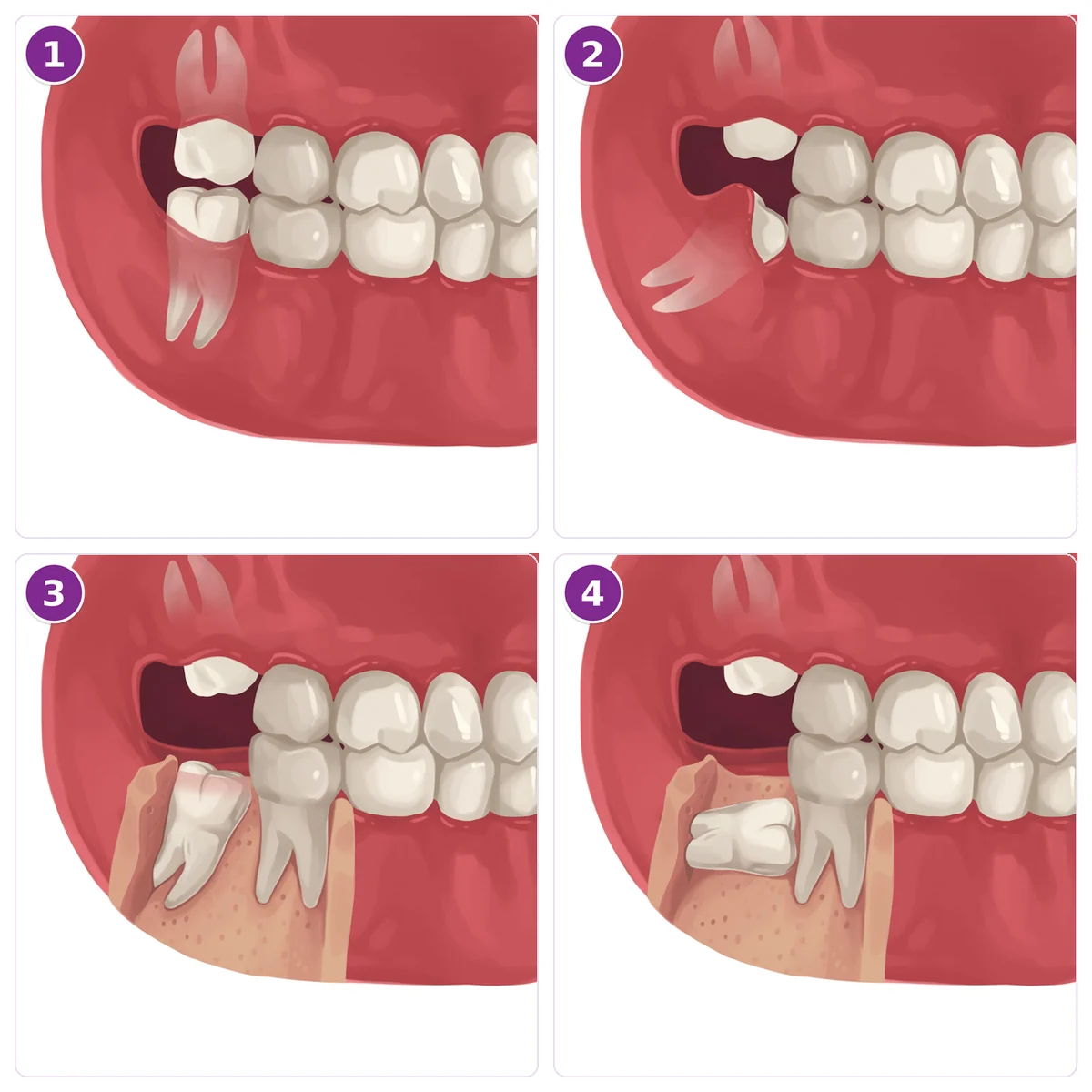
| Position in the jaw | What it means | Usual approach |
|---|---|---|
| Upright and fully through | Works like any other molar if it can be cleaned. | Keep, clean well and check at routine visits. |
| Partly through, with gum over it | Food and bacteria trap under the gum. Repeated infection is common. | Often removed if it keeps causing problems. |
| Tilted forward against the molar in front | Can cause decay or bone loss on the back of the molar in front. | Removal is often advised to protect the tooth in front. |
| Lying flat, fully in bone | Often no symptoms. Roots may lie close to the nerve. | Monitored, or removed if problems appear. A 3D scan helps when roots are near the nerve. |
Read about wisdom tooth removal at the clinic
Keep or remove? How the decision is made
Guidance from the National Institute for Health and Care Excellence in the UK has long advised against removing impacted wisdom teeth only as a precaution, and recommends removal when there is disease, such as repeated gum infection, decay that cannot be restored, cysts, or damage to nearby teeth. On gum infection over a wisdom tooth, NICE notes that a first episode, unless severe, is not usually a reason for surgery on its own, while repeated episodes are. Cleveland Clinic also notes that if impacted wisdom teeth are not causing problems, removal is probably unnecessary. The NHS gives the same message: a wisdom tooth that causes no problems is usually left in place and checked at routine dental visits.
| Situation | Often fine to keep and monitor | Removal is usually advised |
|---|---|---|
| Symptoms | No pain, no swelling, gum healthy | Repeated pain, swelling or gum infection |
| Keeping teeth clean | Brush and floss reach it easily | Food traps and decay cannot be cleaned or restored |
| The tooth in front | No decay or bone loss on its back surface | Decay or bone loss on its back surface |
| X-ray findings | No cyst or other change around the tooth | A cyst or other change around the tooth |
| Other treatment | No orthodontic or other plan affected | Your orthodontist asks for removal as part of the plan |
What about impacted teeth that cause no problems? A Cochrane review updated in 2020 found insufficient evidence to say whether removing or keeping them is better. Very low certainty evidence suggested that keeping them may be linked with a higher risk of gum problems on the tooth in front over the long term, and the review advised that patient values and the clinical judgment of the dentist should guide the decision. A large study in the US found that decay on the back of the second molar was most common next to partly erupted wisdom teeth. So the decision for a tooth without symptoms depends on its exact position and how easily the area can be cleaned.
If you keep your wisdom teeth: how to look after them
Keeping a wisdom tooth works well when it stays clean and is checked over time. The back of the mouth is the hardest place to reach, so it helps to give it a little extra attention every day.
- Open your mouth only halfway when brushing the back teeth. This relaxes the cheek and makes room for the brush.
- Angle the brush behind the last tooth, and use a small single-tuft brush if a full brush does not reach.
- Clean between the last two molars every day with floss or an interdental brush.
- Have the area checked at routine visits, with an X-ray from time to time as your dentist advises.
- Mention any new pain, swelling, food trapping or bad taste early, before it becomes a flare-up.
What X-rays show, and when a 3D scan helps
A panoramic X-ray shows the whole of both jaws: how each wisdom tooth sits, how far the roots have formed, whether there is room, and whether there is decay or bone loss nearby. When the roots of a lower wisdom tooth appear close to the nerve canal that runs through the jaw, a cone beam CT scan, a 3D X-ray, shows the exact relationship. This helps your dentist plan removal so that the area near the nerve is treated with extra care.
Nerve problems after wisdom tooth removal are uncommon. The NHS explains that numbness or tingling of the tongue, lip or chin can happen, usually gets better, and can last a few weeks or months. For lower teeth whose roots are very close to the nerve, some surgeons consider removing only the crown and leaving the roots, called coronectomy. A review found this lowered the risk of nerve injury, with a higher chance of needing a second procedure later. Your dentist explains whether any special approach is relevant to your tooth.
Read about oral surgery at the clinic
If radiation worries you: at our clinic, X-rays inside the mouth are digital, taken with phosphor plates and sensors that help lower the dose compared with film. Our Planmeca ProMax CBCT has an Ultra Low Dose mode, your dentist chooses the mode that suits each case, and X-rays are taken only when they are needed.
Dental X-ray radiation: how much is it, and how we keep it low
How wisdom tooth removal works
- Assessment: a panoramic X-ray, and a CBCT scan when the roots are close to the nerve. Your medical history and medicines are checked.
- Numbing: the area is numbed with local anesthesia, so you feel pressure rather than sharp pain. Tell your dentist if you feel anything sharp.
- Removal: for an impacted tooth, the gum is opened and the tooth may be divided into pieces so it can be removed gently. Stitches are usually placed.
- If you feel anxious, inhaled or oral sedation is available for suitable cases.
- Check visit: about 7 days later, healing is checked and stitches are removed if needed.
Whether all four wisdom teeth can be removed at once depends on how difficult each one is, your health and your preference. Your dentist suggests whether to remove them together or in separate visits. If you take a blood thinner or antiplatelet medicine, do not stop it yourself and tell your dentist its name. In some cases the medicine does not need to be stopped; in others, your dentist may first consult the doctor who looks after you.
Recovery, day by day
| When | What may happen | What helps |
|---|---|---|
| First day | Numbness wears off, mild oozing, soreness begins. | Bite on gauze, ice pack on and off, no spitting, hard rinsing, smoking or straws. Take medicines as prescribed. |
| Days 2 to 3 | Swelling is often at its most, then starts to settle. The jaw may feel stiff. | Soft, cool food on the other side. Gentle rinses as your dentist advises. Most people can travel 2 to 3 days after removal. |
| Days 4 to 7 | Soreness eases day by day. | Brush gently near the area. Check visit and stitch removal at about day 7. |
| Up to about 2 weeks | The gum heals over. Some stiffness or mild discomfort when chewing can remain. | Return to normal food gradually. |
Practical tips from the NHS: eat soft food, and avoid hard or crunchy food, smoking, alcohol and very hot drinks in the first days. If bleeding starts again, press on the area with clean gauze for at least 10 minutes. Cleveland Clinic adds ice packs 20 minutes on and 20 minutes off, and no straws.

Dry socket: what it is and how to lower the risk
A dry socket happens when the blood clot in the socket does not form properly or is lost early, leaving the bone exposed. It usually shows as pain that gets worse a few days after removal instead of better, sometimes with a bad taste. Protecting the clot in the first day by not spitting, rinsing hard, smoking or using a straw lowers the risk. If pain is getting worse rather than better, contact the clinic, because a dry socket can be treated to ease the pain.
A sore wisdom tooth right now: what to do until your appointment
Most flare-ups come from the flap of gum over a partly erupted tooth, where food and bacteria collect. MedlinePlus notes that pain relievers and warm salt water rinses can ease discomfort, and that removal is the usual treatment for impacted wisdom teeth that keep causing symptoms. These steps can help you feel more comfortable until you are seen.
- Clean the area gently but thoroughly. Use a soft brush angled behind the last tooth, and rinse food out from under the gum.
- Rinse with warm salt water several times a day, especially after meals.
- Use a pain reliever you normally take safely, following the label, and avoid placing tablets on the gum.
- Chew on the other side and choose soft food until the area settles.
- Avoid taking leftover antibiotics on your own. If medicine is needed, your dentist decides after an examination.
- Book a check once it has calmed down, so the tooth can be assessed and planned rather than treated in a hurry.
If the swelling spreads to the cheek or under the jaw, it becomes hard to open your mouth or swallow, or you have a fever, do not wait for the next routine visit. Contact a dentist promptly.
Preparing for wisdom tooth removal
| When | What to do | Why it helps |
|---|---|---|
| When booking | Tell the clinic about travel dates, health conditions and medicines, including blood thinners. | The check visit and any coordination with your doctor can be planned in advance. |
| The day before | Buy soft food, prepare an ice pack, and plan a quiet evening. | You can rest instead of shopping after surgery. |
| On the day | Eat a normal meal beforehand unless told otherwise, brush well, and bring your list of medicines. | A clean mouth and a settled stomach make the day easier. |
| If you have sedation | Follow the instructions you are given, and arrange for someone to take you home if advised. | Sedation can affect alertness for some time afterward. |
| After surgery | Rest, follow the first-day advice, and keep your check visit. | Protecting the clot lowers the risk of dry socket. |
Common myths about wisdom teeth
| Myth | Fact |
|---|---|
| Every wisdom tooth must come out. | Teeth that come through straight and can be cleaned can usually stay. |
| If it does not hurt, there is no problem. | Decay on the tooth in front or bone loss can develop without pain. An X-ray shows what you cannot feel. |
| Wisdom teeth always cause crowding of the front teeth. | Crowding mainly comes from tooth and jaw size and changes over life. Wisdom teeth are assessed for their own reasons. |
| You cannot remove a wisdom tooth while it is swollen. | The infection is often settled first, then the tooth is removed. Your dentist decides the timing. |
| Recovery always takes weeks off work. | Many people return to normal activities within a few days. Swelling and soreness usually ease after a few days. |
| Antibiotics alone can fix an infected wisdom tooth. | Medicines can settle a flare-up, but the cause stays if food keeps trapping under the gum. |
When to contact a dentist promptly
- Before removal: swelling of the cheek or under the jaw, difficulty opening your mouth or swallowing, or fever.
- After removal: bleeding or pain that gets worse instead of better.
- After removal: a fever or chills, or increasing swelling, redness or discharge.
- Numbness of the lip, chin or tongue that is still present after the anesthetic should have worn off.
- Bleeding that does not stop after pressing with gauze for at least 10 minutes.
Need to be seen soon? Contact the clinic
Wisdom teeth at the clinic, step by step
- Tell the coordinator which side is bothering you, and send a recent X-ray if you have one. A time is booked with a dentist.
- Your dentist examines the area and takes a panoramic X-ray, adding a CBCT scan if the roots are close to the nerve.
- You hear whether each tooth can stay or should come out, how it would be removed and the fee, which depends on whether the tooth is in the gum only, partly in bone or fully in bone.
- Removal is done under local anesthesia, with inhaled or oral sedation for suitable cases. X-rays, sedation and medicines are charged separately, only if you need them.
- You get aftercare instructions, and a check visit about 7 days later. If you are traveling, tell the clinic your dates when you book.
Wisdom teeth are removed by dentists with postgraduate training in oral and maxillofacial surgery, including a master degree in oral and maxillofacial surgery from Prince of Songkla University. If you use Thai Social Security for wisdom tooth surgery, you pay at the clinic, the clinic gives you a medical certificate and a receipt, and you claim the amount yourself.
If this sounds like you: what to do
These are example situations, not patient stories, to help you find the next step that fits.
- Your upper and lower wisdom teeth came through straight and you clean them well: they can usually stay. Keep them in mind at routine check-ups.
- The gum over a lower wisdom tooth swells every few months: this is a common reason for removal. Book a check when it is calm, so the tooth can be planned rather than treated in a flare-up.
- An X-ray shows a lower wisdom tooth lying flat in bone, with no symptoms: ask what the X-ray shows about the tooth in front, and discuss keeping it under review or removing it.
- Your orthodontist has asked for wisdom teeth to be removed: the timing is planned with your orthodontic treatment.
- You are visiting Chiang Mai and a wisdom tooth starts to hurt: contact the clinic. Most people can travel 2 to 3 days after removal, but your dentist confirms this for your case.
- You feel very anxious about the procedure: mention it when you book. Inhaled or oral sedation may be suitable for you.
- You take a blood thinner: keep taking it as prescribed and tell your dentist the name. Your dentist decides whether to consult your doctor first.
Frequently asked questions about wisdom teeth
Can I keep a wisdom tooth that does not hurt?
Often yes, if it has come through straight and you can clean it. If it is impacted, an X-ray shows whether it is affecting the tooth in front. For impacted teeth with no problems, the evidence is uncertain, so regular checks and a shared decision make sense.
Does wisdom tooth removal hurt?
The area is numbed, so you should feel pressure rather than sharp pain. Swelling and soreness for a few days afterward are common and ease with the medicines your dentist prescribes.
At what age should wisdom teeth be checked?
An X-ray in the late teens or early twenties shows how the teeth are developing. MedlinePlus notes that removal tends to go more easily before about age 20, when the roots are not fully formed. That is a reason to check early, not to remove every tooth.
How long does it take to recover?
Swelling and soreness usually ease after a few days, and the gum heals in about 2 weeks. Stitches, if placed, are removed at a check visit about 7 days later.
Can I fly after wisdom tooth removal?
Most people can travel 2 to 3 days after removal. Your dentist confirms this for your case, so tell the clinic your travel dates when you book.
What can I eat after wisdom tooth removal?
Soft, cool food on the other side at first, such as rice porridge, soft eggs or yogurt. Avoid hard or crunchy food, very hot drinks and alcohol in the first days, then return to normal food gradually.
Can I use Social Security for wisdom tooth surgery?
Yes, by claiming it yourself. You pay at the clinic, the clinic gives you a medical certificate and a receipt, and you submit them to claim the amount.
Will removing wisdom teeth change my face shape?
Wisdom tooth removal is done for oral health, not to change the shape of the face. Any swelling afterward settles as you heal.
Summary
Not every wisdom tooth needs to come out. The decision depends on how the tooth sits, whether it causes problems, and what the X-ray shows.
- Straight, fully erupted wisdom teeth that you can clean can usually stay.
- Removal is usually advised for repeated infection, decay, damage to the tooth in front, cysts or orthodontic plans.
- For impacted teeth with no problems, evidence is uncertain, so check regularly and decide together.
- A CBCT scan helps when roots are close to the nerve.
- Protect the clot on the first day, and contact the clinic if pain or swelling gets worse instead of better.
References
NHS (UK): Wisdom tooth removal
NICE (UK): Guidance on the extraction of wisdom teeth (TA1)
MedlinePlus (US National Library of Medicine): Impacted tooth
MedlinePlus (US National Library of Medicine): Breath odor
Cleveland Clinic: Impacted Wisdom Teeth