

You have been paying Social Security every month, and you know there is a dental benefit somewhere in it. Then the questions start. Is it still the same this year? Which treatments count? Do you have to go to a hospital, or can you use a private clinic? And if you pay first, what exactly do you need to keep so the claim goes through?
The good news is that the dental benefit is broader than many people think. From 1 May 2026 the Social Security Office expanded it for insured persons under Sections 33 and 39: scaling, fillings and extractions are still covered, wisdom tooth surgery now has its own separate amount, and the denture benefit was increased. The details depend on where you are treated, so it helps to understand the rules before you book.
This article walks you through it in plain language: a quick check of whether you can use the benefit, what each treatment covers, how hospitals, contracted clinics and other clinics differ, the documents to keep, how to claim online or at an office, common misunderstandings, example situations, and exactly what happens when you use your benefit at our clinic.
In short: Social Security dental care can be used for scaling, fillings, extractions, wisdom tooth surgery and dentures. At Kitcha Dental Clinic you pay at the clinic, we give you a medical certificate and an itemized receipt, and you claim the amount back from Social Security yourself, online or at a Social Security office. The amounts and conditions are set by the Social Security Office, so check the current rules at sso.go.th or by calling 1506.
Can you use your Social Security dental benefit? A quick check

You are ready to use it
- You are insured under Section 33 (an employee) or Section 39 (you continue paying yourself after leaving a job).
- You have paid contributions for at least 3 months within the 15 months before the day of treatment.
- You know whether the place you are going to bills Social Security directly, or whether you will pay first and claim back.
Check a little more first
- You recently changed jobs, or your employer only just started paying contributions for you.
- You have already used part of your dental benefit this year and are not sure how much is left.
- You need several treatments, for example scaling plus two fillings, and want to know how they fit within the amount.
- You need a wisdom tooth removed or a denture, which follow their own separate rules.
Call 1506 or check sso.go.th before you go
- You left your job some months ago and are not sure whether you are still covered.
- You are insured under Section 40, or you are not sure which section you belong to.
- You have lost all your teeth and are interested in the implant benefit, which has specific conditions.
- You saw a post saying the dental amount has gone up or down and want to know if it is true.
The last group is not unusual at all. A short call to the Social Security hotline, or a look at your own record in the e-Self Service system, usually answers the question in a few minutes and saves a wasted trip.
Who can use Social Security dental care
The dental benefit belongs to the medical benefits of Social Security. According to the announcements about the May 2026 changes, it applies to insured persons under Section 33 and Section 39. The key condition is your contribution history, not your age or nationality on its own.
| Who it applies to | Can use the dental benefit? | What to check |
|---|---|---|
| Section 33: employees whose employer pays Social Security for them | Yes | Contributions for at least 3 months within the 15 months before treatment |
| Section 39: people who left a job and chose to keep paying themselves | Yes | The same contribution condition; keep your payments up to date |
| Former Section 33 members who have just left work | For a limited time | Announcements say cover continues for up to 6 months after insurance ends |
| Section 40: self-employed and informal workers | Not in the announced dental benefit | Check your own benefits with the 1506 hotline |
If you work for a Thai employer and Social Security is deducted from your salary every month, you are most likely insured under Section 33. That is true for many foreign employees too. The easiest way to be sure is to log in to e-Self Service at sso.go.th, where you can see your insured status and contribution history.
What Social Security dental care covers
The benefit is not one single amount for everything. Since May 2026 it works as several separate parts, and each part has its own limit and rules set by the Social Security Office. We do not list the amounts here because they are announced by the Office and can change; please check the current figures at sso.go.th or with 1506.
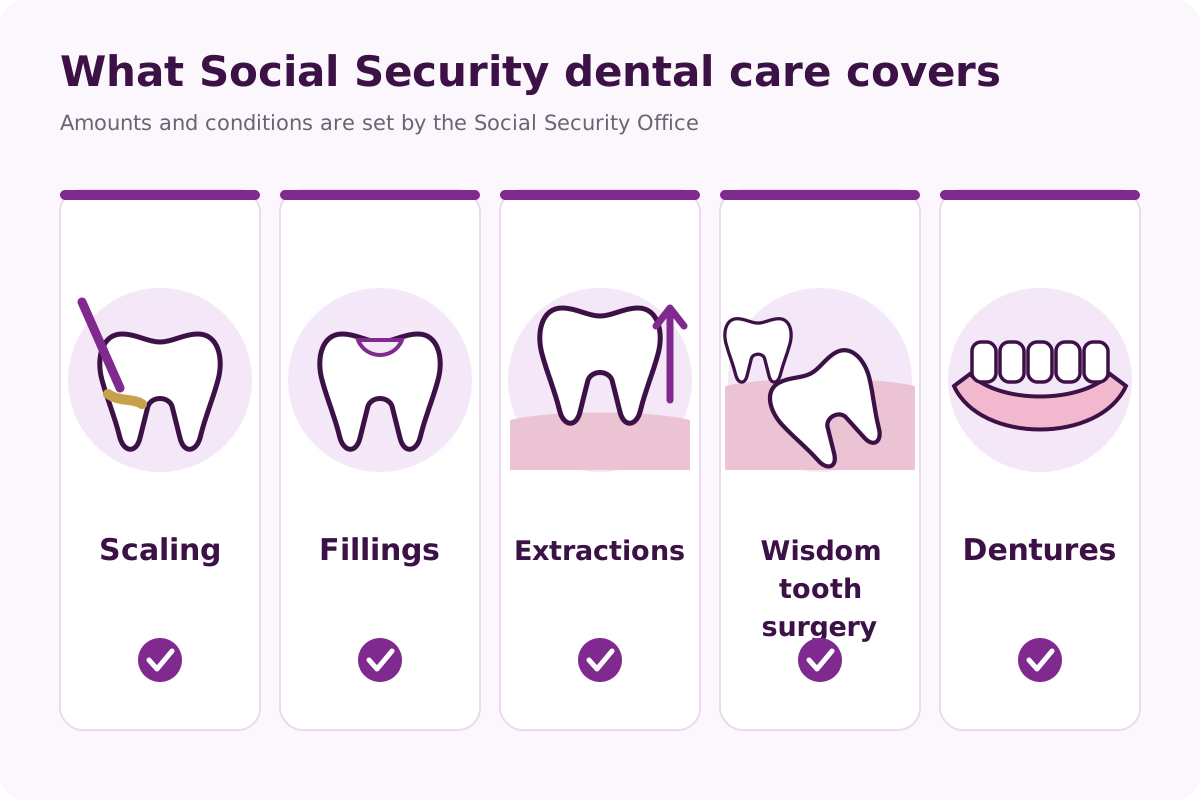
| Dental treatment item | How the benefit works | At our clinic |
|---|---|---|
| Scaling (teeth cleaning) | Shares a yearly amount with fillings and extractions at private clinics and private hospitals | Pay at the clinic, receive the documents, claim it back |
| Fillings | Part of the same yearly amount | Tooth-colored composite fillings; the same claim steps |
| Simple extractions | Part of the same yearly amount | Under local anesthesia; the same claim steps |
| Wisdom tooth surgery | Since May 2026, a separate amount per tooth that depends on how complex the surgery is | Planned with X-rays, and CBCT when the roots are close to the nerve; the same claim steps |
| Dentures | A separate amount that depends on the type of denture and the number of teeth, plus a separate amount for repairs | See our article on Social Security dentures for the steps |
| Implants for people who have lost all their teeth | A new benefit for people who cannot use a removable denture, with specific conditions | Ask 1506 about the conditions first, then talk to your dentist |
At public hospitals that have an agreement with the Social Security Office, the announcements describe a wider package: basic treatments are given according to medical need without a set number of visits, and root planing and bone smoothing before dentures were added. Special clinics, such as after-hours clinics, can charge extra fees.
Treatments for appearance, such as whitening or veneers, and orthodontic treatment are not in the list of announced dental benefits. You can still have them, but they are not claimed through this benefit.
Social Security dentures: how to use your benefit
Hospitals, contracted clinics and other clinics: how payment differs
Where you are treated changes how you pay, not whether you have the benefit. Some places have an agreement with the Social Security Office and bill it directly. At other places you pay first and then claim the amount back yourself. Both routes use the same benefit.
| Where you are treated | How payment works | Good to know about claims |
|---|---|---|
| A public hospital with an agreement | Usually nothing to pay for covered treatment | Special or after-hours clinics may charge extra; waiting times vary |
| A private clinic or hospital with an agreement | The place bills Social Security directly within the limit; you pay any amount above it | Look for the Social Security sign and ask about any extra cost before treatment |
| Any other clinic or hospital | You pay first, then claim back from Social Security up to the set amount | Keep the medical certificate and receipt, then claim online or at an office |
At Kitcha Dental Clinic we use the pay-and-claim route. You pay at the clinic with the payment method that suits you, and we prepare the medical certificate and an itemized receipt for your claim. Many people choose this route because they can book a time that fits their day, including evenings and weekends, and choose the treatment approach they prefer, then claim the covered part back.
The lists of contracted hospitals and clinics are published by the Social Security Office and change when agreements are renewed, so check the current list at sso.go.th if you want the direct-billing route.
Using your benefit at our clinic, step by step

Here is the whole journey from booking to receiving your money back. Most of it takes only a few minutes of your time; the part that needs care is keeping the documents together.
Before your visit
- Check your status: log in to e-Self Service at sso.go.th or call 1506 to confirm you meet the contribution condition and to see how much of this year amount you have used.
- Book and mention Social Security: when you book, tell us you plan to claim from Social Security so the team prepares the right documents.
- Have your details ready: bring your ID card or passport, and a list of the medicines you take.
On the day of your visit
- Examination: your dentist checks your teeth and gums and takes X-rays if needed.
- Plan and fee first: the dentist explains what needs treatment and the fee before starting, so you know which part your benefit covers and which part you pay.
- Treatment: scaling, a filling or an extraction, often finished in one visit.
- Payment and documents: you pay at the clinic and receive the medical certificate and the itemized receipt.
After your dental visit
- Check the documents before you leave: your name and the treatment date should be correct, and each treatment should be listed.
- Submit your claim online through e-Self Service, or at a Social Security office.
- Follow the status in the system or with 1506 until the money reaches your account.
- Keep copies of everything until the claim is paid.
The claim period counts from the date of treatment shown on your documents. Rather than waiting, it is easiest to submit within a few days, while everything is still together.
Documents for a Social Security dental claim
What the clinic gives you
- A medical certificate from the dentist who treated you.
- An itemized receipt that lists each treatment, in the format the Social Security Office expects.
What you prepare yourself
- Your ID card, or the identity document registered with Social Security.
- Bank account details for the refund, such as the first page of your bank book. Some guides note that an account linked to PromptPay by ID number can be used for online claims.
- For an in-person claim, the dental benefit claim form, known as form SPS 2-16.
Other documents for the claim, and where to submit it, are set by the Social Security Office. Please check the current rules and amounts on the Social Security Office website or with the SSO hotline 1506.
Social Security Office website (sso.go.th)
How to claim online or at a Social Security office
There are two ways to submit a claim after you have paid. Both use the same documents; choose the one that is easier for you.
Online through e-Self Service
- Go to sso.go.th and log in to the insured person system with your ID number, or register first if you have not used it before.
- Choose the menu for claiming benefits yourself, then choose the dental category.
- Upload clear photos of the medical certificate, the receipt and your bank account page, and choose how to receive the money.
- Submit, then check the status in the system until it is approved and paid.
Menu names on the website change from time to time. If a step looks different, the 1506 hotline can guide you through it.
In person at a Social Security office
You can also take the original documents, the claim form and your ID card to any Social Security office. This suits people who prefer to ask questions face to face, or whose claim is more complicated, such as dentures.
Planning your treatment around the benefit
A little planning helps the benefit go further, especially when you need more than one treatment. The aim is not to delay what your teeth need, but to know the order and what to expect.
| If your situation is | A sensible way to plan |
|---|---|
| You only need your regular check-up and cleaning | Most people have a check-up and cleaning about every 6 months; your dentist may suggest a different interval for your gums. Use the benefit for the visit you need now and ask your dentist when to come back. |
| The check-up finds a cavity as well | Ask the dentist which tooth is most urgent. Scaling and fillings share the same yearly amount at private clinics, so knowing the fee for each helps you decide what to do today and what to book next. |
| A wisdom tooth keeps getting swollen | Wisdom tooth surgery has its own amount per tooth since May 2026, so it does not use up the amount for cleaning and fillings. Have an X-ray first so the dentist can explain how complex it is. |
| You are missing several teeth | Dentures have a separate amount based on type and number of teeth. Ask your dentist which design suits your mouth, then check the benefit for that type. |
| Your treatment costs more than the benefit | The difference is paid by you. Ask for the fee before treatment starts, and look at the payment options that suit you. |
Cleaning is the treatment people most often skip because nothing hurts. Yet tartar cannot be removed by brushing, and regular check-ups let the dentist find problems such as decay or a cracked filling while they are easier to treat. That makes the cleaning visit one of the most useful ways to use the benefit.
Does teeth cleaning hurt, and how often should you have it?
Common myths about Social Security dental care
| What people often think | What actually applies |
|---|---|
| Social Security dental care only works at public hospitals. | You can use it at contracted private clinics with direct billing, or at other clinics by paying first and claiming back. |
| If I pay first, I cannot claim anything. | Paying first is a normal route. Keep the medical certificate and itemized receipt and claim online or at an office. |
| Wisdom tooth surgery uses up the cleaning and filling amount. | Since May 2026, wisdom tooth surgery has its own separate amount per tooth. |
| The dental amount was raised, a friend shared the post. | Posts like this have been checked and found false before. Trust sso.go.th, the official channels and 1506. |
| Once I leave my job, the benefit stops the same day. | Announcements say cover continues for up to 6 months after insurance ends, and Section 39 lets you keep paying yourself. |
| Whitening and braces can be claimed too. | They are not in the announced dental benefits. You can still have them, paid as usual. |
Things that help your claim go smoothly
- Check your contribution status before treatment, not after, especially after a job change.
- Ask about fees before treatment so the part above the benefit is not a surprise.
- Make sure the name on the documents matches your ID card exactly.
- Take clear photos of every document before you submit, and keep the originals.
- Submit soon after treatment instead of collecting receipts for months.
- Check news about changes on the official channels; amounts and partner lists are updated by the Social Security Office.
What happens at our clinic
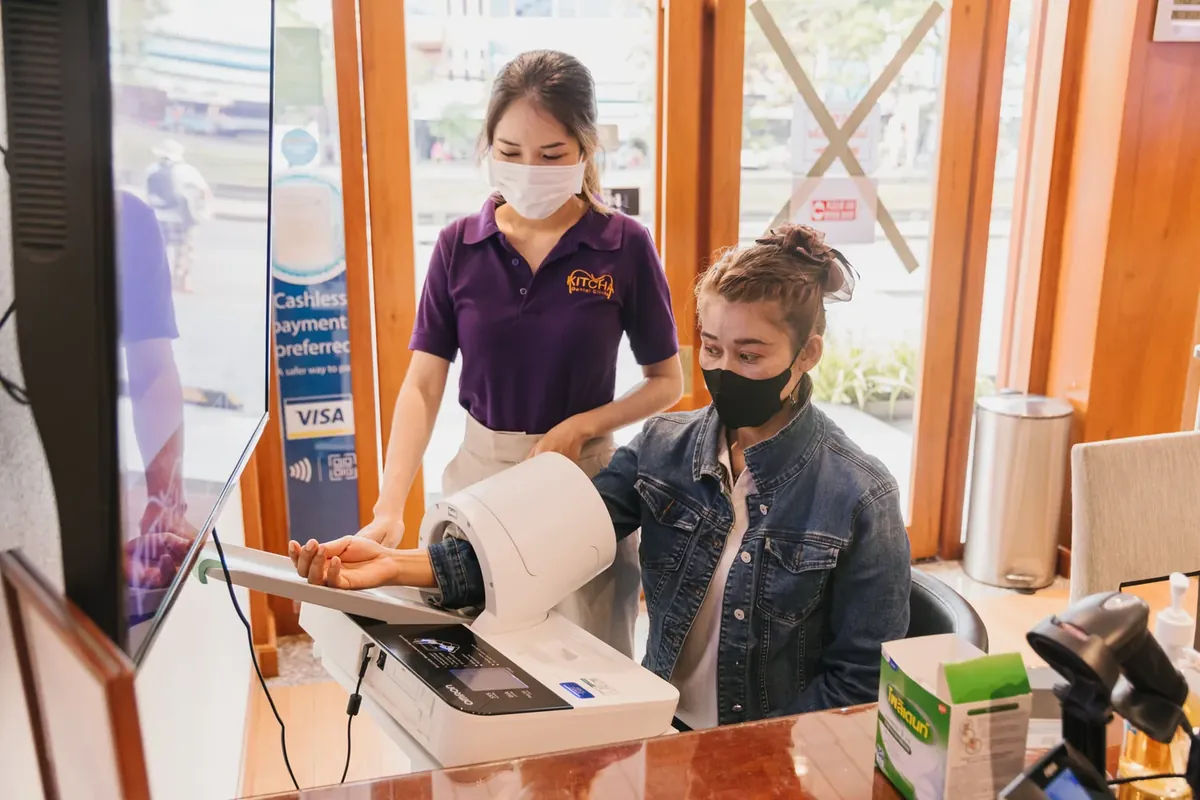
At Kitcha Dental Clinic, Social Security scaling, fillings, extractions, wisdom tooth surgery and dentures all follow the same process: you pay at the clinic, we issue a medical certificate and an itemized receipt, and you claim the amount from Social Security yourself. This is what each treatment usually looks like.
Scaling and check-up
Your dentist checks your teeth, gums and existing fillings, takes X-rays if needed, then removes tartar, plaque and stains. Depending on your teeth this may use ultrasonic and hand instruments followed by polishing, an Airflow spray, or GBT, which first colors the plaque so it can be seen and removed. Most people feel only vibration and some sensitivity; if your teeth or gums are sensitive, tell your dentist, because the area can be numbed. You leave with advice on the spots to brush or floss better.
Fillings
We fill teeth with tooth-colored composite. Small, shallow cavities often need no anesthetic; for deeper decay the dentist gives a local anesthetic first. The decay is removed, the composite is placed in layers, hardened with a light, shaped and polished, and your bite is checked. Most fillings are finished in one visit. Large cavities may be better protected by an inlay, onlay or crown, and the dentist explains this before starting.
Extractions and wisdom teeth
Before an extraction the dentist reviews your health and medicines and takes an X-ray, or a CBCT scan when needed. The area is numbed with a local anesthetic and checked before starting, so during the extraction you usually feel pressure rather than pain; tell the dentist straight away if you feel anything sharp. Afterwards you bite on gauze for 20 to 30 minutes, and a wound check is usually booked about 7 days later. Wisdom teeth are removed by dentists with postgraduate training in oral and maxillofacial surgery, including a Master degree from Prince of Songkla University.
If you take a blood thinner or antiplatelet medicine, do not stop it yourself. Tell the dentist the name of the medicine: in some cases it does not need to be stopped, and in others the dentist may first consult the doctor who looks after you. If you are pregnant, tell the dentist, and the dentist will plan your care.
Paying at the clinic
You can pay with no fee by cash, PromptPay, bank transfer or Alipay, and by Visa, Mastercard, American Express or UnionPay card with no fee for amounts over a set minimum. The clinic does not charge VAT. The clinic is open every day from 09:00 to 20:00, opposite Chiang Mai Gate.
Fees for the check-up, cleaning, fillings and extractions are listed on our prices page, and your dentist confirms the fee after the examination.
If this sounds like you: Social Security dental examples
These are example situations, not patient stories, to help you find the next step that fits.
- You have just started a new job and want a cleaning next week: check in e-Self Service whether you already have 3 months of contributions within the last 15 months. If not yet, you can still have the cleaning now and pay as usual, or wait until you qualify.
- You work in Chiang Mai for a Thai company and are not Thai: if Social Security is deducted from your salary, ask HR or 1506 to confirm your section, then use the same steps as everyone else.
- You left your job two months ago: you may still be within the period of cover after insurance ends. Confirm with 1506 before your visit, and consider Section 39 if you want to keep paying yourself.
- Your wisdom tooth keeps getting swollen: book an examination and X-ray. Wisdom tooth surgery now has its own amount per tooth, and the dentist explains how complex the surgery is before you decide.
- You need a cleaning and two fillings: ask for the fee of each item at the examination, then decide together with the dentist which to do first.
- You are pregnant and your gums bleed when you brush: a cleaning can be part of your care. Tell the dentist that you are pregnant, and the dentist will plan your care.
- You need a new denture: dentures have their own steps and documents. Read our article on Social Security dentures, then book an examination.
Frequently asked questions about Social Security dental care
Can I use Social Security for teeth cleaning at a private clinic?
Yes. At a contracted clinic the clinic bills Social Security directly within the limit. At other clinics, including ours, you pay at the clinic and claim back with the medical certificate and itemized receipt. Scaling shares a yearly amount with fillings and extractions at private clinics.
Can I claim Social Security for wisdom tooth surgery?
Yes. Since 1 May 2026 wisdom tooth surgery has its own amount per tooth, depending on how complex the surgery is, so it no longer shares the amount for cleaning and fillings. If the fee is higher than the amount, you pay the difference.
How long does it take to get the money back?
It depends on when your documents are checked and approved. You can follow the status in e-Self Service or with the 1506 hotline. Clear photos and matching names help avoid delays.
Can I claim later, or only on the day?
You claim after treatment, and there is a claim period that counts from the date of treatment. Check the current period with 1506, and submit soon after your visit so nothing gets lost.
Can Section 40 members use the dental benefit?
The announced dental benefit is for Sections 33 and 39. Section 40 has its own set of benefits, so check what applies to you with the 1506 hotline before your visit.
Do I need to pay extra for Social Security scaling?
Only if the fee is higher than the amount you can claim, or if you have already used part of this year amount. At our clinic you pay the full fee and claim back up to the amount set by Social Security. Ask for the fee before treatment so you know in advance.
Can I use Social Security for dentures or implants?
Dentures have their own amount, based on the type and the number of teeth, and our Social Security dentures article explains the steps. The implant benefit is new and is for people who have lost all their teeth and cannot use a removable denture, with specific conditions; ask 1506 about it before planning.
How do I check my Social Security dental benefit?
Log in to e-Self Service at sso.go.th to see your status and contributions, or call the 1506 hotline. The Social Security Office also posts updates on its official social media and LINE account, @ssothai.
Summary
Social Security dental care is there to be used: scaling, fillings, extractions, wisdom tooth surgery and dentures are all part of it for Sections 33 and 39.
- Check your status first: at least 3 months of contributions within the 15 months before treatment.
- Each part has its own rules: cleaning, fillings and extractions share a yearly amount at private clinics; wisdom teeth and dentures have separate amounts.
- At our clinic: pay at the clinic, receive a medical certificate and itemized receipt, then claim online or at a Social Security office.
- Ask for the fee before treatment and submit your claim soon after.
- For amounts and changes, trust sso.go.th and the 1506 hotline.
References
Social Security Office website (sso.go.th)
Thailand Consumers Council: Social Security dental benefit changes from 1 May 2026 (in Thai)
The Coverage: new Social Security dental rules, contracted hospitals and clinics (in Thai)
Bangkok Biz News: Social Security dental care from 1 May, paying first and co-payment (in Thai)
FlowAccount: how to claim Social Security dental costs online, documents and steps (in Thai)
Sanook: summary of Social Security dental rights from 1 May 2026 (in Thai)
NHS (UK): Wisdom tooth removal
American Dental Association (MouthHealthy): Brushing Your Teeth