

You bite into something and a tooth gives a little. Or your tongue keeps finding the same tooth, and it seems to move when you press it. For an adult this is unsettling, because a permanent tooth is meant to stay put, and the first thought is often: am I about to lose it?
The reassuring part first: a loose tooth is a signal, not a verdict. The most frequent cause in adults is gum disease that has reduced the bone around the tooth, and other causes include grinding, a knock to the mouth and infection at the root tip. Each cause has its own treatment, and a large review of patients followed for more than a decade found that most mobile teeth were still kept in the long term when the gums were treated and looked after.
This article helps you work out what is behind your loose tooth and what to do next. You will find a one-minute self-check, a table of causes and how to tell them apart, the mobility grades dentists use, what you can safely do while you wait, treatment by cause including splints, a typical treatment timeline, common myths, the signs that mean you should come in quickly, and what actually happens at the clinic.
In short: an adult tooth that moves should be checked, not wiggled. Chew on the other side, keep cleaning gently, and book a dental check. If the tooth loosened after an accident, was pushed out of place, or comes with swelling or fever, contact a dentist the same day.
Is my loose tooth urgent? A one-minute self-check
Usually not urgent: watch it and book a routine check
- You wear braces or clear aligners and your teeth feel slightly loose for a few days after an adjustment.
- You are pregnant and your gums are a little puffy, and a tooth feels very slightly less firm than before.
- A tooth feels a little tender and loose a day after you bit something very hard, but it is not out of place and is settling.
Book a dental check soon, within the next week or two
- A tooth moves when you push it with your tongue or finger, and you have not had an accident.
- Your gums bleed when you brush, look red or have pulled back so the teeth look longer.
- Gaps are opening between your front teeth, or your teeth seem to be fanning out or shifting.
- Your bite feels different, or food now packs between teeth where it did not before.
- You wake with a tired jaw, or someone has heard you grinding at night.
Contact a dentist the same day
- The tooth loosened after a fall, a sports knock or a blow to the face.
- The tooth has been pushed out of place, looks longer than its neighbors, or your teeth no longer meet properly.
- There is swelling, pus or a bad taste around the tooth, or the tooth hurts to bite on.
- You have a fever, or the swelling is spreading in your face.
If swelling spreads toward your eye, neck or under your tongue, or you have trouble breathing or swallowing, go to a hospital emergency department rather than waiting for a dental appointment. These signs are rare with a loose tooth, but they are worth knowing.
Why adult teeth become loose
A tooth is not glued into the jaw. It sits in a socket of bone and is held there by thousands of tiny fibers called the periodontal ligament. These fibers act like a shock absorber, so every healthy tooth moves a tiny amount when you bite. You cannot feel this normal movement. A tooth feels loose when the support around it has weakened, or when the forces on it have become too strong for that support.
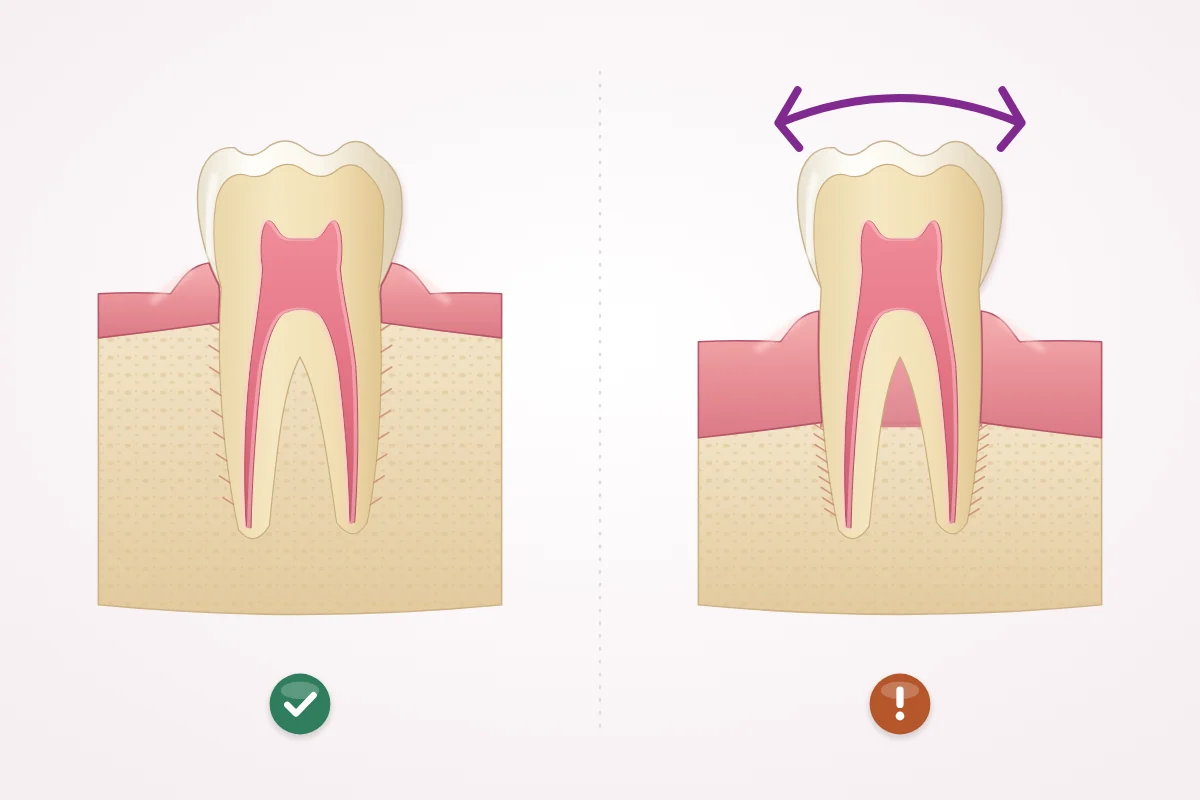
Gum disease weakens the support. Plaque at the gum line keeps the gums inflamed, and over time the inflammation spreads down to the ligament and the bone. Pockets form between tooth and gum, the bone around the root slowly shrinks, and the tooth has less to hold on to. This usually happens without pain, which is why many people only notice it once a tooth starts to move.
Heavy forces overload the support. Grinding and clenching put far more force on the teeth than chewing does, and a tooth that is hit in an accident can have its ligament stretched or torn in a moment. Research reviewed for the international classification of gum diseases found that these heavy forces do not start gum disease by themselves, but they can make a tooth more mobile, and that reducing those forces is part of treatment because it lowers mobility and makes chewing more comfortable.
Often it is a mix. A tooth that has already lost some bone to gum disease is more easily loosened by grinding, and an infection at the root tip can weaken the bone from below. That is why a dentist looks for every contributing cause, not only the most obvious one.
Causes of a loose tooth and how to tell them apart
The table starts with the most frequent cause in adults. Use the middle column to see which description fits you most closely, and remember that more than one cause can be present at the same time.
| Cause | How to tell | What to do |
|---|---|---|
| Gum disease that has reached the bone (periodontitis), the most frequent cause | Several teeth slowly loosen; bleeding gums, receding gums, bad breath, new gaps; usually no pain | A gum check with pocket measurements and X-rays, then gum treatment |
| Grinding or clenching (bruxism) | Worn, flat or chipped teeth, a tired jaw in the morning, loose teeth that feel sore to bite | A bite check; a night guard or occlusal splint; bite adjustment if needed |
| An injury: a fall, a sports knock, a blow to the face | Loose right after the knock; the tooth may be tender, bleeding at the gum or pushed out of place | See a dentist the same day; the tooth may be repositioned and splinted |
| Infection at the root tip or a gum abscess | One tooth that hurts to bite, a swelling or pimple on the gum, a bad taste, sometimes a darker tooth | Root canal treatment or gum treatment, depending on the source |
| A high spot on a new filling or crown | One tooth feels sore and slightly loose since recent dental work, and it meets first when you bite | Ask your dentist to check and adjust the bite |
| Orthodontic treatment (braces or aligners) | Mild looseness and tenderness for a few days after each adjustment, while the teeth are moving | Usually expected; tell your orthodontist if it is strong, painful or does not settle |
| Pregnancy and other hormone changes | Puffy gums that bleed easily, and teeth that feel very slightly less firm, mostly late in pregnancy | Clean gently and thoroughly; tell your dentist that you are pregnant and they will plan your care |
| Less frequent causes: a cyst or growth in the jaw, or a bone condition | Looseness that does not match the gums or the bite, sometimes with numbness or a swelling of the jaw | X-rays at the dental check; your dentist refers you on if further tests are needed |
Smoking deserves a note of its own. It is one of the strongest risk factors for gum disease, and it can hide the warning signs, because the gums of people who smoke often bleed less even while the disease is getting worse. If you smoke and a tooth feels loose, a gum check gives a clearer answer than how your gums look.
How loose is it? Mobility grades and what they mean
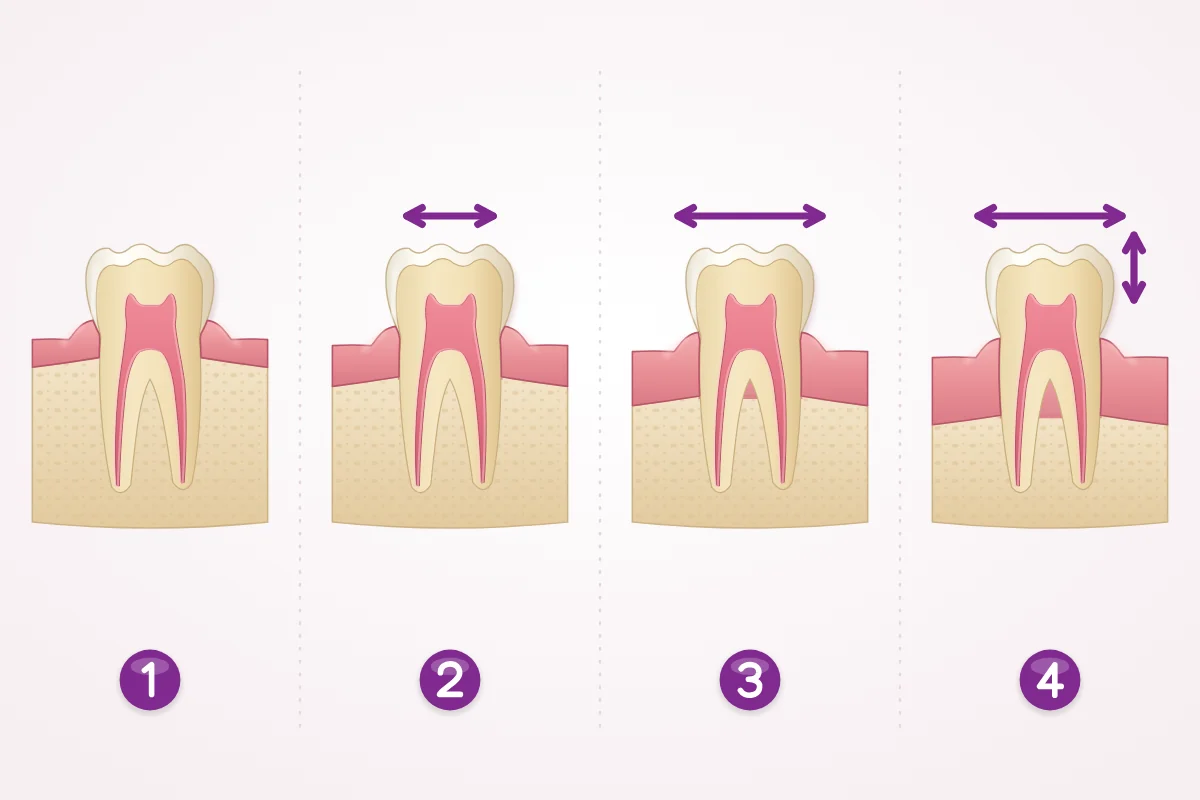
Dentists grade looseness by holding the tooth between two instruments and gently moving it. The exact scale differs a little between textbooks, but most follow the same idea: how far the tooth moves side to side, and whether it can also be pushed up and down. The table gives a plain-language version.
| Grade | What you notice | What it usually means |
|---|---|---|
| Normal | You cannot feel any movement; the tooth feels solid when you bite | The ligament is cushioning normally |
| Grade 1 (slight) | A little more movement than normal, side to side; you may only notice it when biting or pushing with your tongue | Often early bone loss, an inflamed ligament, or a tooth under heavy force; frequently improves once the cause is treated |
| Grade 2 (moderate) | Clearly moves side to side, about a millimeter or more; you can feel it without trying | Usually moderate to advanced bone loss; gum treatment, bite control and sometimes a splint are considered |
| Grade 3 (severe) | Moves side to side and can also be pushed up and down into the socket | Very little support left; your dentist explains whether the tooth can be kept or should be replaced |
The grade is only part of the picture. A large review of studies that followed people with gum disease for more than a decade grouped teeth by how much they moved. Mobile teeth were more likely to be lost than firm ones, and the risk rose with the grade, yet overall only about 1 in 12 teeth was lost and the authors concluded that most mobile teeth can be kept in the long term. Their advice was that mobility alone should not be the reason to remove a tooth.
What matters just as much is why the tooth is loose, how much bone is left on the X-ray, whether the gum disease is under control, and how well the area can be cleaned. A grade 2 tooth whose gums have healed may be steadier in a year than a grade 1 tooth whose cause has been left alone.
What to do while you wait for your appointment
Home care cannot tighten a loose tooth, but it can protect it, keep the area clean and stop things getting worse until your dentist has had a look. These steps are safe for most people.

- Leave the tooth alone. Try not to test it with your tongue or fingers; each push stretches the ligament again.
- Chew on the other side, and choose softer foods for now: rice, eggs, fish, tofu, soups, cooked vegetables and soft fruit.
- Avoid biting into hard, crunchy or chewy foods with that tooth: ice, nuts, bones, hard candy, crusty bread and sticky sweets.
- Keep brushing, gently. Use a soft brush at the gum line around the loose tooth, and keep cleaning between your teeth, so plaque does not add more inflammation.
- Rinse with warm salt water after meals if the gum feels sore. It soothes the area but does not treat the cause.
- If you grind at night and already have a night guard, wear it. Do not use a store-bought guard on a newly loose tooth until your dentist has checked it.
- Write down when you first noticed it, whether it hurts, and any recent dental work or accident. Bring a list of your medicines.
If the tooth was loosened in an accident
Contact a dentist the same day. Treatment tends to work better the sooner the tooth is seen, especially if it has been pushed out of place. Do not try to push it back hard yourself; bite gently on a clean cloth to keep it steady on the way. If the tooth has come out completely, hold it by the crown, not the root, keep it moist, ideally in milk, and get to a dentist right away. If you also hit your head or jaw, go to a hospital first.
Emergency dentist in Chiang Mai
Taking a blood thinner or another regular medicine?
Keep taking it as prescribed. Do not stop it yourself, and tell your dentist its name before any treatment. In some cases the medicine does not need to be stopped; in others, your dentist may first consult the doctor who looks after you.
How a loose tooth is treated, cause by cause
There is no single treatment for a loose tooth, because looseness is the result, not the cause. Treatment aims first at what is loosening the tooth, then at protecting the tooth while the support recovers. Many people need a combination.
| Treatment | When it is used | What it aims to do |
|---|---|---|
| Scaling and root planing (deep cleaning below the gums) | Gum disease with pockets and bone loss | Remove the bacteria and tartar under the gums so inflammation settles and the gums can tighten around the tooth |
| Gum surgery, and sometimes bone or gum grafting | Pockets that stay deep after deep cleaning | Clean the root surfaces that cannot be reached otherwise and reshape or rebuild the support |
| Splint for loose teeth | Mobile teeth that make chewing uncomfortable, or a tooth loosened in an accident | Join the loose tooth to firmer neighbors so it is held steady while the area heals |
| Night guard or occlusal splint | Grinding or clenching | Spread and soften the grinding forces during sleep and protect the teeth |
| Bite adjustment | A tooth that takes too much force when you bite, including a new filling or crown that is high | Even out the contacts so the loose tooth is not overloaded |
| Root canal treatment | Infection at the root tip, or a tooth injured in an accident whose nerve is affected | Clear the infection inside the tooth so the bone around the root can heal |
| Orthodontic treatment | Teeth that have drifted or flared once the gums are stable | Move the teeth back into positions that share the bite more evenly and are easier to clean |
Splints for loose teeth: what to expect
A splint for loose teeth is a thin wire or fiber strip bonded with tooth-colored material to the back of the loose tooth and its neighbors. It is usually used on front teeth, where it does not show from the front. Splinting helps comfort and chewing and gives the area a stable start while the gums heal, and a review of splinting notes that it does not by itself cure gum disease, so it is always combined with treating the cause.
- Cleaning needs extra care. Plaque collects along the splint, so your dentist shows you how to thread floss or use small interdental brushes under it.
- Avoid biting directly into very hard foods with the splinted teeth, and tell your dentist if any part feels rough or loose.
- After an accident, a splint is usually kept for a limited time and then removed once the tooth has settled. For gum-related looseness it may stay longer, and your dentist explains the plan.
Teeth grinding and night guards
A typical timeline for a tooth loosened by gum disease
Gum-related looseness improves over weeks and months, not days. Knowing the usual rhythm helps you stay patient and keep your part going. Your own plan depends on what the examination finds.
| Treatment stage | What happens | Your part |
|---|---|---|
| First appointment | Examination, pocket measurements, mobility check, bite check and X-rays; your dentist explains the cause and gives a plan and cost estimate | Bring your list of medicines and any old X-rays; ask every question you have |
| Active treatment, usually over a few visits | Deep cleaning section by section under local anesthesia; a splint, night guard or bite adjustment if the plan includes them | Brush and clean between your teeth every day as shown; the gums may feel sore for a few days after each session |
| First weeks after treatment | Bleeding and swelling settle; the gums shrink back slightly as they tighten, so teeth may look a little longer or feel more sensitive for a while | Keep cleaning carefully even if it feels strange; this is when the habit matters most |
| Re-evaluation, after the gums have had time to heal | Pockets and mobility are measured again; areas that are still deep may need gum surgery | Many loose teeth feel firmer by now; tell your dentist which ones still bother you |
| Long-term maintenance | Regular maintenance cleanings keep the gums stable; after gum treatment many people come about every 3 to 6 months | Keep the appointments and your daily cleaning; wear a night guard if you have one |
Bone that has been lost does not fully grow back on its own, so a tooth may never be quite as firm as it was before the disease. The aim is a tooth that is comfortable, stable and healthy, and that stays that way.
Deep cleaning or regular cleaning: what is the difference?
Common myths about loose teeth
| Myth | Fact |
|---|---|
| A loose adult tooth always has to come out. | Many loose teeth can be kept once the cause is treated. Long-term studies found that most mobile teeth were still in place more than a decade later. |
| If it does not hurt, it is not serious. | Gum disease, the most frequent cause, usually does not hurt, even when bone is being lost. |
| Loose teeth are a normal part of getting older. | Gum disease is more common with age, but age itself does not loosen healthy teeth. A loose tooth at any age is worth checking. |
| Salt water, herbal rinses or a special toothpaste can tighten a loose tooth. | They can soothe the gums, but none removes tartar under the gums or rebuilds support. Tightening comes from treating the cause. |
| I should stop brushing the loose tooth so I do not disturb it. | Gentle cleaning protects it. Plaque left on a loose tooth keeps the inflammation going. |
| A splint fixes the problem. | A splint steadies the teeth and helps comfort, but it works alongside gum treatment and bite control, not instead of them. |
| Pulling a loose tooth out myself saves a visit. | An adult tooth that is loose may still be saved, and the root can break or the socket become infected if it is pulled at home. |
Signs that mean you should come in quickly
Most loose teeth can wait for a planned appointment within a week or two. These situations are different, and it is worth contacting a dentist the same day:
- The tooth loosened after an accident, or was pushed out of place, sideways or deeper into the gum.
- Your teeth suddenly do not meet the way they used to.
- There is swelling, pus, a bad taste, or pain when you bite.
- You have a fever or feel unwell together with the swelling.
- Several teeth have loosened over a short time, or a loose tooth comes with numbness of the lip or chin.
Go to a hospital emergency department instead if swelling spreads toward the eye, neck or under the tongue, if you have difficulty breathing or swallowing, a high fever with facial swelling, bleeding that will not stop with firm pressure, or an injury to the head or jaw.
Loose teeth, diabetes, smoking and pregnancy
Gum disease is common. In the United States, about 4 in 10 adults aged 30 and over have periodontitis, rising to about 6 in 10 among people aged 65 and over. Two groups stand out in the same data: people who smoke and people living with diabetes, among whom about 6 in 10 have periodontitis.
- Diabetes: high blood sugar makes gum inflammation harder to control, and untreated gum disease can make diabetes harder to manage. The two are related, so it helps to have regular gum checks and to let both your doctor and your dentist know.
- Smoking: it raises the risk of gum disease, slows healing and makes treatment less successful, and it can hide bleeding. Stopping helps the gums respond to treatment.
- Pregnancy: hormone changes make the gums react more strongly to plaque, and a study that measured teeth through each trimester found a small increase in tooth mobility, highest late in pregnancy. This usually settles after the baby is born. Tell your dentist that you are pregnant and they will plan your care.
- Medicines and other conditions: some medicines and long-term illnesses affect the gums or healing. Bring a full list of your medicines so your dentist can take them into account.
What happens at a loose-tooth check, step by step
At Kitcha Dental Clinic, gum treatment is planned by dentists with postgraduate training in periodontics, including master and doctoral degrees. When the cause lies elsewhere, such as an injury, an infection or grinding, dentists from the related fields in the clinic plan the care together.
- History: when you noticed the looseness, any accident or recent dental work, grinding, your general health and every medicine you take.
- Examination: how much the tooth moves, the condition of the gums, and how your teeth meet when you bite and grind.
- Gum measurements: the pockets around each tooth are measured and recorded on a gum chart, so later visits can be compared.
- X-rays: to see how much bone is left around the roots and to look for infection at the root tips.
- Explanation and plan: your dentist explains the cause, the options and whether the tooth can be kept, and gives you a treatment plan and cost estimate before anything starts.
- Treatment of the cause: deep cleaning below the gums section by section, usually under local anesthesia and over more than one visit; root canal treatment if the root tip is infected; a night guard if grinding is part of the cause.
- Support for the tooth: a splint for loose teeth when it suits your case, and bite adjustment where one tooth takes too much force. A tooth loosened in an accident can be held with a wire-and-composite splint while it settles, then checked for root canal needs.
- Re-evaluation and ongoing care: once the gums have healed, pockets and mobility are measured again. Areas that are still deep may need gum surgery. Regular maintenance visits keep the gums stable, and many people come about every 3 to 6 months after gum treatment.
If radiation worries you: at our clinic, X-rays inside the mouth are digital, taken with phosphor plates and sensors that help lower the dose compared with film. Our Planmeca ProMax CBCT has an Ultra Low Dose mode, your dentist chooses the mode that suits each case, and X-rays are taken only when they are needed.
Dental X-ray radiation: how much is it, and how we keep it low
Your dentist may also use the Waterlase dental laser alongside standard gum treatment when it suits your case. It is an addition to cleaning, not a replacement for it.
Root canal treatment in Chiang Mai
Gum treatment fees are listed on our prices page. The cost depends on how many areas need care and how advanced the disease is, and you receive a plan and estimate after the examination, before any treatment starts.
If the tooth cannot be kept

Sometimes a tooth has too little support left, or it keeps flaring up despite treatment. Then your dentist talks you through removing it and how to replace it. When gum disease has made a tooth very loose, the extraction is done under local anesthesia, and the gums around the other teeth are treated as part of the same plan so the new tooth has healthy neighbors.
| Option | How it works | Good to know |
|---|---|---|
| Implant and crown | Replaces the root and the tooth without shaping the neighboring teeth | Needs enough bone, planned with a 3D CBCT scan; the gums need to be healthy first, and implants need regular cleaning and checks |
| Dental bridge | A fixed tooth held by crowns on the teeth either side | The support teeth need healthy gums and bone; a loose support tooth is one of the usual reasons bridges are replaced |
| Partial denture | A removable plate carrying one or more teeth | Can replace several teeth at once and be added to later |
If you have implants, the same gum care applies around them. We recommend a scale and clean every 6 months and an implant check once a year.
Replacing a single missing tooth
Dental bridge or implant: which suits one missing tooth?
If this sounds like you: what to do
These are example situations, not patient stories, to help you find the next step that fits.
- Your lower front teeth feel slightly loose and your gums bleed when you brush: book a gum check with pocket measurements and X-rays. Keep brushing gently and cleaning between your teeth in the meantime.
- You fell off a bicycle this morning and a front tooth moves and looks slightly longer: contact a dentist the same day. Bite gently on a clean cloth and do not push the tooth back hard. If you hit your head, go to a hospital first.
- Your partner hears you grinding and your back teeth feel sore and a little loose in the morning: book a bite and gum check. A night guard is often part of the plan, together with treating any gum disease found.
- One tooth hurts when you bite and there is a small bump on the gum next to it: book soon. A bump that comes and goes is often an infection draining from the root tip, and root canal treatment may be needed.
- You are pregnant and a tooth feels a little less firm, with puffy gums: clean gently and thoroughly, and tell your dentist that you are pregnant so they can plan your care.
- Your new crown feels high and the tooth has felt sore and slightly loose since it was fitted: contact the clinic. A bite adjustment often helps the tooth settle.
- You smoke, your gums rarely bleed, but your teeth seem to be spreading apart: have a gum check anyway. Smoking can hide bleeding, and pocket measurements show what is happening below the gum.
- You have diabetes and several teeth feel loose: book a gum check, keep up regular maintenance visits, and let your doctor know too.
Frequently asked questions about loose teeth
Can a loose tooth tighten up again?
Often, yes, at least partly. A tooth loosened by a minor knock, a high filling or grinding frequently firms up once the cause is dealt with. A tooth loosened by gum disease usually becomes steadier after gum treatment as the inflammation settles, although bone that has been lost does not fully grow back on its own. Home remedies alone do not tighten a tooth.
Does a loose tooth have to be pulled out?
Not necessarily. Many loose teeth can be kept, and long-term research suggests mobility alone should not be the reason to remove a tooth. Your dentist looks at the cause, the bone on the X-ray and whether the area can be kept clean, then explains whether the tooth can be kept and what keeping it involves.
My tooth is loose but does not hurt. Should I still see a dentist?
Yes. Gum disease, the most frequent cause in adults, usually does not hurt, and the earlier it is treated the more options you have. An adult tooth should not move, so a check within the next week or two is worthwhile even without pain.
A tooth is loose after an accident. What should I do?
Contact a dentist the same day, because treatment tends to work better when the tooth is seen early. Bite gently on a clean cloth to keep it steady and avoid chewing on it. The tooth may be eased back into place and held with a splint while it settles, and your dentist checks the nerve at follow-up visits. If you hit your head or the swelling is severe, go to a hospital first.
Can grinding my teeth make them loose?
Yes. Grinding and clenching put heavy, repeated forces on the teeth, which can make them sore and mobile, especially teeth that have already lost some bone. A custom night guard spreads those forces during sleep, and reducing them is part of treating a loose tooth. Grinding does not cause gum disease by itself, so the gums are checked as well.
Is it normal for teeth to feel loose during pregnancy?
A slight change is common, because pregnancy hormones affect the gums and the tissues around the teeth, and the effect is usually greatest late in pregnancy and settles after birth. Clear looseness, swelling or bleeding that does not settle is still worth checking. Tell your dentist that you are pregnant, and they will plan your care.
How long does a splint for loose teeth stay on?
It depends on why it was placed. After an accident a splint is usually needed only until the tooth has settled, then it is removed. When teeth are loose because of gum disease, a splint may stay for much longer to keep chewing comfortable. Either way, your dentist checks it at each visit and shows you how to clean around it.
Can a loose tooth be saved with a dental implant later if needed?
Often, yes, once the gums are healthy and there is enough bone, which is checked with a 3D CBCT scan. Bone grafting can be added when more bone is needed. Gum disease can also affect the tissues around implants, so treating it first and keeping up regular cleanings and checks protects the new tooth as well.
Summary
A loose adult tooth is a sign that its support has weakened or is overloaded. The most frequent cause is gum disease, and many loose teeth can be kept when the cause is treated.
- Do not wiggle it. Chew on the other side, choose softer foods and keep cleaning gently.
- Book a check within a week or two, even if it does not hurt. Pocket measurements and X-rays show the cause and how much bone is left.
- Contact a dentist the same day after an accident, or if there is swelling, pus, fever or a change in your bite.
- Treatment targets the cause: gum treatment, a night guard, bite adjustment or root canal treatment, with a splint to steady the tooth when it suits your case.
- Tell your dentist about diabetes, smoking, pregnancy and every medicine you take, and keep up regular maintenance visits.
References
MedlinePlus (US National Library of Medicine): Periodontitis
National Institute of Dental and Craniofacial Research (US): Gum disease
CDC (US): About Periodontal (Gum) Disease
American Dental Association (MouthHealthy): Dental emergencies
Fan J, Caton JG. Occlusal trauma and excessive occlusal forces. J Periodontol, 2018
Tonetti MS et al. Staging and grading of periodontitis. J Periodontol, 2018
Mishra PS et al. Mobility of teeth during pregnancy measured with Periotest. Indian J Dent Res, 2017