

You are looking at one front tooth, or maybe several, and two words keep coming up: veneer and crown. Both can change how a tooth looks. One dentist mentions a thin shell, another a full cap, and it is hard to tell which is the gentler choice for your tooth and which is simply the bigger treatment.
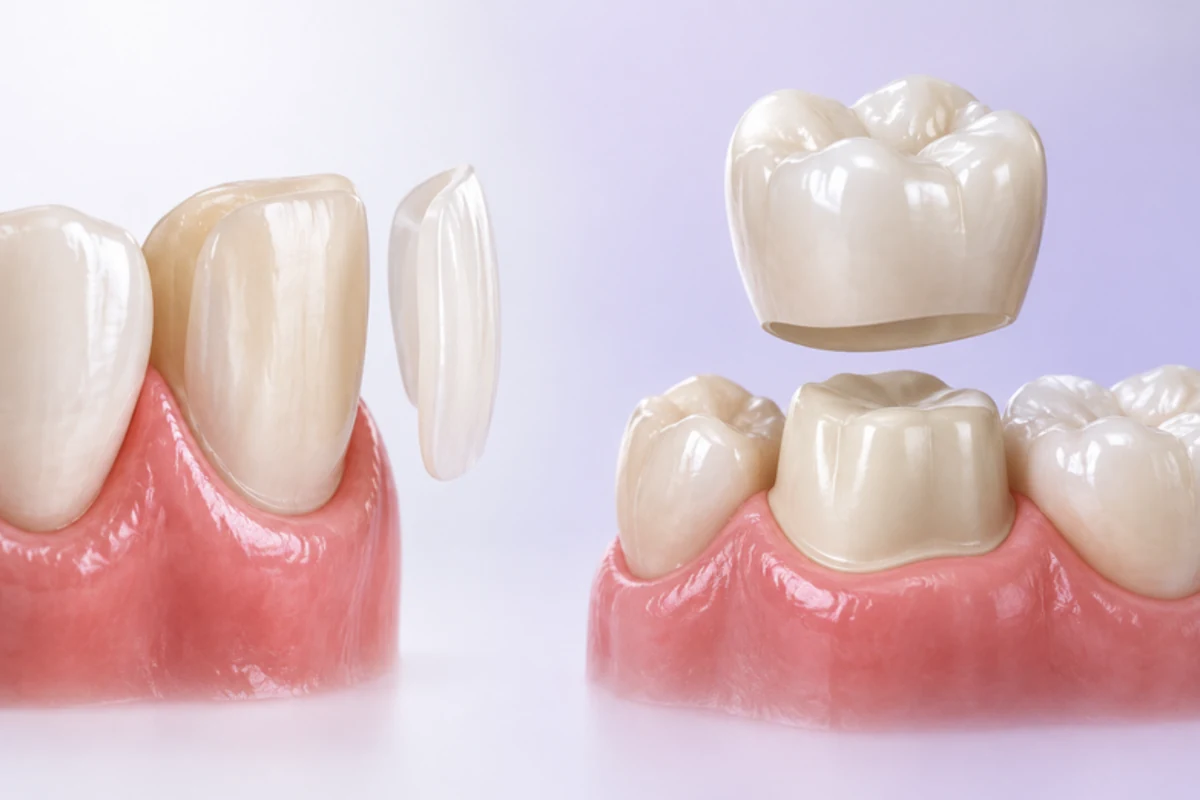
Here is the short version. A veneer covers the front of a tooth, so it fits a tooth that is mostly healthy and needs a better color, shape or position. A crown covers the whole visible tooth, so it fits a tooth that is cracked, heavily filled, weakened after root canal treatment, or too stained for a veneer to hide. Between those two groups there is a grey area, and that is where your dentist’s examination matters most.
This article helps you place yourself in that picture. You will find a quick self-check, a side-by-side table, how much of the tooth is shaped for each, a checklist by tooth type, materials, gums, whitening, the steps, aftercare, other options, myths and facts, and answers to common questions.
In short: choose by what the tooth needs, not by which word sounds gentler. A mostly healthy front tooth that needs a new look often suits a veneer. A tooth that is cracked, heavily filled or root-canal treated often needs the protection of a crown. If you grind your teeth, plan for a night guard with either. Your dentist confirms the choice after an examination and X-rays.
Which group are you in? A quick self-check
Tick the statements that sound like your tooth. The group with the most ticks is a starting point for the conversation with your dentist, not a diagnosis.
Leans toward a veneer
- The tooth is mostly healthy, with no large filling and no crack.
- You want to change color, shape, size or a small gap or slight overlap on the front teeth.
- Whitening has not removed the stain, or the front surface has small chips.
- There is enough healthy enamel on the front of the tooth for a veneer to bond to.
Leans toward a crown
- The tooth is cracked, broken, or a large part of it is already filling material.
- The tooth has had root canal treatment, especially a back tooth.
- It is a back tooth that takes heavy chewing forces.
- The tooth is very dark or badly worn, so a thin shell may not cover it well.
Grey area: ask your dentist to compare
- A front tooth with a medium filling and some chipping.
- A tooth with a mix of stain and wear.
- You grind your teeth and also want the most natural look.
- One tooth is much darker than its neighbors.
Veneer and crown side by side
| Point | Veneer | Crown |
|---|---|---|
| What it covers | The front surface, and sometimes the biting edge | The whole visible part of the tooth |
| Main purpose | Looks: color, shape, small gaps, small chips | Protection and strength, with looks as a bonus |
| Tooth shaped away | Usually a thin layer, mostly enamel | More, all around the tooth |
| Suitable for | Mostly healthy front teeth | Cracked, heavily filled, root-canal treated or worn teeth, front or back |
| Handling heavy biting | Thin, so it needs care with grinding and hard foods | Covers and holds the tooth together, so usually suits heavy forces better |
| Can it be undone? | Not once enamel is removed | Not once the tooth is shaped |
| Number of visits | Porcelain veneers: one trip, 10 to 14 days at the clinic | Usually 2 visits; the fastest crowns finish in 1 day |
The visit counts come from our clinic’s own treatment pages. The rest of the table is general knowledge from the sources listed at the end, and your own teeth may differ. The American Dental Association describes a veneer as covering only the front surface of the tooth, not the whole tooth, and a crown as covering the tooth to restore its shape and size and to make it stronger.
Read about veneers at the clinic
Read about crowns at the clinic
How much of the tooth is shaped for each
This is the question most people care about, and the answer is a real difference. A laboratory study on resin model teeth measured the tooth structure removed for different designs on front teeth. Porcelain veneer and resin-bonded designs removed roughly 3 to 30 percent of the tooth crown by weight. Full-coverage crowns, whether all-ceramic or metal-ceramic, removed roughly 63 to 72 percent. The authors concluded that veneer preparations needed about one quarter to one half of the reduction of a conventional crown.
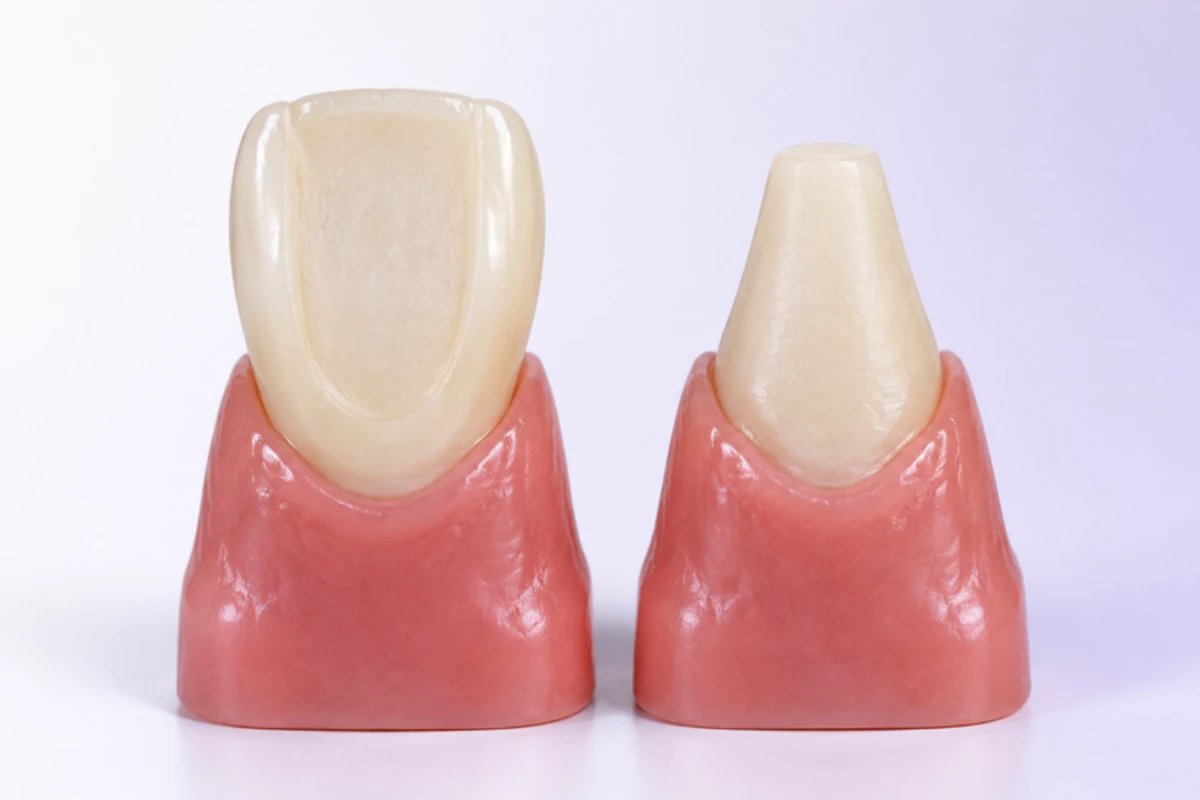
Two cautions go with that number. It comes from model teeth, not patients, so use it to understand the direction, not to predict your own tooth. And “thin layer” does not mean “no preparation”. The American Dental Association notes that enamel is removed to place a veneer and that the treatment is not reversible. Our clinic’s treatment page says the same: porcelain veneers usually need some enamel removed, this cannot be undone, and the dentist explains during smile planning whether your teeth need it and how much.
What about veneers that need no grinding at all? Some reports describe a “no-prep” approach. In one retrospective study of 78 no-prep porcelain veneers reviewed after about 43 months, the survival rate was 97.4 percent, with no gum recession seen. The authors’ conclusion was that a no-prep approach may be used safely only with strict rules for choosing the patient and placing the edge of the veneer. In other words, it suits some teeth, not every tooth, and it is a dentist’s decision after looking at your bite and tooth position.
Why this matters for your choice: the tooth structure you keep is the part you cannot buy back. If a tooth can be improved with a thin veneer, that usually keeps more of it than a crown would. If the tooth is already badly broken down, the crown is not removing healthy tooth so much as protecting what is left.
Strength and how well each holds up
Neither treatment comes with a fixed lifespan, and it is better to look at what studies actually report. A systematic review and meta-analysis of 13 clinical studies on porcelain and glass-ceramic veneers estimated overall survival of about 89 percent over long-term follow-up. Chipping or fracture was the most common complication, at about 4 percent, followed by debonding at about 2 percent. The authors concluded that ceramic veneers are a safe option that preserves tooth structure.
For crowns, a 2026 systematic review and meta-analysis of 64 studies compared five-year survival across materials. Monolithic lithium-disilicate (e.max-type) crowns were about 98.5 percent, monolithic zirconia about 96.8 percent, and metal-ceramic about 97.1 percent. The authors concluded that lithium-disilicate and zirconia crowns reach survival comparable to metal-ceramic crowns, and that solid (monolithic) designs reduce chipping. Note that these studies measure different things, so read them as “both are well-studied and generally dependable”, not as a race.
Where the two really differ is in what happens under heavy force. A veneer is a thin shell bonded to the front of a tooth. A crown surrounds the tooth. That is why a back tooth, or a tooth with little healthy structure left, usually leans toward a crown. For teeth that grind at night, see the checklist below, because the answer is not simply “always a crown”.
Checklist by tooth condition
Use this table to see which way your tooth tends to lean. Each row is a common situation. “Often leans toward” describes a general pattern, and your dentist may recommend something different after an examination.
| Your tooth | Often leans toward | Short reason |
|---|---|---|
| Front tooth, healthy, wants a new look | Veneer | Covers the visible front and keeps more of the tooth |
| Small chip or small gap on a front tooth | Veneer, or bonding | Bonding is lighter still; the dentist compares both |
| Slightly crowded or uneven front teeth | Veneer, or braces | Veneers reshape the look; braces move the teeth |
| Stain that whitening did not remove | Veneer, or crown if very dark | A very dark tooth may show through a thin shell |
| Medium or large filling, tooth still mostly sound | Inlay or onlay, or crown | Covers the weak part while keeping more tooth than a crown |
| Cracked or broken tooth | Crown | Holds the tooth together and protects what is left |
| Root canal treated tooth | Crown, especially for back teeth | Little structure often remains; evidence favors cuspal coverage when much is lost |
| Back tooth | Crown, or onlay | Takes the heaviest chewing forces |
| Teeth grinding or clenching | Depends on the tooth, plus a night guard | Grinding raises risk for both; a night guard protects the work |
Root canal treated teeth
A tooth that has had root canal treatment has usually lost a lot of structure to decay, to the opening made for treatment, or to an old filling. A 2025 systematic review compared root-canal-treated teeth restored with direct composite and with crowns. In the short term both did well. In studies with follow-up of around eight to ten years, crowned teeth generally did better, especially when a lot of structure was lost. Teeth with one to three surfaces lost and intact walls did well with bonded composite, while teeth with four to five surfaces lost benefited from cuspal coverage. The authors also note the evidence is limited. Your dentist decides from how much of the tooth is left.
Root canal treatment in Chiang Mai
Grinding and clenching
Grinding is the main thing that can break a thin veneer. In a study of 70 patients with 323 porcelain veneers, most of the fractures and debonding happened in people with bruxism, and wearing an occlusal splint lowered the risk of fractures. The American Dental Association also says veneers may not be a good choice for people who clench or grind. That does not mean a crown is automatic. It means the plan should include a night guard, and sometimes a different design, which your dentist builds around your bite.
At Kitcha Dental Clinic, a night guard is the recommended protection for people who grind, for both veneers and crowns.
Teeth grinding and night guards
Materials: porcelain, e.max, zirconia and composite
Materials are a separate decision from veneer versus crown, and the same word can mean different things. This table keeps it simple, using the materials our clinic’s treatment pages list.
| Material | Used for | Good to know |
|---|---|---|
| Porcelain and e.max ceramic | Veneers, and all-ceramic crowns | Lifelike look, resists staining; made in a dental laboratory |
| Zirconia | Crowns, bridges | Strong tooth-colored ceramic, often chosen for back teeth |
| Composite resin | Direct veneers, bonding, some crowns | Built on the tooth, easier to repair; can stain and wear more over time |
| Metal-ceramic and metal | Crowns only | Metal is very durable and needs the least tooth removed, but looks metallic |
A few points about these materials. The composite row matches the American Dental Association: porcelain veneers are more durable and more expensive, while composite veneers are easier to repair but less resistant to stains and wear. For crowns, Cleveland Clinic lists zirconia as very durable and gentler on opposing teeth, and says metal rarely chips and needs the least enamel removed but suits back teeth because of its color. Same-day milled crowns exist, but they are not suitable for everyone. Our clinic offers zirconia, all-ceramic (IPS e.max, Empress), metal-ceramic and full metal crowns, and digital CAD/CAM crowns that can be finished in as little as 1 day. The dentist chooses the material from the tooth’s position, shape and shade.
Which crown material suits which tooth: zirconia, ceramic or metal
Veneers, crowns and your gums
Both veneers and crowns end near the gum line, so the gums matter before, during and after treatment. Before: Thai dental school advice is to treat decay, old fillings and gum inflammation first, so the work sits on healthy teeth and gums. The American Dental Association adds that veneers over unhealthy teeth can make existing problems worse.
After: a retrospective study of 28 patients with 6 to 10 e.max veneers each, half of them in place for more than five years, found healthy gums with no bleeding in about 64 percent, and gum inflammation with bleeding on probing in about 36 percent. Recession was absent in about 96 percent. The authors concluded that good oral hygiene is vital for long-term success. Cleveland Clinic makes a similar point for crowns: a poor fit can trap bacteria and lead to decay, and gums can be sore for a few days after the crown is placed.
For some smiles, the gum line itself is part of the plan. Before veneers or crowns, some people need the gums reshaped or the tooth lengthened so the teeth look balanced. At our clinic the periodontists and the restorative dentists plan this together, and the healing time and number of visits are explained by the dentist for your case.
Gummy smile: can the gums be reshaped?
Whitening: before or after?
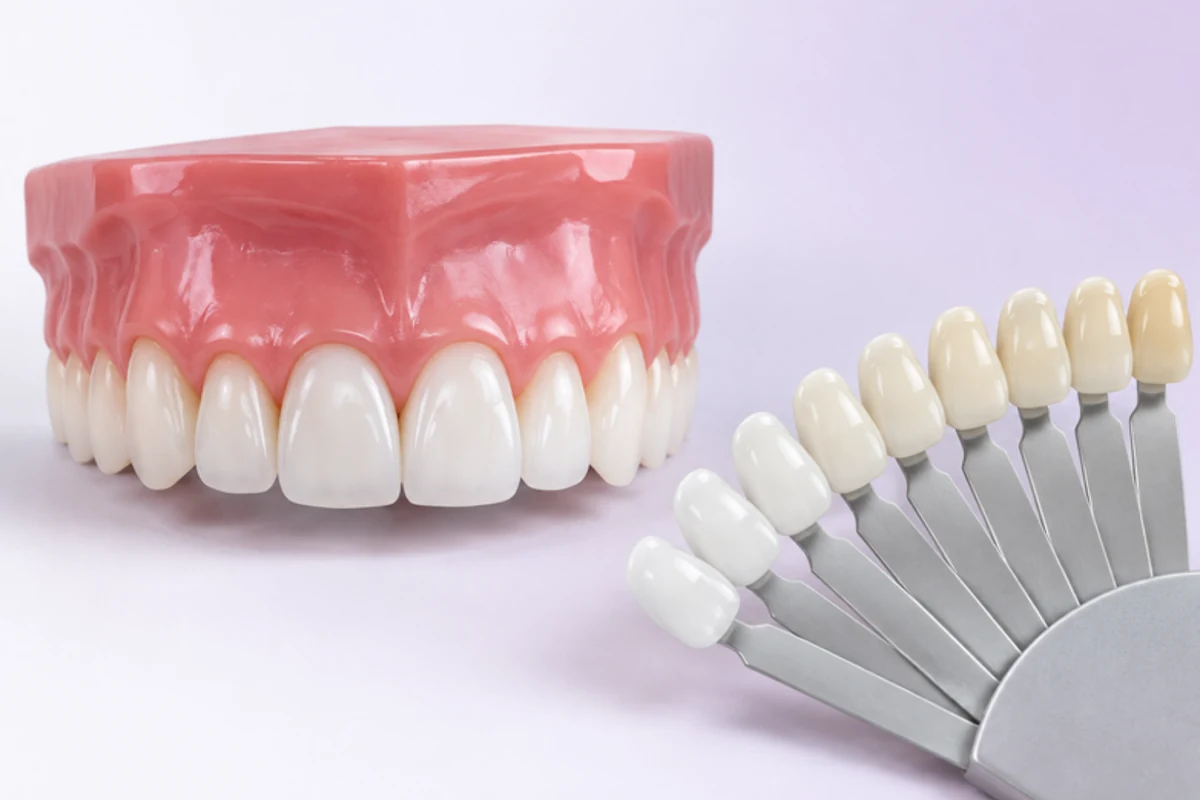
Whitening works only on natural teeth. It does not change the color of a veneer, a crown or a filling. So if you want your other teeth lighter, the usual order is to whiten first, wait for the shade to settle, and then choose the color of the veneers or crowns to match. Our clinic’s treatment page gives the same order: the shade of a veneer has to match the neighboring teeth, and a dentist usually asks for whitening to be done before the shade is chosen.
There is a bonding reason to leave a gap too. A laboratory study found that bleaching reduces the bond strength of composite to enamel, most at one day after bleaching, and that the effect was temporary: a wait of at least three days reversed it. The study tested composite, not porcelain veneers, so treat it as one reason why your dentist asks you to wait a little after whitening rather than a fixed rule.
Yellow teeth: causes and ways to brighten them
Steps and number of visits for each
Porcelain veneers and crowns follow a similar path, because both are made in a laboratory or milled from digital scans. The difference is in how many days to plan. This is how the steps usually run at our clinic.
Porcelain veneers: one trip, 10 to 14 days
- Consultation and smile design. Examination, X-rays if needed, photos, a digital scan and Digital Smile Design. If it helps, a wax-up on a model of your teeth lets you see the planned shape.
- Tooth preparation. In some cases this can be on the same day as the consultation. The dentist shapes the teeth, scans or takes an impression, and places temporary veneers.
- While the laboratory works. Porcelain veneers are made by an ISO-certified partner laboratory. This is the time you plan around.
- Try-in and bonding. You check the shade, shape and fit together with the dentist, small changes are made if needed, then the veneers are bonded permanently and the bite is checked.
Crowns: usually two visits
- Visit 1: tooth preparation. The dentist shapes the tooth, takes a digital scan or impression, chooses the shade with you and places a temporary crown. If the tooth first needs root canal treatment or a post, there is an extra visit.
- Between visits: the crown is made. The time depends on the type of crown, the treating dentist and public holidays. The fastest crowns finish in 1 day, and the second visit is usually 3 to 7 days after preparation.
- Visit 2: fitting. The dentist removes the temporary crown, checks shape, shade and bite on the new one, adjusts if needed, then cements it permanently.
If you are travelling to Chiang Mai, tell the clinic your dates when you book, so the visits can be planned to fit your stay. Fees are shown per tooth on the prices page, and the dentist confirms the cost after the examination.
How long do veneers take, and how long should you stay in Chiang Mai?
Looking after veneers and crowns
Neither treatment makes the tooth underneath immune to problems. The American Dental Association warns that you can still get cavities under or around a veneer, and Cleveland Clinic says the same care applies to crowns. The habits below protect both.
- Brush twice a day with fluoride toothpaste and clean between the teeth every day, paying attention to the gum line where the edge of the work sits.
- Avoid biting fingernails, ice, hard nuts, popcorn kernels and sticky sweets, and do not use your teeth to open bottles or packets.
- Wear a mouthguard for sports that risk a blow to the mouth.
- If you grind or clench, wear the night guard your dentist makes.
- Limit staining drinks such as coffee, tea and red wine, which can mark composite and the natural teeth beside a veneer.
- See your dentist for check-ups as advised, and contact the clinic early if a piece feels loose, chips or the bite feels high.
Mild sensitivity to hot and cold is common for a short time after preparation and bonding, and gums can feel sore for a few days. Tell your dentist if it lasts or gets worse. Lab-made veneers and crowns from our clinic have a 1-year warranty, terms apply, and it is used at the clinic in Chiang Mai.
Other options to compare
- Whitening: when the only issue is that teeth are yellow, whitening may be all that is needed, with no tooth preparation.
- Composite bonding: tooth-colored material shaped on the tooth to close a small gap or repair a small chip, often in one visit, and easier to repair later.
- Inlay or onlay: for a tooth with a large cavity or a broken cusp but mostly good structure. It protects the tooth while removing less than a crown.
- Braces or clear aligners: when the real issue is crowding or a gap, moving the teeth keeps all of the natural enamel.
- Gum reshaping: when a smile looks short because of the gums, shaping the gums may be part of the plan before any veneer.
- Bridge or implant: when a tooth is too broken for a crown to be reliable, your dentist explains replacement options.
Common myths and the facts
| Myth | Fact |
|---|---|
| Veneers need no tooth preparation at all. | Porcelain veneers usually need some enamel removed. A no-prep approach is possible only for carefully selected teeth, and the dentist decides. |
| A crown is always stronger, so it is always the better choice. | A crown removes more of the tooth. The better choice is the one that fits what the tooth needs. |
| After a veneer, the tooth can go back to how it was. | Once enamel is removed it cannot grow back, so the treatment is not reversible. A veneer can be replaced, but the tooth stays prepared. |
| A veneer or crown cannot get cavities. | The tooth underneath and the edge around it can still decay, so brushing and cleaning between the teeth still matter. |
| Whitening later will lighten my veneers too. | Whitening does not change veneers, crowns or fillings, so whiten first if you want the other teeth lighter. |
| If I grind my teeth, I cannot have veneers. | Grinding raises the risk of fractures and debonding, but a night guard lowered the risk of fractures in a study. The dentist plans around your bite. |
| Crowns always look fake. | All-ceramic crowns, including zirconia, are described as looking most like natural enamel. The result depends on the material, the shade match and the tooth position. |
Choosing between them with the clinic, step by step
- Send a few clear photos of your smile, say which tooth or teeth bother you, and add your travel dates if you are coming from elsewhere. A coordinator replies in Thai or English. The clinic is open every day from 09:00 to 20:00, except 31 December, 1 January and 13 to 15 April.
- At the visit the dentist examines the teeth and gums, takes X-rays if needed and checks your bite. Whether you grind your teeth, and whether any tooth has had root canal treatment, are among the things that shape the advice.
- The dentist explains the options for each tooth in plain words, including how much of the tooth would be shaped, and you decide together. For veneers, a Digital Smile Design lets you see the planned smile first.
- If you grind your teeth, a night guard is planned alongside the work.
- Veneers are planned and placed by dentists with postgraduate training in esthetic restorative dentistry and prosthodontics. Crowns are planned and placed by the clinic’s dentists, including those with postgraduate training in prosthodontics.
If this sounds like you: what to do
These are example situations, not patient stories, to help you find the next step that fits.
- Your front teeth are healthy but darker than you like, and whitening did not remove the stain: a veneer is often worth discussing, because it covers the front and keeps most of the tooth.
- A front tooth has a large old filling and a small crack at the edge: ask the dentist to compare a crown with an onlay-type option, because the structure matters more than the look.
- A back tooth had root canal treatment and now has a thin wall: a crown is the usual direction, because the tooth takes strong chewing forces.
- You want an even, brighter smile across the front teeth and you also grind at night: veneers can still be planned, with a night guard and a bite check built in.
- You have a small gap between two front teeth and nothing else bothers you: composite bonding or a veneer could both work, and the dentist can show you the trade-offs.
- You are planning a trip to Chiang Mai and want porcelain veneers: send photos and dates first, then plan one trip of 10 to 14 days around the visit plan.
Frequently asked questions about veneers and crowns
What is the difference between a veneer and a crown?
A veneer is a thin shell bonded to the front of a tooth, mainly to improve looks. A crown covers the whole visible tooth to protect and strengthen it, and also improves looks. A veneer suits a mostly healthy tooth, and a crown suits a tooth that is cracked, heavily filled or weakened.
Which one needs more of the tooth removed?
A crown. In a laboratory study on model teeth, veneer preparations removed roughly 3 to 30 percent of the tooth crown by weight, and full-coverage crown preparations roughly 63 to 72 percent. Real teeth vary, and your dentist explains how much your tooth needs.
Can a veneer be removed so my tooth goes back to normal?
No. Porcelain veneers usually need some enamel removed, and enamel does not grow back, so the treatment is not reversible. A veneer can be replaced, and the tooth underneath stays prepared. That is why the choice is made after planning, not on impulse.
My front tooth is chipped. Veneer or crown?
For a small chip, a veneer or composite bonding is often considered, because most of the tooth is still healthy. For a large break, or a tooth with a big filling, a crown may protect it better. The dentist decides after looking at how much healthy tooth remains.
Can I have a veneer on a root canal treated tooth?
Sometimes, for a front tooth with enough structure left, but a crown is more common, especially for back teeth. A 2025 review found that when a lot of structure was lost, crowned teeth generally did better over longer follow-up. Your dentist checks how much of the tooth is left.
I grind my teeth. Can I still have veneers?
Often yes, with a plan. Grinding raises the risk of fractures and debonding, and in one study a night guard lowered the risk of fractures. At our clinic a night guard is the recommended protection, and the dentist checks your bite before choosing the design.
How many visits and days do veneers and crowns take?
Porcelain veneers: we recommend one trip with a stay of 10 to 14 days. Crowns: usually 2 visits, and the fastest crowns finish in 1 day, with the second visit usually 3 to 7 days after preparation. Extra visits are needed if a tooth first needs root canal treatment.
Can veneers or crowns get cavities?
The material itself does not decay, but the tooth underneath and the edge where it meets the tooth can. The American Dental Association notes you can still get cavities under or around a veneer. Brushing, cleaning between the teeth and regular check-ups protect the work.
Should I whiten my teeth before a veneer or crown?
Usually yes, if you want your other teeth lighter, because whitening does not change veneers or crowns. Whiten first, let the shade settle, then choose the color of the new work. The dentist advises the timing.
Does it hurt, and will my teeth be sensitive?
Preparation is done with local anesthetic when needed. Mild sensitivity to hot and cold for a short time afterwards is common, and the gums can feel sore for a few days. Tell your dentist if it lasts or gets worse.
Does the work come with a warranty?
Lab-made veneers and crowns from our clinic have a 1-year warranty, terms apply. It is used at the clinic in Chiang Mai and covers work done at the clinic. Your dentist explains the warranty terms for your case.
Summary
Choose by what the tooth needs. A mostly healthy front tooth that needs a new look often suits a veneer, which keeps more of the tooth. A cracked, heavily filled or root-canal treated tooth, or a back tooth, often suits a crown. If you grind your teeth, plan a night guard with either.
- A veneer covers the front of the tooth; a crown covers the whole visible tooth.
- Veneers usually need much less tooth shaped, but porcelain veneers still need enamel removed and cannot be undone.
- Treat decay and gum problems first, and whiten before choosing the shade.
- Porcelain veneers: one trip, 10 to 14 days. Crowns: usually 2 visits.
- Send photos of your smile and your travel dates, and the dentist advises after an examination.
References
American Dental Association (MouthHealthy): Veneers
American Dental Association (MouthHealthy): Crowns
Cleveland Clinic: Dental Crowns
Imad R et al. Evaluation of E-max porcelain veneer failures: a retrospective study. Cureus 2024
Faculty of Dentistry, Naresuan University: Veneers (Dr. Pornpot Jiangkongkho)