
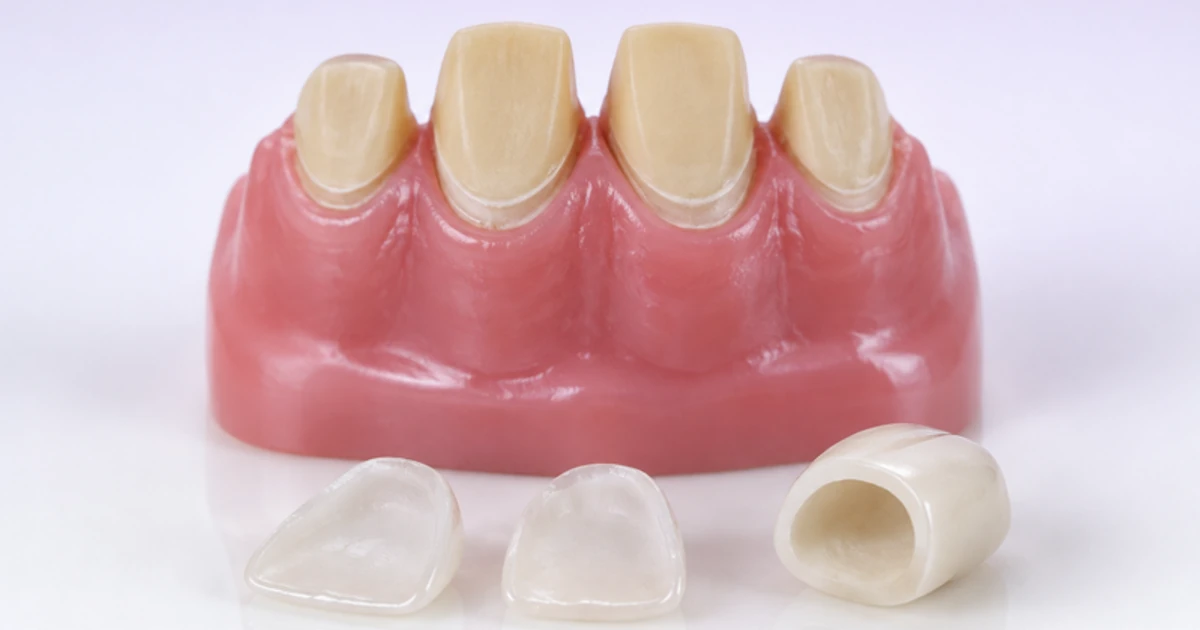
Veneers that looked great at first can, after some years, stop matching the teeth next to them, show a visible line at the edge, or partly come off. An old crown may start to leak at the edge, and sometimes there’s decay hiding underneath where you can’t see it.
When it’s time to replace them, patients usually ask two things: “How much of my tooth will be left?” and “Can a laser help?” The short answer: a laser can help remove veneers and crowns, but once they’re off, the old bonding layer still has to be polished off and the tooth smoothed before the new piece is made. How much tooth is lost depends on the existing material and how it was bonded, and your dentist needs to see your actual tooth to tell you.
Quick summary
- Reasons to remove a veneer or crown: it has come loose or broken, the color doesn’t match, the edge leaks, or there’s decay under it
- Some problems only need polishing or a repair, not removal
- A laser can help remove veneers and crowns, but the old bonding layer still has to be polished off and the tooth smoothed every time
- A laser can’t pass through metal, so crowns with metal are removed the usual way, with a drill
When should a veneer or crown be removed?
Compare with what you’re seeing. This is a rough guide, not a diagnosis.
No need to remove it yet if the color has changed slightly, there’s some staining at the edge, or you’re not entirely happy with the shape but have no symptoms. Your dentist may be able to polish or repair it, and a small chip can sometimes be repaired too.
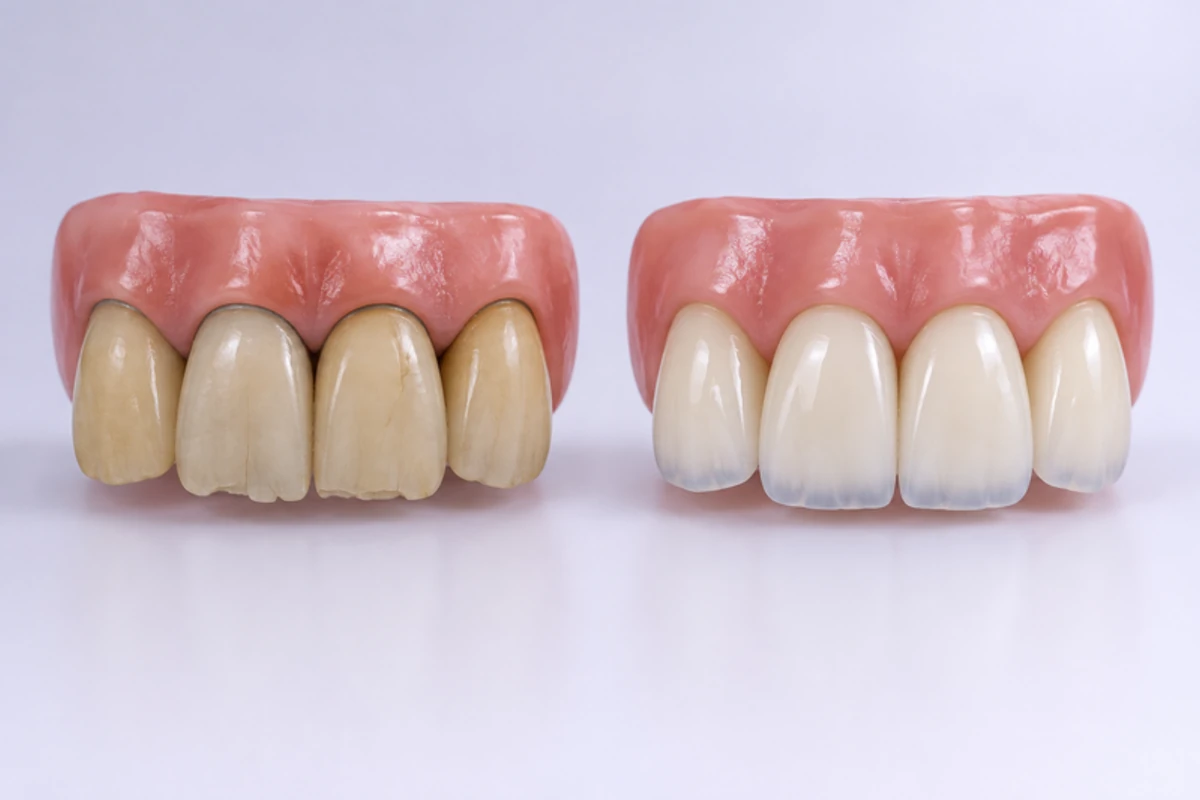
Book a check to plan ahead if the edge shows as a clear line or catches your floss, food gets stuck there regularly, the gum around it is red or bleeds, or the color no longer matches the teeth next to it.
It’s time to remove it if it has come off or broken badly, the edge clearly leaks, or there’s decay underneath. Decay hidden under a veneer or crown often can’t be seen with the naked eye. It shows up on an X-ray, and the piece has to come off so the decay can be cleared. Removal is also needed when your treatment plan changes, for example if you need root canal treatment or your whole mouth is being restored.
How veneers and crowns are removed
Before starting, your dentist checks the things that decide how much tooth will be lost: what the existing piece is made of (ceramic, zirconia, metal or resin), how it was bonded and what cement was used, the condition of the tooth underneath on an X-ray, and your bite. If grinding your teeth at night is what broke the old piece, the cause needs fixing too, for example with a night guard.
There are several ways to remove a veneer or crown, and your dentist chooses what suits yours.
- Cutting it off with a drill. The standard method. The dentist cuts a groove or divides the piece into sections, then lifts it off. It works for almost any material, including crowns with metal.
- Using a laser. The Waterlase laser loosens the cement layer under the piece, which is then gently lifted off (more in the next section).
- Both together. The laser does part of the work, and the drill handles any part that’s still firmly attached.
- Polishing or adjusting. Composite resin can often be polished or reshaped without removing the whole piece.
Whichever method is used, once the piece is off, the old bonding layer has to be polished off and the tooth smoothed before the new piece is made. This step touches the tooth surface slightly, which is why no one can tell you in advance exactly how much tooth will be lost.
How much can a laser help?
Patients thinking about replacing their veneers often ask about lasers, because they want to keep as much of their own tooth as possible.
A laser can help remove veneers and crowns. The dentist uses the Waterlase laser to send energy through the thin restoration to the cement underneath. This loosens the piece from the tooth so it can be gently lifted off. A water spray keeps the area cool during the procedure.
Afterwards, the old bonding layer still has to be polished off and the tooth smoothed. So a laser doesn’t mean your tooth isn’t touched at all.
Good to know:
- The result depends on the type and thickness of the piece, the type of cement and the condition of the tooth. Your dentist assesses this before starting, but can’t promise the outcome in advance.
- Some cases need drilling as well, especially thick or very firmly bonded pieces.
- A laser can’t pass through metal, so crowns with metal are removed the usual way, with a drill.
- The old piece usually can’t be reused, even if it comes off intact. This is especially true if it was removed because of the color, a leaking edge or decay underneath, since that problem has to be fixed before a new piece is made.
To find out whether your veneer or crown suits laser removal, your dentist will look at it and your X-ray and explain. See our service page on laser dentistry.
What happens after removal
Your options depend on how much tooth is left, why the old piece was removed, and what you’d like.
- New veneers suit teeth with good enamel underneath and no decay. See porcelain veneers and how long veneers take.
- A crown suits a tooth that has lost a lot of structure, has deep decay, or has had root canal treatment. See dental crown treatment and which crown material to choose.
- Composite bonding suits simpler problems when you want to keep as much tooth as possible. See composite bonding.
- Treating the gum or the problem underneath first, such as inflamed gum around the edge or decay under the piece. See gum treatment.
which crown material to choose
Between removing the old piece and fitting the new one, your dentist will usually make you a temporary to wear. The number of visits depends on the material and the plan you choose, and your dentist will tell you after the exam.
If a veneer or crown comes off
No need to panic. Here’s what to do:
- Keep the piece in a clean, dry container. Don’t throw it away.
- Don’t stick it back on with regular glue.
- If the tooth is sensitive or has a sharp edge, be careful with your tongue and cheek, and chew on the other side.
- Contact the clinic to find out whether it can be bonded back on or needs to be remade. The clinic also looks after work done elsewhere that has come off.
Read more: A crown has fallen off: what to do.
Contact the clinic soon if there’s pain or swelling under the piece, pus, or an unusual taste or smell. If you have a fever with facial swelling, or difficulty swallowing, see a doctor right away.
Frequently asked questions about removing veneers and crowns
Does removing a veneer mean losing more tooth?
The tooth surface is touched slightly when the old bonding layer is polished off and the tooth is prepared. How much depends on the existing material and how it was bonded. Your dentist can’t give you a number in advance, but will choose the method that removes as little tooth as possible.
Can a laser remove both veneers and crowns?
It can help with both, but it depends on the material, the cement and the tooth. Some cases need drilling as well, a laser can’t be used on crowns with metal, and in every case the old bonding layer is polished off and the tooth smoothed afterwards.
With a laser, is there no drilling at all?
Not always. The laser helps take the piece off, but the old bonding layer still has to be polished off and the tooth smoothed every time, and some cases still need drilling.
Can the old veneer or crown be put back on?
Usually not, especially if it was removed because of the color, a leaking edge or decay underneath. Your dentist can tell you after the exam.
My veneer doesn’t match my other teeth. Does it have to come off?
Not always. Ceramic doesn’t change color with whitening, so if you’re happy with the shape, your natural teeth can sometimes be whitened to match it. Your dentist will assess this.
What does it cost, and how many visits will I need?
It depends on the removal method and the new work. See the relevant sections of the prices page and laser. Your dentist will tell you the number of visits after the exam.
Summary
- Removal is for pieces that have come off, broken, leak at the edge or have decay underneath. Minor problems only need polishing or a repair.
- A laser can help remove veneers and crowns, but the old bonding layer still has to be polished off and the tooth smoothed every time.
- Some cases need drilling as well, and crowns with metal are removed the usual way.
- After removal there are several options, and your dentist explains the pros and cons before you decide.
If you’d like the dentist to look at your veneer or crown and explain the options, you can book an appointment at Kitcha Dental Clinic, call +66 53 200 201 or message us on LINE @kitchaclinic.
Sources for this article
- Research and reviews on laser debonding of veneers and ceramic crowns, 2023-2026
- FDI World Dental Federation, revised criteria for evaluating dental restorations, 2023
- The clinic’s own experience, and the laser dentistry page