
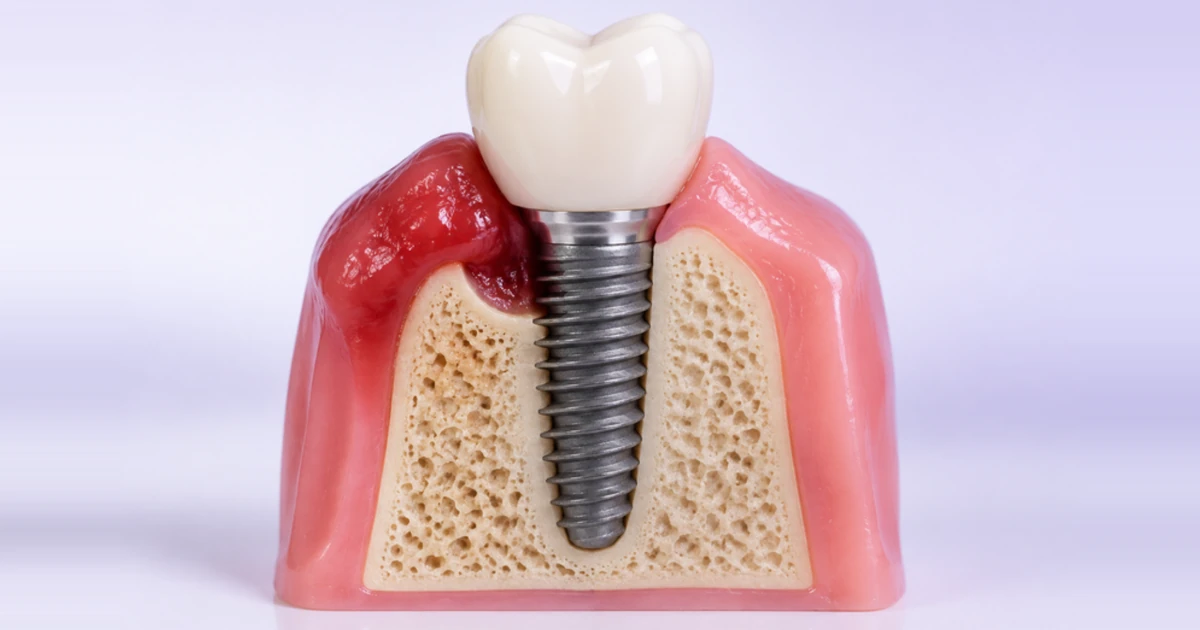
If you have a dental implant and notice blood on your toothbrush around it, or the gum there looks more swollen than usual, your first thought is probably: “Is something wrong with my implant? Will it have to come out?”
The good news is that most of the time it hasn’t come to that. If the problem is found early and the area around the implant is cleaned thoroughly, your dentist will usually aim to keep your implant in use. This article explains, in plain language, what peri-implantitis (sometimes called an infected implant) is, what to look out for, what your dentist does, and how you can look after it at home.
Quick summary · Peri-implantitis is inflammation of the gum around an implant that has spread to the bone. It usually starts with plaque. · Common signs are bleeding, swelling, redness and pus. Many people feel no pain. · Your dentist examines your mouth and checks X-rays, then treats it in steps: first cleaning around the implant, then a re-check. · A laser is an add-on chosen case by case. It doesn’t replace cleaning around the implant. · Don’t wait for it to clear up on its own. Have it checked.
Signs to look for
Common signs around an implant:
- Bleeding when you brush or use an interdental brush
- Gum that is red, swollen or softer than usual
- Pus, a strange taste, or bad breath coming from that area
- Gum that has shrunk back (receded) so the implant threads show
- Food getting caught deeper around the crown than before
- In later stages, the implant may feel loose
An important point: in the early stage, many people have no pain at all. That’s why bleeding is a sign worth taking seriously. “It doesn’t hurt, so it’s fine” isn’t always true.
Compare with what you’re seeing (a rough guide, not a diagnosis)
- A little bleeding once or twice: clean around the implant more carefully, as described in the care section below. If it isn’t better within 1-2 weeks, book a check-up.
- Bleeding that keeps coming back, or gum that stays red and swollen: book a dentist visit and an X-ray. Don’t wait for this to clear up on its own.
- Pus, fast swelling, throbbing pain or a loose implant: contact the clinic promptly.
What is peri-implantitis?
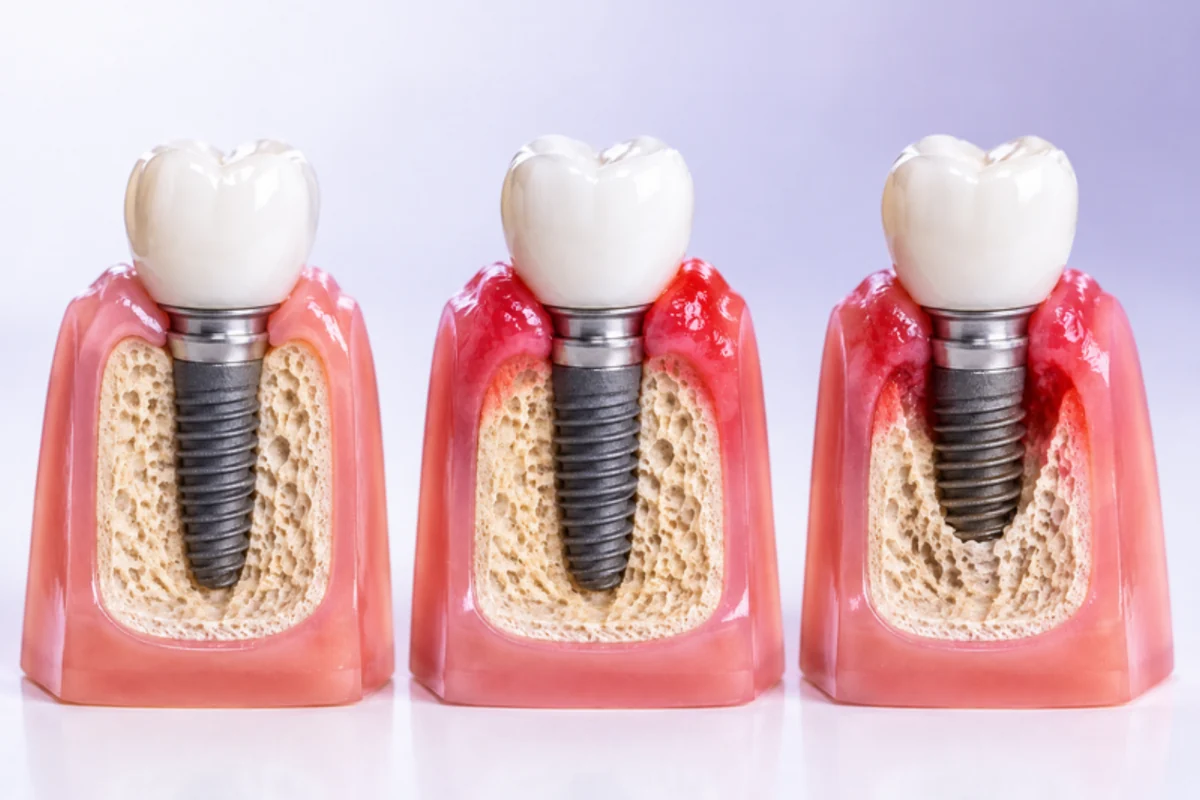
An implant can’t decay like a natural tooth, but the gum and bone around it are living tissue. They can become inflamed when plaque builds up. There are two stages.
1. Inflamed gum around the implant (peri-implant mucositis). Only the gum is inflamed, and the bone isn’t affected yet. At this stage the gum can get back to normal with careful, regular cleaning around the implant.
2. Peri-implantitis. The inflammation has reached the bone that holds the implant, and the bone slowly breaks down. This stage needs treatment from a dentist, and waiting isn’t advised: if it’s left, more and more bone is lost.
This is why regular implant check-ups are worthwhile. They catch the early stage, while it’s still easier to reverse. For the bigger picture, read how long dental implants last and dental implant aftercare.
What causes it?
The main cause is plaque building up around the implant and crown. Other factors make it more likely to start, or make it progress faster.
- Not cleaning thoroughly around the implant, especially at the gum line and under the crown
- Skipping regular check-ups and cleanings, even when nothing feels wrong
- A history of gum disease or severe periodontitis, so tell your dentist, and get the gums around your natural teeth under control too
- A crown that’s hard to clean, or cement left under the gum. Your dentist checks for this, and some crowns need reshaping
- Smoking, poorly controlled diabetes and teeth grinding. Their direct link to peri-implantitis is less clear than the factors above, but they’re worth managing as part of your overall oral health
Note: these factors describe risk, not blame. People who look after their implants well can still get it, and some people with risk factors never do. Your dentist looks at your situation individually.
What your dentist does for peri-implantitis
Checking
- Your history: your symptoms, when the implant and crown were placed, health conditions, medicines, smoking, and how you clean at home
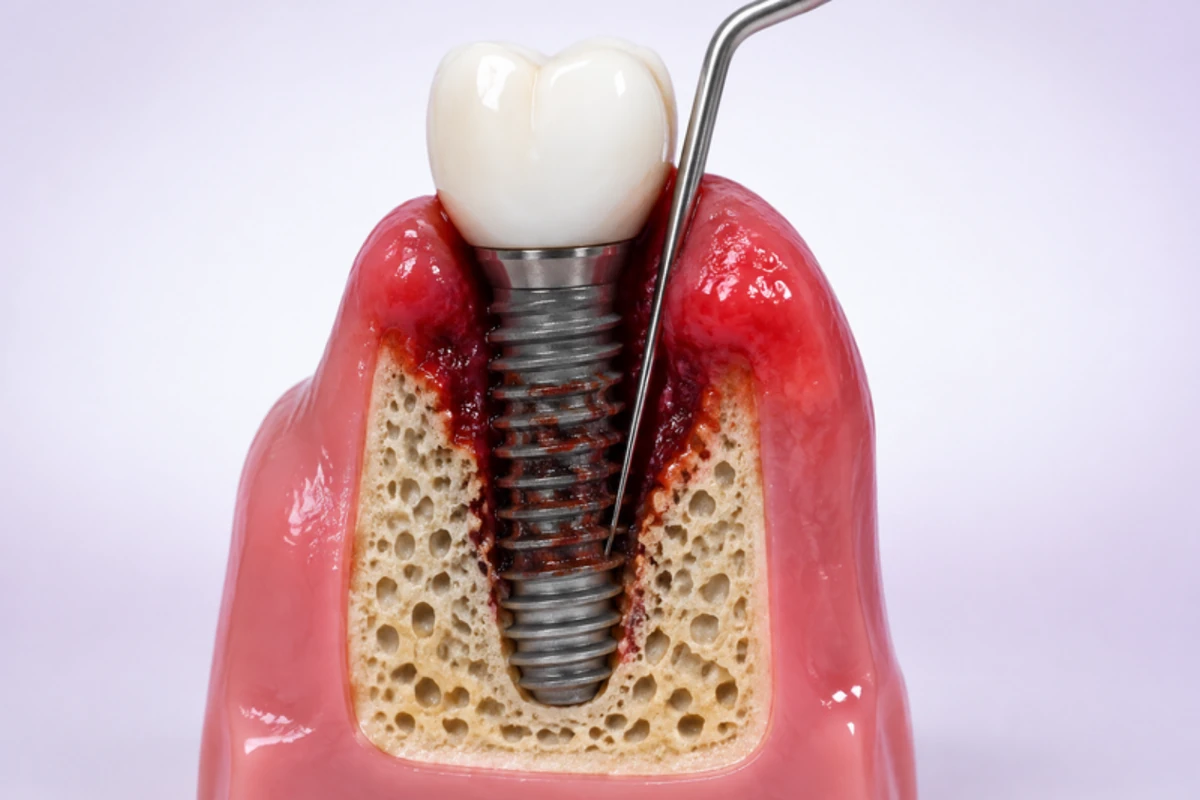
- The gum around the implant: color, swelling, a gentle measurement of the gum pocket with a blunt probe, and any bleeding or pus
- The crown and your bite: whether it’s easy to clean, and whether biting force or grinding needs attention
- X-rays: to see the bone level around the implant and compare it with older images. An X-ray from when the crown was first fitted is very helpful, so bring it if you have one
Treatment is done in order, and your dentist adapts it to you.
- Tackling the cause and teaching cleaning: how to brush and use interdental brushes around the implant at home, managing risk factors such as smoking, and reshaping the crown if it’s hard to clean
- Cleaning around the implant with instruments (no surgery): removing plaque and tartar around the implant, above and below the gum line, then a re-check a few weeks later
- Surgery to open the gum: if things aren’t improving, the dentist lifts back the gum to properly clean the implant surface and the inflamed tissue. Some people may also have a bone graft, depending on the bone
- Removing the implant (only when necessary): considered when the disease can’t be controlled. The dentist explains why, and the replacement options, first
- Ongoing follow-up: the problem can come back after treatment, so regular checks around the implant are needed
Three things patients often ask about:
- Antibiotics aren’t the main treatment and aren’t used routinely. The dentist uses them only in selected cases.
- Mouthwash can help in some cases if your dentist recommends it. It doesn’t replace cleaning around the implant with instruments.
- How it feels: before starting, your dentist explains how your comfort will be looked after. Afterwards, most discomfort is mild to moderate and is strongest in the first two days.
Surgery for peri-implantitis is delicate work. European dental guidelines recommend that it be done by a dentist with specific training in this area.
How the clinic uses the laser
Many patients ask about lasers, so here’s a straight answer.
The clinic has a Waterlase laser. For some patients, the dentist may use it as an add-on, alongside the usual cleaning around the implant with instruments.
What you should know: the evidence on lasers for peri-implantitis is still limited. Most studies follow patients for only a short time. They suggest a laser can reduce inflammation somewhat, but not that it works better than careful cleaning with instruments, and European dental guidelines don’t currently recommend using a laser routinely.
So a laser isn’t a substitute for cleaning around the implant, and it isn’t a sure cure. The result depends on the overall cleaning, the condition of the bone and your ongoing care. If you’d like to know whether a laser suits your case, your dentist will explain after examining you. You can read about the clinic’s laser on the laser dentistry page.
Care and prevention
Inflamed gum around an implant can recover, but peri-implantitis that has reached the bone is much harder to treat. Prevention is well worth it for your implant.
At home
- Brush twice a day with a soft toothbrush, angling the bristles toward the gum line around the implant and crown
- Clean around the implant every day with an interdental brush of the right size or implant floss. Ask your dentist or dental assistant to help you choose the size and show you how
- If you smoke, cutting down or quitting helps the gums in your whole mouth
- If you grind your teeth, ask about a night guard
- If you have diabetes, keep it under control with your own doctor
Care at the clinic
- The clinic recommends a professional cleaning every 6 months and an implant check once a year
- If you’ve had peri-implantitis before, your dentist will set more frequent check-ups based on your risk
- Comparing X-rays over time helps spot changes in the bone early
When to see a dentist soon about your implant
No need to panic, but contact us soon if:
- There is pus, or a pimple-like bump on the gum around the implant
- The swelling is getting worse quickly, or there’s throbbing pain
- You have a fever along with the gum symptoms
- The implant or crown feels loose
- Bleeding happens every day, or things aren’t better after 1-2 weeks even with careful cleaning
If you have a fever together with facial swelling, or difficulty swallowing, go to the nearest doctor or emergency department right away.
Frequently asked questions about peri-implantitis
Can peri-implantitis go away on its own?
Don’t wait for it to. When only the gum is inflamed, it may improve with thorough cleaning. But once the inflammation has reached the bone, it needs treatment from a dentist.
Does an infected implant always have to be removed?
No. The dentist’s first aim is to keep the implant. Removal is only considered if the disease can’t be controlled, and that’s decided case by case.
Does treatment hurt?
Your dentist looks after your comfort during treatment. Afterwards you may have mild to moderate discomfort, strongest in the first two days. If you’re worried, tell your dentist before you start.
Do I need antibiotics?
Not always. Antibiotics aren’t the main treatment. The key is cleaning around the implant with instruments, and the dentist prescribes them only when they’re needed.
Can it come back after treatment?
Yes, it can. That’s why daily cleaning at home and regular check-ups after treatment matter. Your dentist will tell you how often to come in.
Is mouthwash enough?
No. The core of treatment is removing plaque around the implant: brushing, cleaning between the teeth, and professional cleaning by the dentist. Mouthwash only helps in some cases.
Can an implant placed many years ago still get it?
Yes, it can happen at any time. It depends on plaque and your own risk factors, not just how old the implant is. A yearly check helps catch changes early.
How much does peri-implantitis treatment cost?
It depends on how advanced the inflammation is and which steps you need. The dentist assesses this and tells you before starting. See the relevant sections on the prices page and for laser.
Summary
- Peri-implantitis is inflammation of the gum around an implant that has reached the bone. It usually starts with plaque, and many people feel no pain.
- Bleeding, swelling and pus are signs to have checked by a dentist.
- Treatment goes in steps: learning to clean well and cleaning around the implant with instruments, a re-check, then surgery if it isn’t improving.
- A laser is an add-on the dentist chooses case by case. The evidence is limited, and it doesn’t replace cleaning.
- You can help prevent it with daily cleaning around the implant, a professional cleaning every 6 months and an implant check once a year.
If you’d like a dentist to examine you and explain your options, you can book or send your X-ray film for a first look at Kitcha Dental Clinic by phone on +66 53 200 201 or by WhatsApp on +66 91 797 7888. Related services: dental implants – gum treatment – laser dentistry
book or send your X-ray film for a first look
Sources for this article
- European Federation of Periodontology (EFP), clinical practice guideline on the prevention and treatment of peri-implant diseases, 2023
- Systematic reviews on laser in non-surgical treatment of peri-implantitis, 2024 and 2025
- Clinic laser information: the laser dentistry page