
You are trying to choose between four implants and six implants to hold a whole arch of teeth, and every page seems to say something slightly different. One says six is stronger. Another says four is enough. A third talks mostly about price. You just want to know which one is right for your mouth, how many times you must travel to Chiang Mai, and what your teeth will look like in the weeks in between.
The short version is reassuring. Both options give you a fixed full-arch bridge that only your dentist removes. Reviews of the research find that implant and bridge survival is similar for the two. The difference is mostly in how the load is shared and in which mouths need the extra support, and that is decided from your own scan, not from the number in the name.
This article walks through the differences in a table, what the research says, a checklist to see which group you fall into, how the dentist decides, the two trips step by step, temporary teeth, eating and cleaning, comparison with dentures and single implants, planning if you live far away, and the questions people ask most.
In short: All-on-4 uses four implants, with the back two usually tilted, and All-on-6 adds two more where extra support is wanted. Research finds similar survival for both. Your dentist chooses from your CBCT scan, bite and health, and both are one price per jaw. Plan two trips to Chiang Mai.
All-on-4 and All-on-6: what is actually different
Both replace all the teeth in one jaw with a bridge that is fixed on implants. The bridge does not come out when you eat or sleep, and only your dentist takes it off for maintenance. What differs is how many implants hold it and where they are placed.
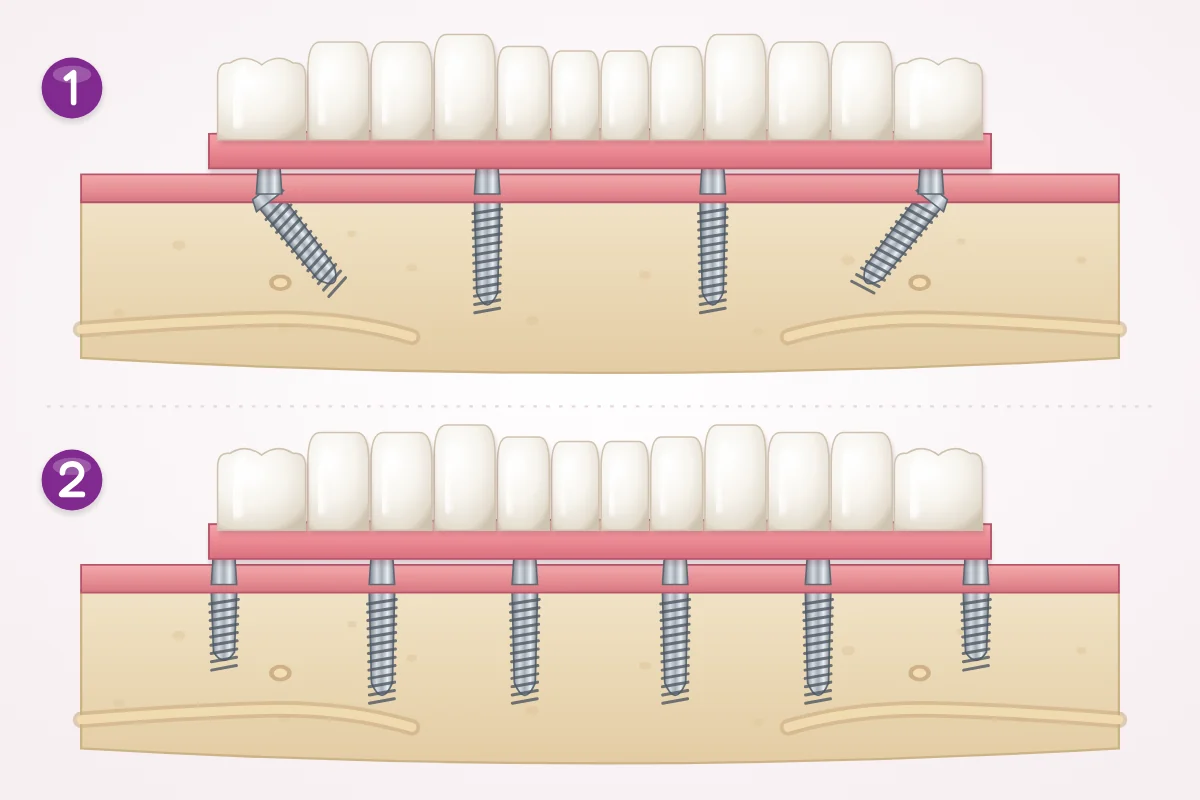
In All-on-4, two implants go in the front and two go in the back, and the back ones are usually tilted. Tilting lets the implant sit in bone you already have, so it often needs less bone grafting than placing an implant for every tooth. All-on-6 adds two more implants where more support is wanted, which spreads the bite over more points.
| What to compare | All-on-4 | All-on-6 |
|---|---|---|
| Number of implants | Four per jaw | Six per jaw |
| How they are placed | Two in front, two at the back, the back two usually tilted. | Six spread along the arch, set by the scan and the bite. |
| Bone it works with | Often used to make the most of the bone already there, which can reduce grafting. | Needs enough bone in more places, or a graft first when it is missing. |
| How the bite is shared | Shared by four supports, with the bridge extending behind the back implants. | Shared by six supports, so each carries a smaller share. |
| Trips and timing | Two trips, with healing in between. | Two trips, with healing in between. Grafting, if needed, can lengthen the healing. |
| Pricing | One price per jaw. | One price per jaw, the same as All-on-4. |
Notice what the table does not say: it does not say one is better. A well-planned set of four can do a good job in the right mouth, and six is not automatically needed. The number is the result of a decision, not the starting point.
Full-mouth implants and All-on-4
If the front teeth are your main worry, it is worth knowing that the look of the final bridge depends on the lip line, the gum shape and the bridge design, not on whether four or six implants sit underneath. Your dentist plans these together with the implants.
What the research says about four versus six
The strongest evidence comes from reviews that pool many studies. One systematic review and meta-analysis looked at fixed bridges on the upper jaw supported by four or six implants. It screened 1,099 articles and included 53. Implant survival, bridge survival, and technical and biological complications did not differ significantly between four and six. Bone around the implants was lost significantly more with four implants. The same review found that a milled framework and implants spread from front to back were linked to better implant survival in the six-implant group.
A separate randomized trial compared four and six implants for an upper bridge placed with guided surgery, with 40 patients. Over the follow-up, a few more implants were lost in the six-implant group than in the four-implant group, but the difference was not statistically significant. No bridge failed, and bone loss and complications did not differ significantly. The authors concluded that both approaches may be a predictable option, and asked for longer trials.
A large retrospective study followed 217 patients with 271 immediately loaded full-arch bridges. Overall, implant survival, bridge survival, complications and bone loss did not differ significantly between four and six. In some subgroups, such as older patients, people who smoke, people who grind their teeth, those with low bone density and bridges with long extensions, six implants looked more predictable. The researchers also noted that experienced implant prosthodontists showed a preference for six.
For All-on-4 on its own, a systematic review of 13 papers covering 4,804 implants reported that most failures happened in the first year after surgery, and found no significant difference between tilted and straight implants. It also pointed out that studies were limited in quality and that data were missing for longer follow-up.
What this means for you: the research does not say one option wins for everyone. It says both work, and that the extra implants matter more in mouths with risk factors. These are results from studies, not figures for any one clinic.
Who is a good fit, and what the dentist looks at
No checklist can choose for you, but it helps you know what to tell the dentist and what to expect. Read the three groups below and see which one sounds most like you.
Often a good fit for a full-arch bridge
- You have lost most or all of the teeth in one jaw, or the teeth you still have cannot be saved.
- Your full denture moves when you eat or speak, and you would like fixed teeth.
- Your gums are healthy, or gum problems have been treated first.
- You are happy to clean around the bridge every day and come for regular maintenance visits.
Points your dentist will look at closely
- Bone: how much there is, how dense it is, and where. Thin or low bone can mean a graft or a sinus lift before or during surgery.
- Smoking: research links smoking with more bone loss around implants and with a higher chance of implants failing to settle. Stopping, and staying stopped, helps.
- Grinding or clenching: research links it with a higher chance of implant failure and of broken or worn parts. A bite guard is usually advised.
- Health conditions: poorly controlled diabetes and some medicines can affect healing. Bring a list of your medicines and tell the dentist about every condition.
- Gum health and cleaning: gum inflammation around implants is the main long-term problem, so your ability to clean matters as much as the surgery.
May need another plan, or other steps first
- Some teeth can still be saved. Your dentist tells you which, and a plan that keeps them may suit you better.
- There is an active infection or untreated gum disease. It is treated first.
- You prefer to avoid surgery, or the budget points to a removable denture. Implants are not the only way, and a denture or an implant-retained denture can also suit you.
How the dentist decides between four and six
The decision comes from what is found, step by step. It starts with questions and an examination, then a 3D CBCT scan that shows the bone in three dimensions.
- Bone volume and quality. The scan shows height, width and density in each area, and where the sinus and nerves lie, so implants are placed with room to spare.
- Bite force and habits. Strong biting, grinding and clenching put more load on the implants, and may point toward more supports or a bite guard.
- The opposite jaw and the bridge design. What you bite against, how far the bridge extends and what it is made of change the load on each implant.
- Gums, remaining teeth and health. Gum disease, teeth that cannot be saved and medical conditions all affect the plan and the timeline.
- Your wishes. How you want to chew, smile and clean also count, and your dentist explains the choices so you can decide.
If radiation worries you, it helps to know that X-rays inside the mouth at our clinic are digital, taken with plates and sensors that help lower the dose compared with film. The Planmeca ProMax CBCT has an Ultra Low Dose mode, your dentist chooses the mode that suits each case, and X-rays are taken only when they are needed.
Dental X-ray radiation: how much is it, and how we keep it low
If a recommendation worries you, you are welcome to ask questions and to seek a second opinion. A comprehensive examination should come first, and the discussion of costs should follow the discussion of your options.
How many trips to Chiang Mai, step by step

Plan two trips. Between them, you go home while the bone grows onto the implants. Here is how it usually runs.
- Before you book: send recent X-rays, scans or photos. A dentist reviews them and gives a preliminary opinion, and the visits are planned around your travel dates.
- Trip 1: examination, CBCT scan, treatment plan, then implant surgery under local anesthesia. Your dentist plans how many days this takes for your case.
- Travel home: when you can fly depends on your case, and your dentist confirms it. After a sinus lift, avoid flying until your dentist says the area has healed enough.
- Healing: the bone grows onto the implants. How long this takes depends on your case, and bone grafting can make it longer.
- Trip 2: impressions or scans, a try-in, and the final full-arch bridge is fixed.
- After that: daily cleaning at home, and regular maintenance visits.
These time frames are what the clinic plans for most patients. Your own timeline depends on your bone, whether a graft is needed and your health, and your dentist confirms it after the CBCT scan. Both All-on-4 and All-on-6 follow the same two-trip pattern.
Planning treatment from abroad
Will I have teeth in between?
This is the question that worries people most, and the honest answer is that it depends on the case. A fixed temporary bridge can be fitted in some cases, depending on how stable the implants are, and your dentist assesses this. Your dentist explains the plan for your temporary teeth before the surgery, so you know what to expect when you wake up and when you go home.
If a fixed temporary bridge is not suitable in your case, your dentist explains what you can wear in the meantime. Either way, the temporary teeth are not the final teeth. They are lighter-duty, so you follow the food advice below until the final bridge is fitted.
The first weeks: eating and getting used to it
- Expect some soreness and swelling for a few days. Your dentist advises on pain relief and gives written aftercare instructions.
- Choose soft foods at first and avoid biting hard or sticky food on the new teeth. Your dentist tells you when to move on to a wider range.
- Speech can feel different for a short while as your tongue learns the new shape. It usually settles with practice.
- Keep clean from the first day, as your dentist shows you. Take medicines as prescribed and come back for the checks that were planned.
- Tell your dentist at once about increasing pain, a loose part, fever or swelling that gets worse instead of better.
Dental implant surgery: what it feels like and how long to rest
Cleaning and looking after a full-arch bridge
A bridge on implants does not decay, but the gums around the implants can become inflamed if plaque builds up. When plaque builds up around an implant it can cause peri-implantitis, with red or swollen gums, bleeding, and in time a loose implant. Cleaning well is what protects your investment.
- Brush twice a day with fluoride toothpaste, including the gum line and the underside of the bridge.
- Clean around and under the bridge every day with interdental brushes. Your dentist shows you the sizes and any other aids that suit the shape of your bridge.
- Come for scaling every 6 months and for an implant check once a year. Your dentist can take the bridge off for a thorough clean when needed.
- If you grind your teeth, wear the bite guard your dentist advises. It protects the bridge and the implants.
- If you smoke, stopping helps the gums around the implants.
Parts of an implant can also loosen or wear with time, which is another reason for regular checks. If a part loosens, treating it early keeps small problems small.
After dental implant surgery: aftercare from the first day to the new crown
Compared with dentures and single implants
A full-arch bridge is one of several ways to replace all the teeth in a jaw. Each suits different bone, health and budgets, so here they are side by side.
| Treatment option | What it is like | Often considered when |
|---|---|---|
| All-on-4 or All-on-6 bridge | Fixed on four or six implants. Stays in place and is removed only by your dentist. | You want fixed teeth, have enough bone or accept a graft, and can clean daily. |
| Implant-retained overdenture | A removable denture that clips onto implants, so it moves less than a conventional denture. | You are happy to take the denture out for cleaning, or would like fewer implants. |
| Full denture | A removable denture with no surgery, including digital dentures. | You prefer no surgery, or implants are not suitable for you at present. |
| An implant for each tooth | One implant per missing tooth, which for a whole jaw means many implants and more surgery. | Only some teeth are missing, and implants can carry a bridge so you may not need one for every tooth. |
There is no single right answer. A bridge or a removable denture can be the right choice for some people, and your dentist explains the options that fit you after the examination and the scan.
Removable dentures, fixed bridges or implants: how to choose
Before dental implant treatment: checks, visits and costs
If you live far away or abroad
Many patients come to Chiang Mai from another province or another country for this treatment, and the two-trip plan is built for that. Planning ahead makes the journey smoother.
- Send recent X-rays, scans or photos by email, WhatsApp, LINE or Messenger. A dentist in the relevant specialty reviews them and gives a preliminary opinion. The final plan always needs an examination in person.
- Tell us your travel dates before you book flights, so the visits are planned around them. If your plans change, you can reschedule or cancel; please let us know in advance.
- Coordinators reply in English and Thai, and a coordinator who speaks Chinese is available. If English is hard to follow, we can explain again or send the explanation as a written message by email or WhatsApp.
- Your coordinator can help arrange a car from the airport or your hotel; you pay the fare.
- Direct billing is available for eligible Cigna, Allianz, International SOS and April patients, after benefit verification and pre-authorization. Contact us before your visit so we can check your cover.
The price is the same for everyone, whether you are Thai or from another country.
Planning treatment from abroad
Feeling anxious about the surgery
The surgery is done under local anesthesia, so the area is numbed and you should feel pressure rather than sharp pain. Tell your dentist at once if you feel anything sharp. Some soreness and swelling for a few days afterwards is common.
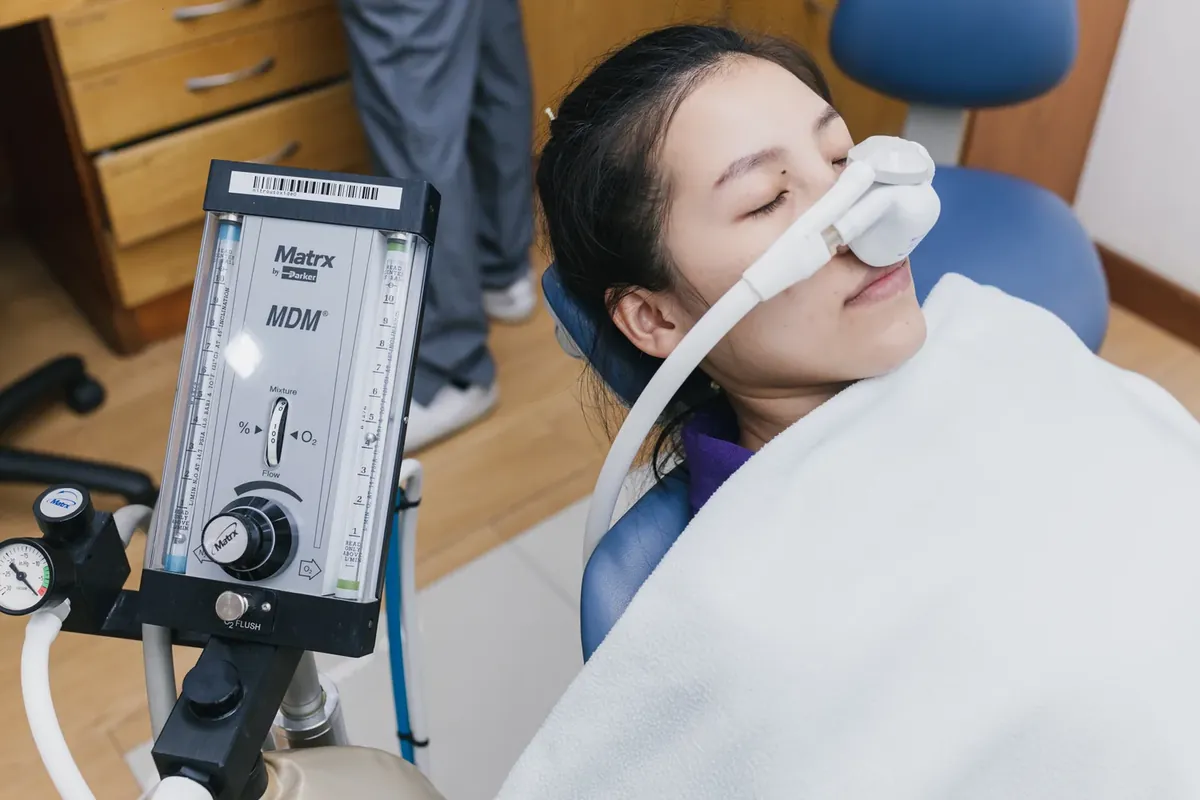
If you feel anxious, two options can help you feel calmer: inhaled sedation through a small nose mask, and an anti-anxiety tablet taken before treatment. With both you usually stay awake and can talk with your dentist. Your dentist reviews your health and medicines first and decides which, if either, suits you. If treatment under general anesthesia is ever needed, we refer you to a hospital and coordinate your care.
Afraid of the dentist? How to make dental visits easier
What the price includes
All-on-4 and All-on-6 are one price per jaw, with a hybrid full-arch acrylic bridge. You can upgrade the final bridge to zirconia for an additional fee per jaw. CBCT, bone grafting and medicines are charged separately, only if you need them.
Your final fee depends on what the examination finds, and your dentist explains it before treatment starts. 1-year warranty on the restoration, terms apply, used at our clinic in Chiang Mai. The prices page lists the fees by category.
If this sounds like you: what to do
These are example situations, not patient stories, to help you find the next step that fits.
- You have lost most of your upper teeth, the rest are loose, you do not smoke and your health is good: you may be a candidate for either. Send an X-ray, book the first trip and let the CBCT scan settle the four-or-six question.
- You were told your back upper jaw has little bone: your dentist may tilt the back implants to use the bone you have, or suggest a graft or sinus lift first. The plan can add time, so tell the coordinator your travel dates early.
- You grind your teeth at night: research links grinding with more broken or worn parts on implant bridges. Ask whether six implants and a bite guard suit your bite.
- You smoke: stopping is a very useful step to take before surgery. Tell your dentist honestly, so the plan and the aftercare fit you.
- You live abroad and can spare about two weeks at a time: send your records first and share your flight dates. Your dentist plans the visits, and when you can fly home, with you.
- Your lower full denture keeps moving and you would rather avoid a large surgery: compare an implant-retained denture with a fixed bridge. Each has different upkeep, so ask which one you would be comfortable cleaning every day.
Common myths and the facts
| Myth | Fact |
|---|---|
| More implants are always better. | Research finds similar survival for four and six. Extra implants help most in mouths with risk factors. |
| The teeth are a removable denture. | The bridge is fixed. Only your dentist takes it off for maintenance. |
| Temporary teeth mean the implants are already healed. | The bone still needs months to grow onto the implants. The temporary teeth are lighter-duty, and you follow food advice. |
| Once it is done, I need no care. | Daily cleaning around and under the bridge and regular checks protect the gums and the implants. |
| If I have little bone, I cannot have this treatment. | Tilting the back implants, a bone graft or a sinus lift may open the way. Your dentist decides from the CBCT scan. |
| I can fly home the next morning. | When you can travel after surgery depends on your case, and your dentist confirms it. |
Frequently asked questions about All-on-4 and All-on-6
What is the difference between All-on-4 and All-on-6?
The number of implants and how they share the bite. All-on-4 uses four implants, the back two usually tilted. All-on-6 adds two more where extra support is wanted. Both carry a fixed full-arch bridge, and research finds similar survival for the two.
Which is better, All-on-4 or All-on-6?
Neither is better for everyone. In the research, overall survival was similar, and six implants looked more predictable in some higher-risk groups, such as people who grind their teeth, smoke or have low bone density. Your dentist chooses from your CBCT scan and examination.
Do I need All-on-6 if my bone is thin?
Not necessarily. Thin or low bone may be handled by tilting implants, by a bone graft or by a sinus lift, and which one your dentist chooses depends on where the bone is missing. Grafting or a sinus lift can lengthen the healing time.
How many times do I have to come to Chiang Mai?
Plan for two trips. The first is for examination, CBCT scan and surgery, and the second is for the final bridge after the healing time. How long each trip takes and how long the healing lasts depend on your case, and bone grafting can lengthen it. Your dentist plans the timeline with you.
Will I have teeth right after the surgery?
A fixed temporary bridge can be fitted in some cases, depending on how stable the implants are. Your dentist assesses this and explains the plan for your temporary teeth before the surgery.
When can I fly home after the surgery?
When you can travel after surgery depends on your case, and your dentist confirms it. After a sinus lift, wait until your dentist tells you the area has healed enough before flying.
Does the surgery hurt, and what if I am nervous?
The area is numbed with local anesthesia, so you should feel pressure rather than sharp pain. If you feel anxious, inhaled sedation or an anti-anxiety tablet may be suitable, and your dentist decides after checking your health.
How do I clean a fixed full-arch bridge?
Brush twice a day with fluoride toothpaste and clean around and under the bridge every day with interdental brushes. Come for scaling every 6 months and an implant check once a year.
How much do All-on-4 and All-on-6 cost?
Both are one price per jaw, with a hybrid full-arch acrylic bridge, and you can upgrade the final bridge to zirconia for an additional fee. The current prices are on the prices page, and your dentist confirms the fee after the examination.
Can I send my X-rays before I travel?
Yes. Send recent X-rays, scans or photos by email, WhatsApp, LINE or Messenger. A dentist reviews them and gives a preliminary opinion. The final plan needs an examination in person, because some things can only be checked in the mouth.
Should I choose All-on-4 or a denture?
It depends on what you need. A fixed bridge does not move the way a denture can, but it needs surgery, enough bone and several months to complete. A denture needs no surgery. Your dentist explains the options that suit you.
Summary
All-on-4 and All-on-6 both give you a fixed full-arch bridge. The choice is made from your scan, your bite and your health, not from the number alone.
- Four implants, with the back two usually tilted, or six where more support is wanted.
- Research finds similar survival, and six implants help more in mouths with risk factors.
- Smoking and grinding are linked with more problems, so tell your dentist and plan around them.
- Plan two trips with healing time between them; your dentist plans the timeline with you for your case.
- Temporary fixed teeth are possible in some cases, and your dentist explains the plan before surgery.
- Clean around and under the bridge every day, scale every 6 months and have the implants checked once a year.
References
Guy’s and St Thomas’ NHS Foundation Trust. Dental implants: overview
Oral Health Foundation. Dental implants
American Dental Association. Statement on dental implant practices in the news, 1 November 2024