

You run your tongue over a back tooth and feel a small hole. Or you notice a dark spot in the mirror, or food keeps catching in the same place. Then the questions start: is it just a filling, will I need a root canal, and is it already too late because it hurt last week?
Here is the reassuring part. Many cavities are found while the nerve of the tooth is still healthy, and those teeth are usually fixed with a filling in a single visit. Even when decay has reached the nerve, root canal treatment is a well-established way to keep your own tooth, and in some cases part of the nerve can still be kept alive. What decides the treatment is not how big the hole looks, but how deep the decay goes and how the nerve inside is responding.
This article helps you read the signs before your appointment. You will find a quick self-check, the stages of decay from a chalky spot to an abscess, a table of pain patterns and what they usually mean, the checklist dentists use to choose between a filling, an inlay, a crown or a root canal, what to do while you wait, common myths, and what happens step by step at the clinic.
In short: a cavity does not heal by itself, but the earlier it is treated, the simpler the treatment. Short, sharp sensitivity to cold or sweets that fades quickly usually means the nerve is still healthy and a filling may be enough. Pain that lingers, wakes you at night, or comes with pain on biting or swelling suggests the nerve is involved, and root canal treatment may be needed. Only an examination with an X-ray can tell for sure.
Quick self-check: what your cavity may need
Often a filling: book a check-up soon
- You can see or feel a small hole, a dark spot or a rough edge, but it does not hurt.
- Cold, sweet or sour things give a short, sharp twinge that is gone within a few seconds.
- Food keeps getting stuck in the same gap, or floss shreds in one spot.
- An old filling has a dark line around it, or a small piece has chipped off.
The nerve may be involved: book an appointment within days
- Hot or cold drinks cause an ache that lingers well after you have swallowed.
- The tooth throbs on its own, without any trigger, or the pain wakes you at night.
- Biting down or tapping on the tooth hurts.
- The pain is hard to pin down and seems to spread to the ear, the temple or other teeth.
- It used to hurt a lot, then went quiet, but the tooth has turned darker.
See a dentist the same day, or a hospital if it is severe
- There is a swelling, a pimple that leaks pus, or a bad taste near the tooth.
- Your face or jaw is swelling, or you have a fever.
- Swelling spreads toward the eye or neck, or swallowing or breathing becomes difficult: go to a hospital emergency department now.
These lists are a guide, not a diagnosis. A tooth with a deep cavity can feel completely normal, and a sensitive tooth can have a cause other than decay, such as a crack or worn enamel.
How a cavity forms and why it gets deeper
A tooth has three layers. The outside is enamel, a very hard tissue with no nerves. Under it is dentin, softer and full of tiny tubes that carry sensations toward the center. In the center is the pulp: soft tissue with nerves and blood vessels that runs from the crown down to the tip of each root.
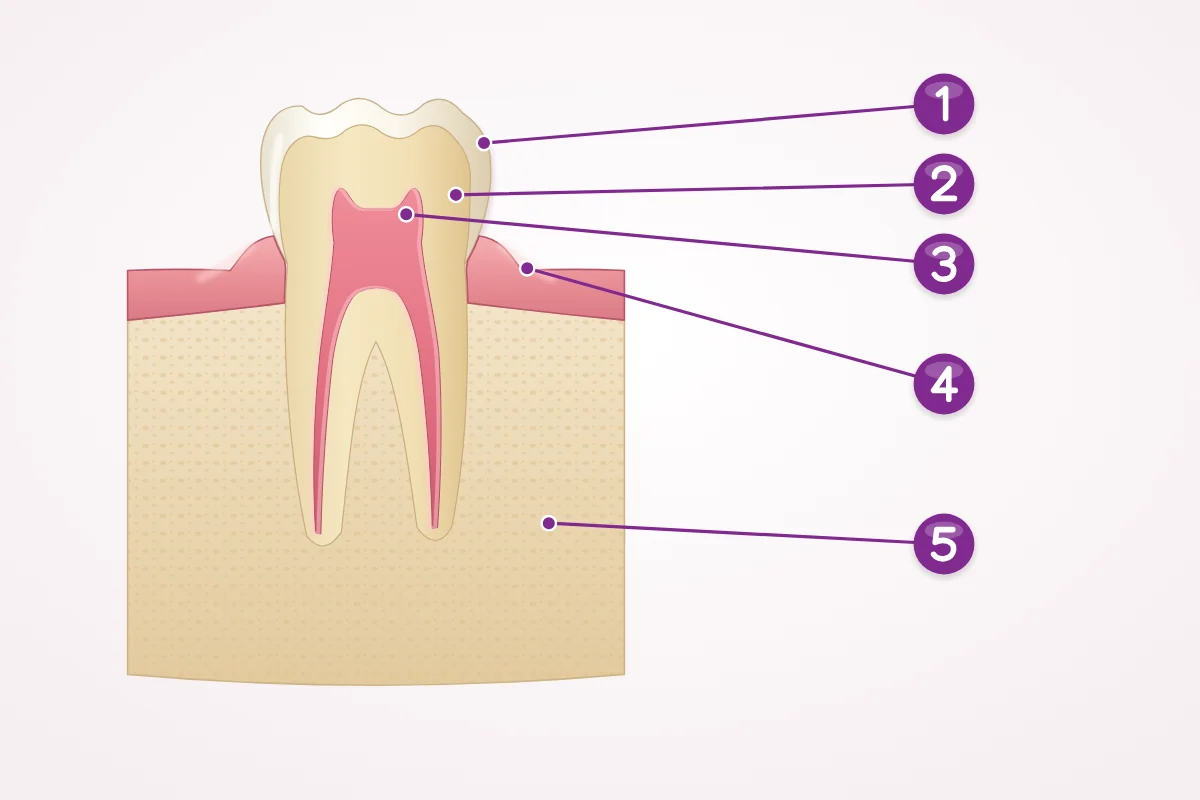
Decay starts with plaque, the sticky film of bacteria that forms on teeth every day. When you eat or drink sugar and other fermentable carbohydrates, these bacteria produce acid that draws minerals out of the enamel. Saliva and fluoride put minerals back between meals. Decay happens when the mineral loss wins, over and over, for weeks and months.
That is why how often you have sugar matters as much as how much. Each sweet snack or sweet drink starts a new acid attack, so sipping a sweet coffee through the afternoon keeps the teeth under attack for hours. Thailand Department of Health guidance for dental staff counts sweet snacks or drinks more than twice a day as a risk factor for decay.
At first the enamel turns chalky white without a hole. At this stage the damage can still be reversed with fluoride and better cleaning. Once the surface breaks down into a hole, the cavity holds bacteria where a toothbrush cannot reach, and it will not close up by itself. When decay reaches the dentin it tends to spread faster, because dentin is softer than enamel. If it continues inward, bacteria reach the pulp, the pulp becomes inflamed, and eventually it can die and become infected, leading to an abscess at the root tip.
Cavities are very common. The World Health Organization describes untreated decay in permanent teeth as one of the most common health conditions worldwide, and in the United States about 1 in 5 adults aged 20 to 64 has at least one untreated cavity. Having a cavity is not a personal failure. What matters is catching it while the treatment is still simple.
The stages of tooth decay and the usual treatment
Dentists describe decay by how far it has traveled into the tooth. The table below follows the five stages used in patient guides such as the one from Cleveland Clinic. The treatment column shows what usually fits; your dentist confirms it after the examination.
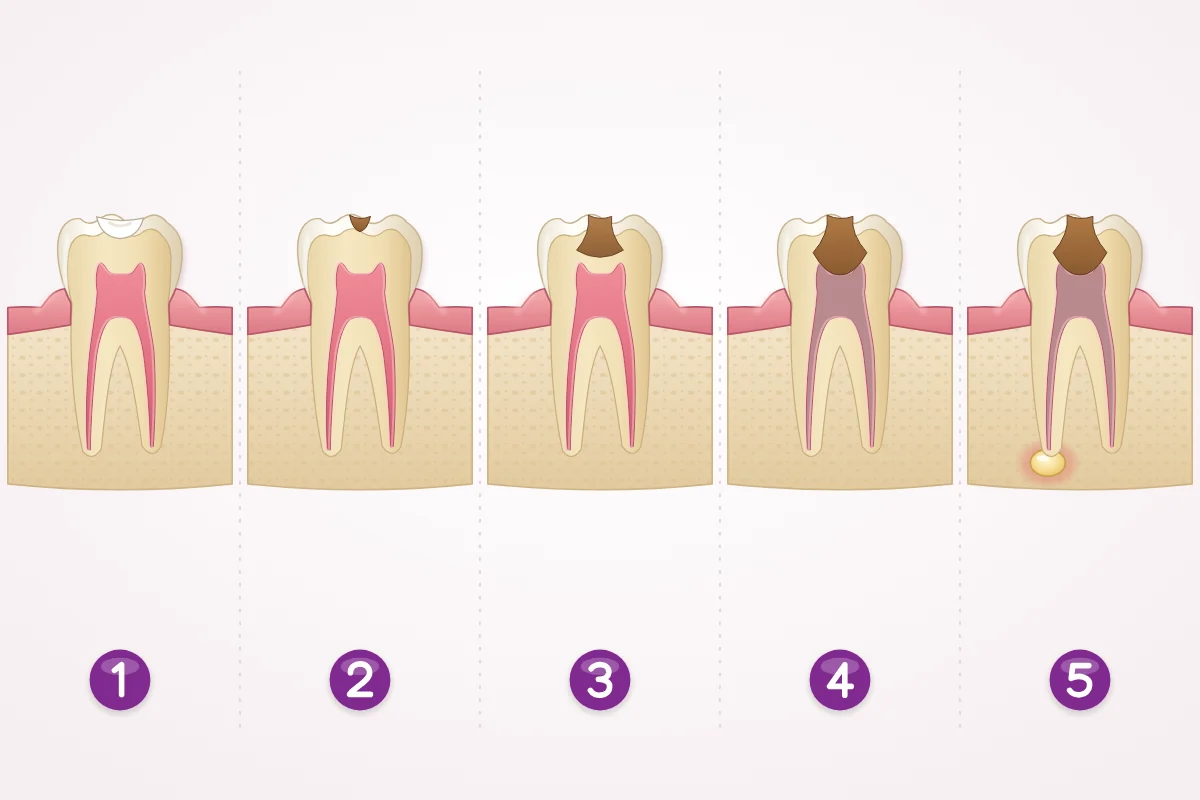
| Stage | What you may see or feel | Treatment that usually fits |
|---|---|---|
| 1. Early mineral loss in the enamel | A chalky white spot, no hole, no pain | Fluoride, better brushing, less frequent sugar; the dentist checks it again next visit |
| 2. Decay through the enamel | A small hole or a light brown spot; usually no pain | A small filling; sometimes sealing or close monitoring if the surface is still intact |
| 3. Decay in the dentin | A visible hole, darker brown color, short sensitivity to cold or sweets | A filling; for a large cavity, an inlay, an onlay or a crown may protect the tooth better |
| 4. Decay reaching the pulp | Lingering pain, night pain, pain on biting; the spot may look dark brown or black | Root canal treatment, then usually a crown or an onlay; in selected cases, treatment that keeps part of the pulp alive |
| 5. Abscess at the root tip | Swelling, a pimple on the gum, a bad taste, pain on biting; sometimes the pain has gone quiet | Draining the infection and root canal treatment, or removing the tooth if it cannot be saved |
Decay in the enamel usually causes no pain at all, and many dentin cavities only cause brief sensitivity. That is why a regular check-up with a small X-ray finds cavities between the teeth or under old fillings that you cannot see or feel.
What the pain is telling you
The most useful clue at home is not how strong the pain is, but how it behaves. Dentists separate an irritated but healthy nerve, called reversible pulpitis, from a nerve that cannot recover, called irreversible pulpitis. The difference shows up in how long the pain lasts after a trigger and whether it starts on its own.
| What the pain is like | What it often points to | What to do |
|---|---|---|
| No pain, only a hole or a spot you can see | Decay in the enamel or dentin; the nerve is often still healthy | Book a check-up in the coming weeks |
| A short, sharp twinge to cold or sweets that fades within a few seconds | An irritated nerve that can still recover once the decay is removed | Book soon; a filling is often enough |
| An ache to hot or cold that lasts more than a few seconds after the drink is gone | Inflammation that has gone deeper into the nerve | Book within days; root canal treatment or pulp treatment may be needed |
| Throbbing pain that starts on its own or wakes you at night | A nerve that is unlikely to recover | Book within days; ask for an earlier appointment if the pain is strong |
| Pain when you bite down or tap the tooth | Inflammation around the root tip, or sometimes a crack | Chew on the other side and book within days |
| Pain that was strong and then suddenly stopped | The nerve may have died; infection can continue quietly | Still book a check; the tooth needs an X-ray |
| Swelling of the gum or face, a pimple on the gum, fever | An abscess | Same day; hospital if swelling spreads or breathing or swallowing is hard |
Pain can be misleading. Pain from an upper back tooth can feel like it comes from a lower tooth or the sinus, and a dying nerve can stop hurting while the infection continues. Use the table to decide how soon to come in, and let the examination decide the treatment.
Filling or root canal: how dentists decide
Your dentist puts several pieces of information together. No single sign decides it on its own, which is why two cavities that look the same in the mirror can need different treatment.

What the dentist checks
- Your symptoms: whether pain is short or lingering, whether it starts on its own, and whether biting hurts.
- The depth of the decay on an X-ray, and whether there is any change around the root tip.
- Tapping and biting tests, and a check of the gum next to the tooth for swelling.
- A pulp test when needed, which shows whether the nerve is still alive.
- How much healthy tooth remains around the cavity, and whether there is a crack.
- What the dentist sees once the decay is removed. Sometimes the final answer only becomes clear during treatment, and your dentist explains any change of plan before continuing.
When a filling is usually enough
A filling fits when the decay has not reached the pulp and the nerve is healthy or only mildly irritated. Modern guidance from an international caries consensus group recommends removing the decay selectively: enough to seal the cavity well and make a filling that lasts, while leaving the deepest layer close to the nerve when removing it would risk exposing the pulp. The aim is to keep the nerve healthy and the tooth strong.
If the cavity is large and the walls of the tooth are thin, a large filling may not protect the tooth well. An inlay, an onlay or a crown may then be a better way to rebuild it, even though the nerve is fine.
When root canal treatment is needed
Root canal treatment is usually needed when the pulp cannot recover or has died: lingering or spontaneous pain, pain on biting, a pimple or swelling on the gum, or a change around the root tip on the X-ray. The treatment removes the inflamed or infected pulp, cleans and shapes the canals inside the roots, and fills and seals them so the tooth can stay in your mouth and keep working.
The middle path: keeping part of the nerve alive
Between a filling and a full root canal there are treatments that aim to keep the pulp alive, known as vital pulp therapy. One of them is a pulpotomy, which removes only the inflamed part of the pulp inside the crown and seals the healthy part below with a biocompatible material. The European Society of Endodontology supports preserving a healthy pulp where possible, and a Thai university dental hospital has published a clinical manual for pulpotomy in permanent teeth. A systematic review found high success for pulpotomy in teeth with signs of irreversible pulpitis at 12 and 36 months, while noting that the studies were small and at high risk of bias. Whether it suits your tooth depends on what the dentist finds.
Your options side by side
| Treatment option | Usually suits | Good to know |
|---|---|---|
| Tooth-colored filling | Small to medium cavities with a healthy nerve | Usually one visit; local anesthesia is used for deeper cavities |
| Inlay, onlay or crown | Large cavities, broken cusps, or weak walls | Lab-made pieces need a second visit to fit them |
| Pulp treatment that keeps the nerve alive | Deep decay where part of the pulp is still healthy | Decided during treatment; the tooth is followed up with X-rays |
| Root canal treatment, then a crown or onlay | A nerve that cannot recover, has died, or is infected | Keeps your own tooth; one visit or more, depending on the tooth |
| Removing the tooth | A tooth that cannot be restored, or when you choose not to keep it | The gap is usually replaced later with an implant, a bridge or a denture |
From finding a hole to a finished tooth: a step-by-step plan

Today
- Look at the tooth in good light and note which tooth it is and what triggers any pain.
- Book a check-up. If you have lingering pain, night pain or pain on biting, ask for an appointment within the next few days.
- Keep brushing the tooth gently with fluoride toothpaste, and spit out the foam without rinsing hard.
While you wait for the appointment
- Chew on the other side and avoid very hot, very cold, sticky or hard food on that tooth.
- Cut down on sweet snacks and drinks between meals.
- Rinse gently with water after eating if food packs into the hole. Do not poke it with toothpicks or sharp objects.
- For pain, use an over-the-counter pain reliever as the label directs. Do not place aspirin or other tablets on the gum, because they can burn it.
- Antibiotics do not treat a cavity. Do not take leftover antibiotics on your own.
At the appointment and afterward
- Examination and X-ray: the dentist finds out how deep the decay goes and explains the options and the fee before starting.
- If it is a filling: most fillings are done in the same visit.
- If it is a root canal: the canals are cleaned over one visit or more, with medicine and a temporary filling between visits when needed.
- The first 2 to 3 days after a root canal: the tooth may be tender on biting. Chew on the other side until the final restoration is done.
- Final restoration: after a root canal, most back teeth receive a crown or an onlay to protect them from cracking.
- Follow-up: regular check-ups, and X-rays when the dentist wants to see the bone healing around the root tip.
Myths about cavities and root canals
| What people often believe about cavities | What is actually true |
|---|---|
| If it does not hurt, it does not need treatment. | Early and medium cavities often cause no pain. Treating them before they hurt usually means a smaller, simpler filling. |
| The pain has stopped, so the tooth has healed. | A nerve that dies can stop hurting while infection continues at the root tip. The tooth still needs an examination. |
| Antibiotics can cure a toothache from decay. | Antibiotics cannot remove decay or clean an infected pulp. Dentists use them only in specific situations, alongside treatment of the tooth. |
| A root canal is more painful than having the tooth out. | Root canal treatment is done under local anesthesia, and the American Association of Endodontists compares it to having a routine filling. The tooth may be tender for a few days afterward. |
| Pulling the tooth is simpler and finishes the problem. | Removing a tooth leaves a gap that usually needs an implant, a bridge or a denture later. Keeping your own tooth keeps natural chewing and protects the neighbors. |
| A root-canal-treated tooth is dead, so it no longer needs care. | The tooth stays in the jaw, held by the bone and gum, and it can still decay at the edges of its filling or crown. It needs the same brushing and check-ups as any tooth. |
| Once a tooth is filled, it cannot decay again. | New decay can start at the edges of a filling, especially when plaque and frequent sugar continue. Prevention protects the filled tooth too. |
When to get help quickly
Most cavities can wait for a planned appointment. A few signs mean the infection may be spreading beyond the tooth, and these are worth acting on the same day.
- Swelling of the gum, cheek or jaw, or a pimple on the gum that leaks pus.
- Fever, or feeling generally unwell together with tooth pain.
- Severe pain that painkillers taken as directed do not control.
- Swelling spreading toward the eye or down the neck, difficulty opening the mouth, swallowing or breathing. Go to a hospital emergency department straight away.
Our clinic is open every day from 09:00 to 20:00, and you can contact us by phone, LINE or WhatsApp to arrange an urgent appointment for a painful or swollen tooth.
Emergency dentist in Chiang Mai
Keeping the next cavity away
A filling or a root canal repairs one tooth, but the conditions that caused it are still in your mouth. These habits are backed by public health guidance and research.
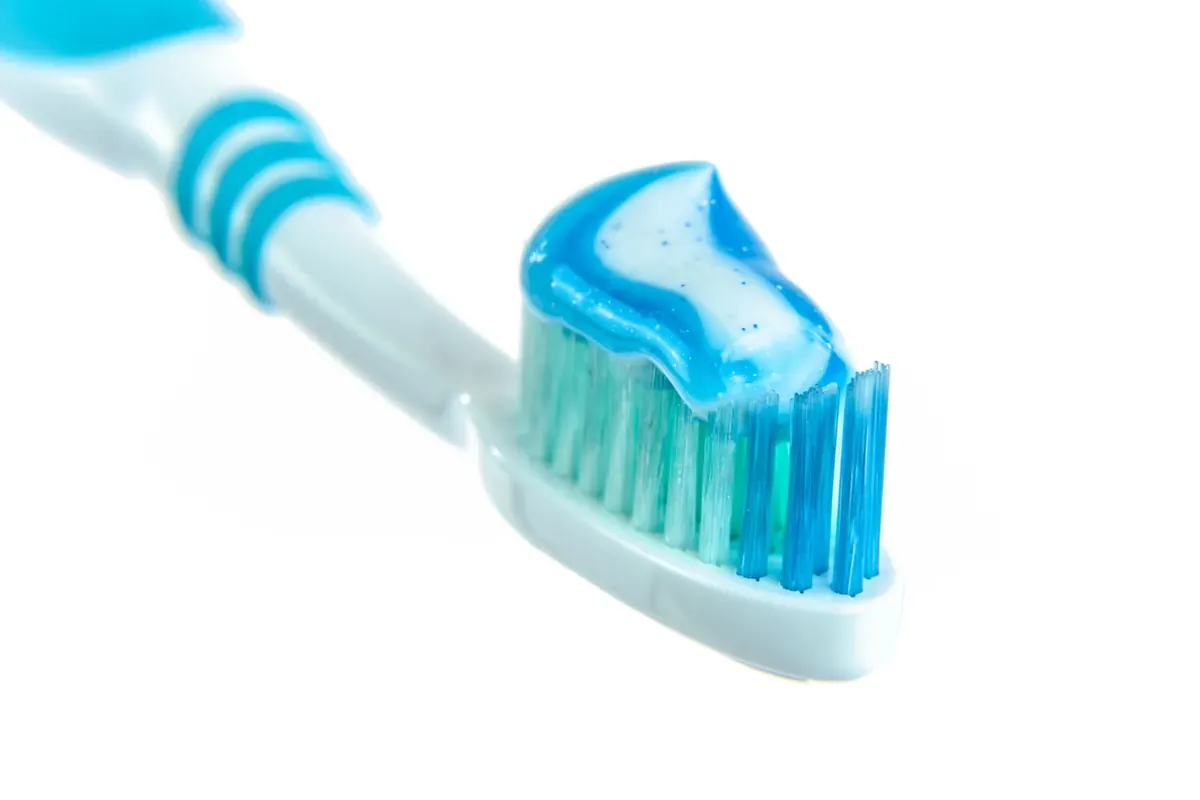
- Brush twice a day with a fluoride toothpaste. The World Health Organization recommends toothpaste with 1000 to 1500 ppm fluoride, and a Cochrane review confirms that fluoride toothpaste prevents decay compared with toothpaste without fluoride.
- Spit out the foam and do not rinse with lots of water, so fluoride stays on the teeth longer.
- Clean between your teeth every day with floss or an interdental brush, because many cavities start between teeth.
- Keep sweet foods and drinks to mealtimes, and choose water between meals.
- Have regular check-ups. If you get cavities often, your dentist may recommend fluoride varnish at the clinic, which usually takes only a few minutes at a check-up.
What happens at the clinic, step by step

At Kitcha Dental Clinic, fillings use tooth-colored materials, such as composite, ceramic or resin, matched to your tooth. Root canal treatment is carried out by dentists with postgraduate training in endodontics. This is what a visit for a cavity usually looks like.
For a filling
- Examination and X-ray: your dentist checks how far the decay goes, using a small X-ray if needed, and explains the plan and the fee before starting.
- Removing the decay: for deeper cavities the tooth is numbed with local anesthesia; small, shallow fillings often do not need it.
- Filling and polishing: composite is placed in layers, hardened with a curing light, shaped and polished, and your bite is checked for high spots.
- Most fillings are done in one visit. If several teeth need treatment, your dentist plans the visits with you.
For a root canal
- Diagnosis: examination, tapping and biting tests, digital X-rays, a pulp test when needed, and a 3D CBCT scan of the tooth when the canals are complex or a crack is suspected.
- Local anesthesia and a rubber dam, a thin rubber sheet around the tooth that keeps it clean and dry. The clinic uses a rubber dam for every root canal treatment.
- Cleaning and shaping the canals one by one, measured with an apex locator and X-rays. The dental operating microscope is used when it helps the dentist see narrow or hidden canals.
- Medicine between visits when the canals need more time, sealed with a temporary filling.
- Filling and sealing the canals, then planning the final restoration, which for most back teeth is a crown or an onlay.
If radiation worries you: at our clinic, X-rays inside the mouth are digital, taken with phosphor plates and sensors that help lower the dose compared with film. Our Planmeca ProMax CBCT has an Ultra Low Dose mode, your dentist chooses the mode that suits each case, and X-rays are taken only when they are needed.
Dental X-ray radiation: how much is it, and how we keep it low
Some teeth are finished in one visit; others need two or more, depending on the tooth, the number of canals and how much infection is present. Your dentist tells you the plan at the first visit. If your root canal treatment was started at another clinic or in your home country, we can continue it here: bring any X-rays or records you have.
When deep decay leaves part of the pulp healthy, your dentist may discuss a pulpotomy, which removes only the inflamed part of the pulp. When a tooth also needs gum treatment, a crown or an implant, the dentists involved plan it together within the clinic.
Root canal treatment in Chiang Mai
Filling prices depend on how many surfaces of the tooth are filled, and root canal fees depend on the type of tooth. Both are listed on our prices page, and your dentist explains any additional items before treatment.
See filling, inlay and crown prices
See root canal treatment prices
You can use Thai Social Security for fillings and extractions: you pay at the clinic, the clinic issues a medical certificate and a receipt, and you then claim the amount from Social Security yourself.
If this sounds like you: cavity situations
These are example situations, not patient stories, to help you find the next step that fits.
- You found a small dark hole on a back tooth and it never hurts: book a check-up in the coming weeks. A small cavity is usually a small filling.
- Cold water gives you a quick twinge that is gone in a second or two: book soon. The nerve is probably still healthy, and a filling is often enough.
- Hot coffee leaves a dull ache for minutes, and last night the tooth woke you: book within days. The nerve may be involved, and the dentist will check whether a root canal or pulp treatment is needed.
- A tooth hurt badly for a week and then went quiet, and now there is a small pimple on the gum: book a check. A quiet tooth with a gum pimple often needs root canal treatment.
- An old filling has a dark edge and floss catches on it: book a check. There may be new decay under the edge, and the filling may need to be replaced.
- You are visiting Chiang Mai for a short stay and have a cavity: a filling is usually done in one visit. If it turns out to need a root canal, tell your dentist your travel dates so the visits can be planned around them.
- You started a root canal elsewhere and the tooth still has a temporary filling: book soon and bring your X-rays or records. The treatment can be continued here.
- Your face is swelling and you feel feverish: contact the clinic today, and go to a hospital emergency department if the swelling spreads or swallowing or breathing becomes hard.
Frequently asked questions about cavities, fillings and root canals
Can a cavity heal on its own?
A chalky white spot without a hole can sometimes be reversed with fluoride and careful cleaning. Once there is a real hole, it does not close by itself, and the decay usually keeps growing. Treating it early keeps the repair small.
My tooth has a hole but no pain. Does it still need a filling?
Usually yes. Many cavities cause no pain until they are deep, and a hole collects plaque that a toothbrush cannot reach. Your dentist checks the depth with an X-ray. A small cavity that does not hurt yet is often the simplest one to treat.
Can decay that has reached the nerve be fixed with just a filling?
Usually not a filling alone. When the pulp is exposed or inflamed beyond recovery, root canal treatment is the usual way to keep the tooth. In selected cases where part of the pulp is still healthy, a treatment that keeps that part alive, such as a pulpotomy, may be possible. Your dentist decides based on your symptoms, the X-ray and what is seen during treatment.
Does root canal treatment hurt?
The tooth is numbed with local anesthesia before treatment starts, and during treatment you feel pressure and the movement of the instruments. Afterward the tooth may be tender on biting, which usually improves within 2 to 3 days. If it gets worse after that, or you notice swelling, contact the clinic.
Is a root canal or an extraction better?
Root canal treatment aims to keep your natural tooth, which keeps natural chewing and protects the neighboring teeth. Removing the tooth is quicker on the day, but the gap usually needs an implant, a bridge or a denture later. Some teeth cannot be saved, for example when too little tooth remains or there is a deep crack. Your dentist explains the options for your tooth.
Why does a tooth need a crown after a root canal?
A tooth that has had a root canal has usually lost a lot of structure to decay and to the access opening, and it can become more brittle over time. Back teeth take strong chewing forces, so most of them need a crown or an onlay to protect them from cracking. Front teeth with little damage can sometimes be restored with a filling. Your dentist recommends the restoration that suits the tooth structure that remains.
My tooth hurts from a cavity. Which medicine should I take?
An over-the-counter pain reliever taken as the label directs can ease the pain while you wait for your appointment. Ask a pharmacist if you have other health conditions or take other medicines. Painkillers only quiet the symptoms; the cavity still needs treatment. Antibiotics do not treat decay, and a dentist decides whether you need them.
How long does a filling or a root canal take?
Most fillings are done in one visit. Root canal treatment takes one visit for some teeth and two or more for others, especially molars with several canals or teeth that need medicine between visits. After a root canal, a crown or onlay made by a laboratory needs another visit to fit it. Your dentist gives you the plan at the first visit.
Summary
A cavity does not heal by itself, but most are found while the nerve is still healthy, and those are usually fixed with a filling in one visit.
- How the pain behaves matters more than how strong it is: short twinges usually mean a healthy nerve; lingering, spontaneous or night pain suggests the nerve is involved.
- When decay reaches the nerve, root canal treatment keeps your own tooth, and in selected cases part of the nerve can be kept alive.
- Pain that stops by itself is not a sign of healing, and antibiotics do not treat decay.
- Swelling, fever, or difficulty swallowing or breathing need help the same day, at a hospital if severe.
- Fluoride toothpaste twice a day, daily cleaning between teeth, sugar at mealtimes and regular check-ups protect both new and treated teeth.
References
NHS (UK): Root canal treatment
American Dental Association (MouthHealthy): Cavities
American Dental Association (MouthHealthy): Root Canals
American Association of Endodontists: What is a root canal?
Cleveland Clinic: Cavities (tooth decay)
MedlinePlus (US National Library of Medicine): Tooth decay
CDC (US): Fast facts, cavities
World Health Organization: Oral health fact sheet
Khon Kaen University Dental Hospital: Manual of vital pulp therapy by pulpotomy in permanent teeth