

A tooth has been taken out, or is about to be, and now there is a gap. Two words keep coming up: bridge and implant. One sounds quicker, the other sounds more permanent, and everyone you ask seems to have a different opinion. It is easy to feel that you are about to make an expensive decision without really knowing what you are choosing between.
The good news is that both are well-established, fixed ways to replace a missing tooth, and neither is the right answer for everyone. The choice usually comes down to a handful of things you can check: the health of the teeth beside the gap, the amount of bone where the tooth was, your general health, how much time you have, and how you prefer to look after your teeth. Once you see those factors laid out, the decision becomes much clearer.
This article walks you through that decision step by step. You will find a quick checklist to see which option your situation leans toward, how each one works, a side-by-side comparison table, the types of bridges and implants, a visit-by-visit timeline, the factors that help each option last, common myths, the signs to get checked, and what happens at a consultation.
In short: a bridge uses the teeth on each side of the gap as supports and is usually finished within a couple of weeks. An implant replaces the root itself without touching the neighboring teeth, but needs enough bone and a few months of healing. If the neighbors already need crowns, a bridge often makes sense. If they are healthy and untouched, and your bone and health allow, an implant keeps them that way.
Which way does your situation lean? A quick checklist
Tick the points that fit you. This is not a diagnosis, but it shows which questions to ask at your consultation.
Points that lean toward a bridge
- The teeth on both sides of the gap already have large fillings or crowns, or will need crowns soon anyway.
- You would prefer to avoid surgery, or a health condition makes surgery less suitable for now.
- There is not enough bone for an implant, and you would rather not have bone grafting.
- You need the gap filled within a few weeks, for example before a trip home or an event.
Points that lean toward an implant
- The teeth beside the gap are healthy, with few or no fillings, and you would like to keep them untouched.
- There is only a tooth on one side of the gap, or the gap is at the back end of the row.
- Your general health is good, you do not smoke, and any diabetes is well controlled.
- You can plan for a few months of healing, or two trips if you live abroad.
Points to talk through with your dentist first
- Your gums bleed, feel puffy, or a dentist has mentioned gum disease. Gums usually need treatment before either option.
- You grind or clench your teeth, especially at night.
- You have had radiotherapy to the head or neck, or take bone medicines such as bisphosphonates.
- Several teeth are missing, or a tooth near the gap is also weak. The plan may need to cover more than one gap.
How a bridge and an implant each replace a tooth
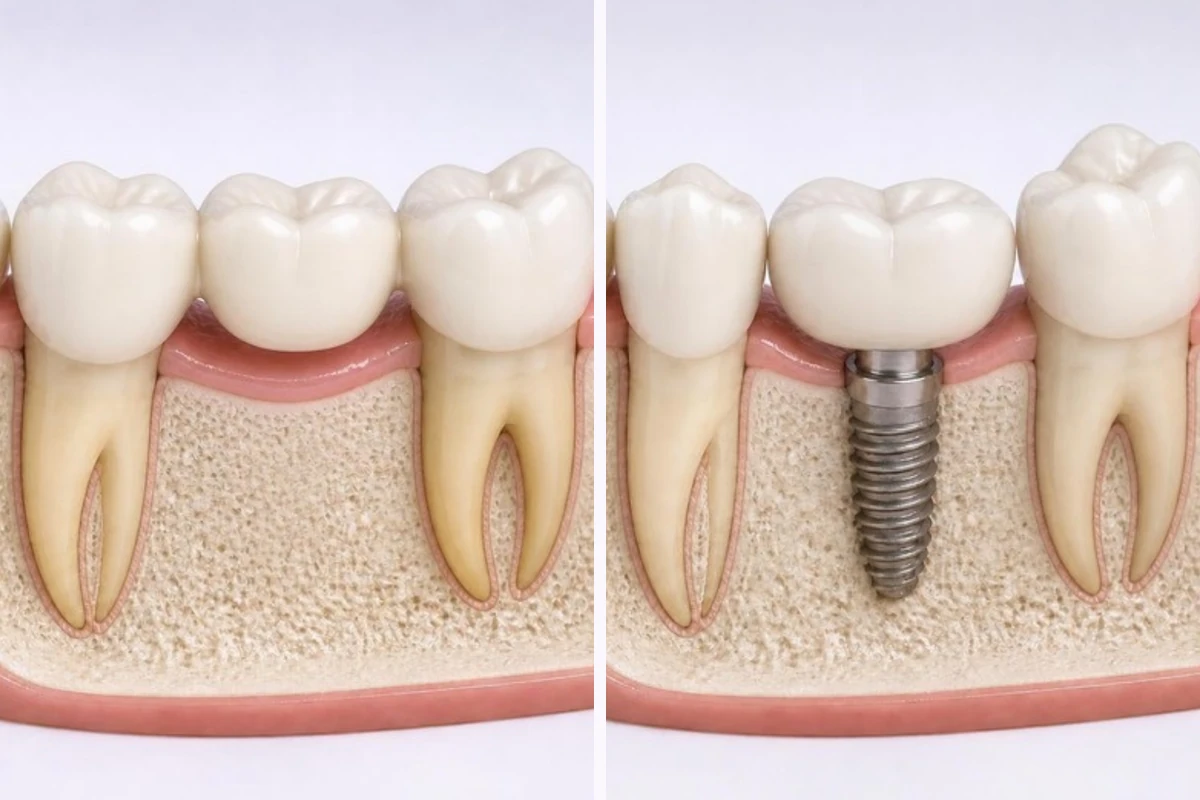
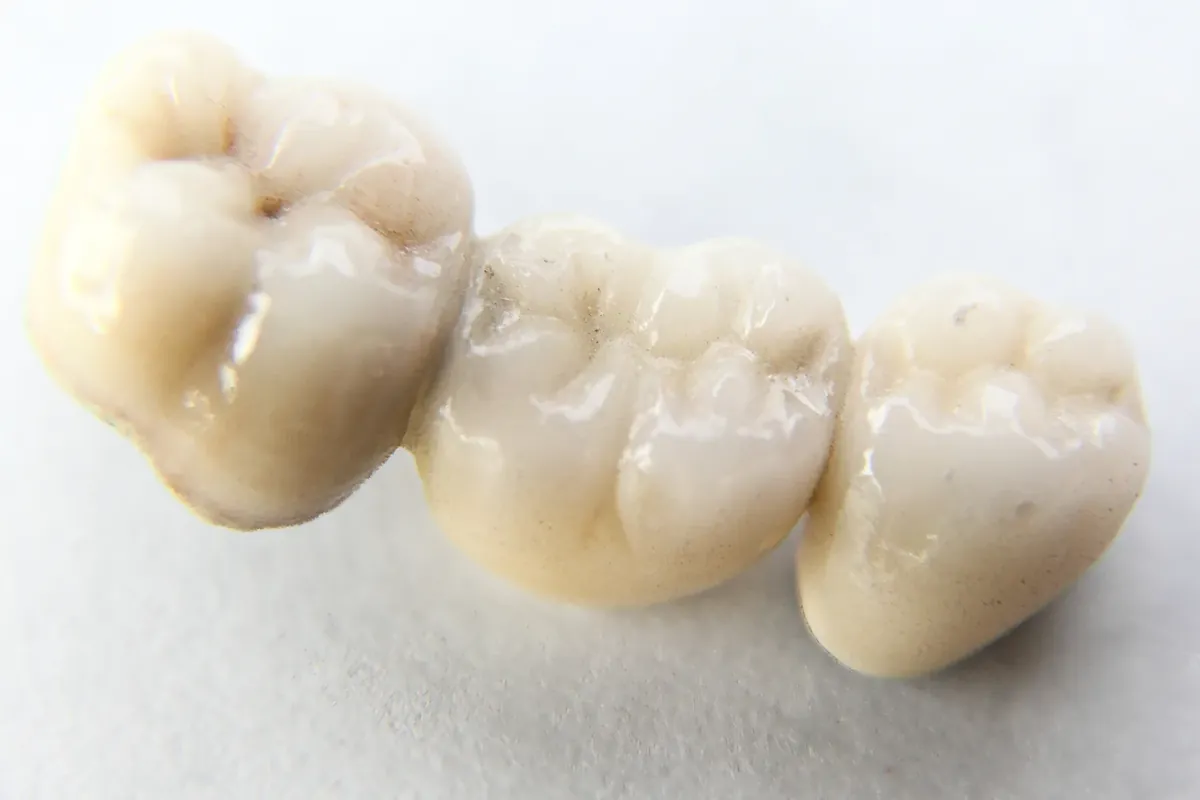
A traditional bridge is a single piece made of three or more joined units: crowns on the teeth on each side of the gap, called the support or abutment teeth, and a replacement tooth in the middle that rests on the gum. To make room for those crowns, the support teeth are shaped down on all sides. The bridge is then cemented in place and can only be removed by a dentist.
How much tooth is removed matters. In a laboratory study that weighed teeth before and after preparation, a full crown preparation removed roughly two-thirds to three-quarters of the visible part of a back tooth, while bonded and inlay-type designs removed far less. For a tooth that is already heavily filled this matters little, because it would need a crown anyway. For a healthy, untouched tooth it is a real trade-off, and it is the main reason dentists talk about implants as the option that leaves neighbors alone.
An implant works differently. A small post, usually titanium or zirconia ceramic, is placed in the jawbone where the root used to be. Over the following months the bone grows tightly onto its surface. A connector called an abutment is then attached, and a crown goes on top. The implant stands on its own, so the teeth on either side are not shaped or joined to it, and you can floss around it like a natural tooth.
There is one more difference that people rarely hear about: what happens to the bone. After a tooth is removed, the ridge of bone that held it naturally shrinks, most quickly in the first three to six months. A review of human studies found that the width of the ridge can reduce by around a third to more than half within six to seven months. A bridge sits on top of the gum and does not load the bone underneath, so this shrinkage carries on under the replacement tooth. An implant sits inside the bone. That is why timing matters if you are thinking about an implant, and why your dentist may suggest a bone graft if the ridge has already thinned.
Leaving the gap is also an option for some people, and it is worth knowing what usually follows. Over time the teeth beside the gap can tilt into it, and the tooth above or below can drift toward it because it has nothing to bite against. This can make chewing and cleaning harder and leave less room for a replacement later. Whether that matters depends on where the gap is: losing the last molar in a row tends to cause fewer changes than losing a tooth in the middle.
Bridge or implant: a side-by-side comparison
This table compares a traditional three-unit bridge with a single implant and crown for one missing tooth. Your own case may differ, but these are the points most people weigh up.
| Aspect | Dental bridge | Implant with a crown |
|---|---|---|
| Neighboring teeth | Both are shaped down for crowns and joined to the bridge | Left untouched |
| Surgery | None | A minor operation under local anesthesia to place the implant |
| Bone needed | No special bone requirement | Enough bone, or a bone graft first or at the same time |
| Time from start to finish | Usually within a couple of weeks once the area has healed | Several months, because the bone needs time to grow onto the implant |
| Main visits | Usually two: preparing the teeth, then fitting | Two stages a few months apart: placing the implant, then the crown |
| Effect on the bone under the gap | The bone under the replacement tooth is not loaded and keeps shrinking slowly | The implant sits in the bone and carries chewing forces |
| Daily cleaning | Brush, plus a floss threader or small brush under the replacement tooth | Brush and floss or use an interdental brush around it, like a natural tooth |
| What most often goes wrong | Decay or nerve problems in a support tooth, or the bridge coming loose | Gum inflammation around the implant from plaque, or a loose screw or crown |
| If a problem happens | A problem in one support tooth can mean redoing the whole bridge | The crown can often be replaced on its own; problems stay with that implant |
| Who it often suits | Neighbors that need crowns anyway; people who prefer no surgery or a quicker result | Healthy neighbors; good bone and general health; time for healing |
| Cost | Priced per unit at the crown price for the material chosen | Priced per implant system; grafting and scans are added only if needed |
Notice that neither column says one option is better overall. A bridge on two teeth that already need crowns can be the most sensible plan. An implant next to two healthy teeth can save them from ever being drilled. The right answer comes from your teeth, not from the option.
Types of bridges and implant options
Both words cover more than one design. Knowing the main types helps you understand why a dentist might suggest a variation you had not heard of.
| Type | How it works | Usually used when |
|---|---|---|
| Traditional bridge | Crowns on the teeth on both sides hold the replacement tooth | There are strong teeth on both sides of the gap |
| Cantilever bridge | The replacement tooth is supported from one side only | Selected situations with a support tooth on one side |
| Maryland bridge (resin-bonded) | A replacement tooth with small wings bonded to the backs of the neighbors, with little or no shaping | Mostly front teeth, where biting forces are lighter |
| Single implant with a crown | One implant in the bone carries one crown | One missing tooth with enough bone |
| Immediate implant after extraction | The implant is placed at the same visit as the extraction | Suitable cases with no active infection and enough bone; a temporary tooth is possible in some cases |
| Implant-supported bridge | A bridge fixed onto implants instead of natural teeth | Several teeth missing in a row, without one implant for every tooth |
Bridges and implant crowns can be made in zirconia, all-ceramic or porcelain fused to metal. Your dentist suggests a material based on where the tooth is, how you bite and how it needs to look. For a deeper look at materials, see the article on crown materials linked at the end of this page.
Studies on resin-bonded bridges show that their most frequent problem is coming unstuck, which can often be re-bonded, and that they tend to do better on front teeth and with a single wing. This matches why they are mainly used for front teeth.
How long each takes, visit by visit
Time is often the deciding factor, especially if you live outside Chiang Mai. Here is what a typical plan looks like for each option. Your dentist confirms the timing for your case after the examination.
A traditional bridge
- Examination and planning: X-rays and an impression or digital scan. If a tooth needs to come out first, the area is usually left to heal for about two months before the bridge is made.
- Preparing the support teeth: the teeth beside the gap are shaped under local anesthesia, a scan or impression is taken, and temporary crowns are fitted.
- Making the bridge: our partner laboratory makes it; the bridge is usually fitted 3 to 5 days after preparation, depending on the type, the dentist and public holidays.
- Fitting: the bridge is tried in, adjusted with you, cemented and your bite is checked. You are shown how to clean under it.
An implant with a crown
- Trip or stage 1, usually about 1 to 2 weeks: examination, CBCT 3D scan and a written plan with a cost estimate, then implant surgery under local anesthesia. Bone grafting, if planned, is done at this stage.
- Healing, usually 2 to 6 months: the bone grows onto the implant. Grafting or a sinus lift can make this longer. You can go home during this time; most people can travel 2 to 3 days after implant surgery, confirmed case by case.
- Trip or stage 2, usually about 1 to 2 weeks: the implant is checked, a scan or impression is taken, and the crown is fitted.
If you are weighing time against keeping your neighboring teeth, it can help to think about the whole picture rather than the next few weeks. A bridge is quicker to complete. An implant takes longer at the start, but involves only the gap itself.
Seven questions that decide between a bridge and an implant
When dentists compare the two options for one person, they work through roughly the same questions. Knowing them in advance makes the consultation much easier to follow.

1. What state are the teeth beside the gap in?
This is often the biggest single factor. If both neighbors have large fillings, cracks or old crowns, crowning them as part of a bridge solves two problems at once. If they are healthy and unfilled, shaping them for a bridge removes sound tooth that cannot be put back, and an implant avoids that. A bridge also depends on its supports, so the roots and gums around those teeth need to be strong.
2. Is there enough bone where the tooth was?
An implant needs enough bone height and width to hold it firmly. A CBCT 3D scan shows this clearly. If there is not quite enough, bone can often be built up with a graft before or during implant surgery, and in the upper back jaw a sinus lift may be needed. These add time, and sometimes they tip the balance toward a bridge.
3. How is your general health?
Health matters more than age. Smoking is linked to more implant failures, more infections after surgery and more bone loss around implants. Diabetes that is not well controlled is linked to a higher risk of inflammation around implants. Radiotherapy to the head and neck, and bone medicines such as bisphosphonates, call for extra planning. None of these automatically rules an implant out, but each one is something to tell your dentist and talk through.
4. Are your gums healthy?
Gum disease weakens the support for bridge teeth and is a known risk for inflammation around implants. Either way, gums are usually treated and stable before a fixed replacement is made. If your gums bleed when you brush, the article on bleeding gums linked below explains what to do first.
5. Do you grind or clench?
Heavy grinding puts extra force on any restoration. It can chip porcelain, loosen screws and overload both bridges and implants. It does not rule either out, but your dentist may recommend a night guard to protect the new tooth.
6. How much time do you have?
A bridge is usually finished within weeks. An implant normally needs two stages a few months apart. If you live abroad, an implant means two trips, while a bridge can often be done in one stay once any extraction site has healed.
7. How do you feel about surgery and cost?
Implant surgery is done under local anesthesia, and most people describe pressure rather than pain during it, with some soreness and swelling for a few days afterward. If you feel very anxious, sedation options can be discussed. On cost, the two are priced differently: a bridge per unit, an implant per system, with grafting and scans only if you need them. Your dentist gives you a written estimate for each option so you can compare them side by side.
What helps a bridge or an implant last
People often ask how many years each option lasts. The honest answer is that it depends far more on a few known factors than on the option itself, and those factors are largely in your hands. Here is what research and dental guidance point to.
| Factor | Dental bridge | Implant with a crown |
|---|---|---|
| Daily cleaning | Plaque under the replacement tooth leads to decay and gum problems in the supports | Plaque around the implant causes gum inflammation that can lead to bone loss |
| Weak spot | The support teeth: decay at the crown edge, or the nerve inside becoming inflamed | The gum seal around the implant and the screw that holds the crown |
| Smoking habit | Raises the risk of gum disease around the supports | Linked to more implant failures and more bone loss |
| Grinding | Can chip porcelain or loosen the bridge | Can chip the crown or loosen the screw |
| Regular checks | Catch decay at the crown edges early | Catch gum inflammation and loose parts early |
Large reviews of bridges show the same pattern: the problems that end a bridge are mostly decay or nerve problems in the support teeth and the bridge coming loose, rather than the bridge itself breaking. For implants, the international classification of gum and implant diseases describes plaque as the cause of inflammation around implants, and inflammation that reaches the bone as peri-implantitis. In other words, for both options, the gum line is where they are won or lost.
Daily care for a bridge
- Brush twice a day with a fluoride toothpaste, angling the bristles toward the gum edge of each crown.
- Once a day, thread floss under the replacement tooth with a floss threader or special floss, or use a small interdental brush.
- Avoid chewing ice, pens or very hard foods on the bridge.
Daily care for an implant
- Brush twice a day around the crown, paying attention to where it meets the gum.
- Clean between the implant and its neighbors every day with floss or an interdental brush that fits the space.
- Keep your maintenance visits. After implant treatment, we recommend a scale and clean every 6 months and an implant check once a year.
Bridges and implants: myths and facts
| Myth | Fact |
|---|---|
| An implant is always the better choice. | It is often a good choice, but a bridge can be the more sensible plan when the neighbors need crowns anyway or surgery is not suitable. |
| A bridge ruins the neighboring teeth. | It does require shaping them, which cannot be undone. With good cleaning and checks, support teeth can stay healthy. |
| An implant cannot get gum disease because it is not a real tooth. | Plaque causes inflammation around implants too, and it can lead to bone loss. Implants need the same daily cleaning as teeth. |
| You are too old for an implant. | There is no fixed upper age. General health and bone matter more than age. |
| A bridge does not need any special cleaning. | The space under the replacement tooth needs cleaning every day, or plaque builds up around the supports. |
| If a tooth is missing at the back, it does not matter. | Sometimes that is true, especially for the last molar. Elsewhere, neighbors can tilt and the opposing tooth can drift, so it is worth an assessment. |
| An implant can be finished in one day. | In suitable cases the implant can go in on the day of the extraction, and a temporary tooth is possible in some cases, but the final crown is made after the bone has healed. |
Signs to have a bridge or implant checked
Most problems with bridges and implants start quietly and are easiest to fix early. Book a check if you notice any of these:
- The bridge or crown feels loose, moves when you bite, or your bite suddenly feels different.
- A bad taste or smell that keeps coming from under a bridge.
- A support tooth becomes sensitive or aches, especially on biting.
- The gum around an implant bleeds when you brush, looks red or puffy, or has pus.
- Porcelain chips, or you see a dark line at the edge of a crown.
If a bridge or crown comes off completely, keep it clean and dry in a small container and bring it with you. Do not glue it back yourself. If you have swelling of the face, a fever or pain that keeps getting worse, contact the clinic the same day, or go to a hospital emergency department if the swelling spreads or you have trouble swallowing or breathing.
What happens when you come in to compare the options
At Kitcha Dental Clinic, bridges and implants are planned by our dentists, including dentists with postgraduate training in prosthodontics, implant dentistry and oral surgery. If your case needs more than one field, for example gum treatment or bone grafting first, the dentists involved plan it together. A consultation usually runs like this.
- Your story: which tooth is missing or failing, how long ago, your health conditions, whether you smoke, and every medicine you take.
- Examination of the gap, the teeth on each side, your gums and your bite.
- X-rays, and for implant planning a CBCT 3D scan to see the bone height, width and nearby structures.
- Explanation and options: your dentist explains what fits your case, including a bridge, an implant or a removable partial denture, and gives you a cost estimate before anything starts.
- For a bridge: the support teeth are prepared at one visit and the bridge is fitted at the next, usually 3 to 5 days later. Bridges are made by our ISO-certified partner laboratory.
- For an implant: surgery under local anesthesia, a healing period of usually 2 to 6 months, then the crown. In suitable cases the implant can be placed on the same day as the extraction, and a temporary tooth is possible in some cases.
- Follow-up care: you are shown how to clean your new tooth, and your dentist recommends maintenance visits. For implants we recommend a scale and clean every 6 months and an implant check once a year.
We use Straumann and Dentium implants, and the Neodent Zi zirconia implant for suitable cases. Your dentist recommends a system after checking your bone on the CBCT scan and explains why. Implant prices are listed for each system, and a traditional bridge is priced per unit at the crown price for the material you choose.
If radiation worries you: at our clinic, X-rays inside the mouth are digital, taken with phosphor plates and sensors that help lower the dose compared with film. Our Planmeca ProMax CBCT has an Ultra Low Dose mode, your dentist chooses the mode that suits each case, and X-rays are taken only when they are needed.
Dental X-ray radiation: how much is it, and how we keep it low
Replacing a single missing tooth
See filling, inlay and crown prices
If you live abroad, you can send a recent X-ray or photo before you travel. Your dentist looks at it and gives an initial opinion, and the final plan is confirmed after the examination in Chiang Mai.
Planning treatment from abroad
If this sounds like you: which option to explore first
These are example situations, not patient stories, to help you find the next step that fits.
- A back tooth was taken out last week and both neighbors already have large fillings: a bridge is worth discussing, because crowns would protect those teeth too. Expect to wait about two months for the area to heal first.
- A front tooth is missing and the teeth beside it are healthy: ask about an implant, and also about a Maryland bridge, which needs little or no shaping of the neighbors.
- A tooth is cracked and needs to come out, and you would like to avoid a long gap: ask whether an implant can be placed at the same visit as the extraction. It depends on infection and bone, which the CBCT shows.
- You smoke and are keen on an implant: talk to your dentist about cutting down or stopping before treatment, because smoking affects how the bone heals around an implant.
- You live abroad and can make only one trip this year: a bridge may fit your schedule better, or you can start an implant now and plan the crown for your next visit.
- You have an old bridge and one support tooth has started to ache: book a check soon. Your dentist can see whether the tooth can be treated, and what the options are if the bridge needs to be replaced.
- Several teeth in a row are missing: ask about an implant-supported bridge, which can replace them without one implant for every tooth.
Frequently asked questions about bridges and implants
Which is better, a dental bridge or an implant?
Neither is better for everyone. An implant leaves the neighboring teeth untouched and sits in the bone, but needs enough bone, good health and a few months. A bridge needs no surgery and is quicker, but the neighboring teeth are shaped for crowns. If those teeth need crowns anyway, a bridge often makes sense; if they are healthy, an implant protects them.
How long does a bridge or an implant last?
It depends mainly on daily cleaning, regular checks, smoking, grinding and the health of the gums and support teeth, rather than a fixed number. Bridges most often run into trouble through decay in a support tooth; implants through gum inflammation around them. Keeping those areas clean and checked is what helps either one last.
Does a bridge mean the neighboring teeth have to be drilled?
For a traditional bridge, yes: the teeth on each side are shaped all round to hold crowns, and this cannot be reversed. A Maryland bridge, used mostly for front teeth, is bonded to the backs of the neighbors with little or no shaping.
Does getting an implant or a bridge hurt?
Both are done under local anesthesia, so during treatment most people feel pressure and vibration. After implant surgery, soreness and swelling for a few days are common, and your dentist advises on pain relief. After a bridge, the support teeth may feel a little sensitive for a short time. If you feel very anxious, ask about sedation options.
Can I have an implant later if I choose a bridge now?
Often yes, but the bone under a bridge keeps shrinking slowly, so a graft may be needed later, and the support teeth will already have crowns. If you think you will want an implant eventually, it is worth asking about timing now.
I am older. Can I still have an implant?
There is no fixed upper age. What matters is your general health, your bone and how well you can clean around the implant. Conditions such as diabetes, and medicines that affect bone, are discussed at the consultation. A bridge or a removable partial denture are also options.
What if I do not replace the missing tooth at all?
Not every gap needs treatment, especially the last molar. Elsewhere, the neighboring teeth can tilt into the space and the opposing tooth can drift, which can affect chewing and cleaning and leave less room later. Your dentist can tell you whether your gap is likely to cause changes.
My bridge came off. What should I do?
Keep it clean and dry in a small container, avoid chewing on that side, and book an appointment. Do not glue it back yourself, because the support teeth need checking for decay first. Depending on its condition, the bridge may be re-cemented or a new one made.
Summary
A bridge and an implant are both reliable fixed ways to replace a missing tooth. The better choice depends on your neighboring teeth, your bone, your health and your time.
- If the neighbors already need crowns, a bridge solves two problems at once; if they are healthy, an implant leaves them untouched.
- A bridge is usually finished in weeks; an implant takes a few months and two stages.
- Bone, gum health, smoking, diabetes and grinding all shape which option suits you.
- Either option lasts longest with daily cleaning at the gum line and regular checks.
- A consultation with an X-ray or CBCT scan gives you a clear plan and a cost estimate for each option before you decide.
References
American Dental Association (MouthHealthy): Bridges
American Dental Association (MouthHealthy): Implants
American Dental Association (MouthHealthy): Missing Teeth
Cleveland Clinic: Dental Bridges
Cleveland Clinic: Dental Implants
Cambridge University Hospitals NHS Foundation Trust: Dental implants in restorative dentistry
Faculty of Dentistry, Mahidol University: Crowns and bridges
Ramathibodi Hospital, Mahidol University (Dental Division): Implant dentistry