
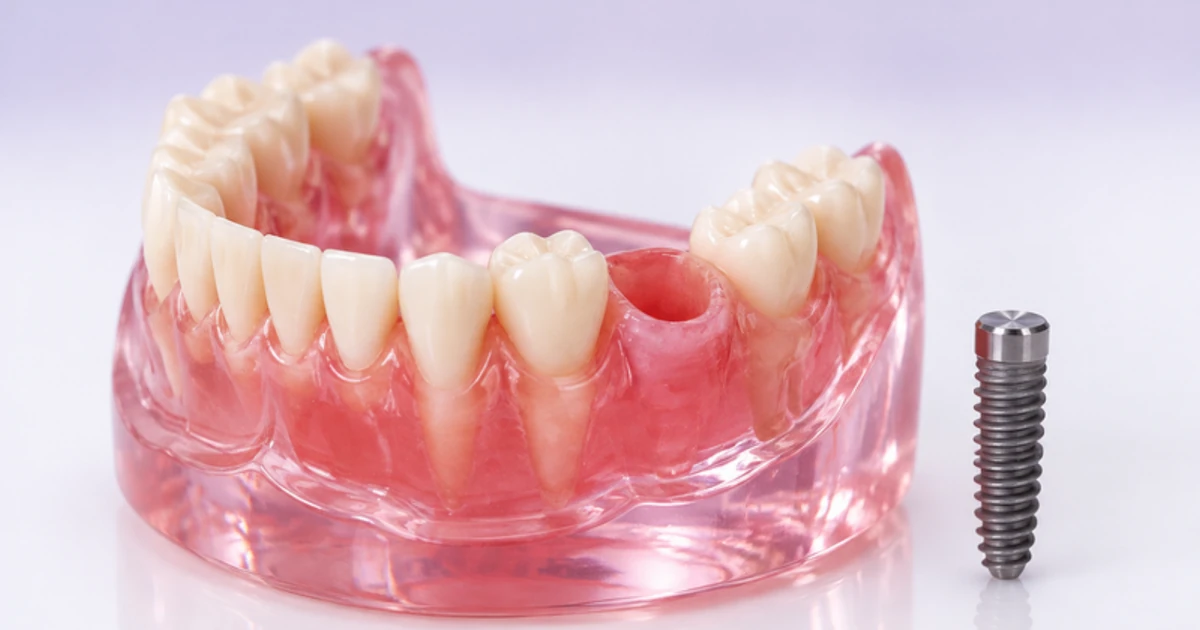
Many patients sit in the dental chair and ask, “If you take this tooth out, can the implant go in straight away? I really don’t want a gap at work for months.” The honest answer: yes for some people, not for others. If you can’t, you’re not losing out. It just means a little more preparation first, so the implant you end up with stays with you for a long time.
This article walks you through what the dentist looks at before deciding, so you can get a rough idea of which side you’re likely to fall on, and go into your consultation with better questions.
Quick summary
- An immediate implant after extraction means the tooth comes out and the implant goes in at the same visit. A temporary tooth can be fitted in some cases only
- It can be done when the bone and gum around the tooth are ready and there’s no infection that can’t be controlled
- If you’re not ready yet, waiting for healing or having a bone graft first is planning for a good long-term result, not wasted time
- You can send your old X-rays to the dentist before your appointment
Implant on the same day, or wait for healing: what’s the difference?
After a tooth is taken out, there are usually three points at which an implant can go in: on the day of the extraction, after waiting a while for the gum to close over, or after waiting until the bone in the old socket has filled in well, which takes longest.
At the clinic, we call the first option “immediate implant placement after extraction.” You may also have heard of “same-day implants” or “same-day teeth.” That phrase actually bundles two things together: placing the implant straight away, and fitting a temporary tooth straight away. The dentist decides these separately. Being able to have the implant placed straight away doesn’t always mean you’ll get a temporary tooth that day.
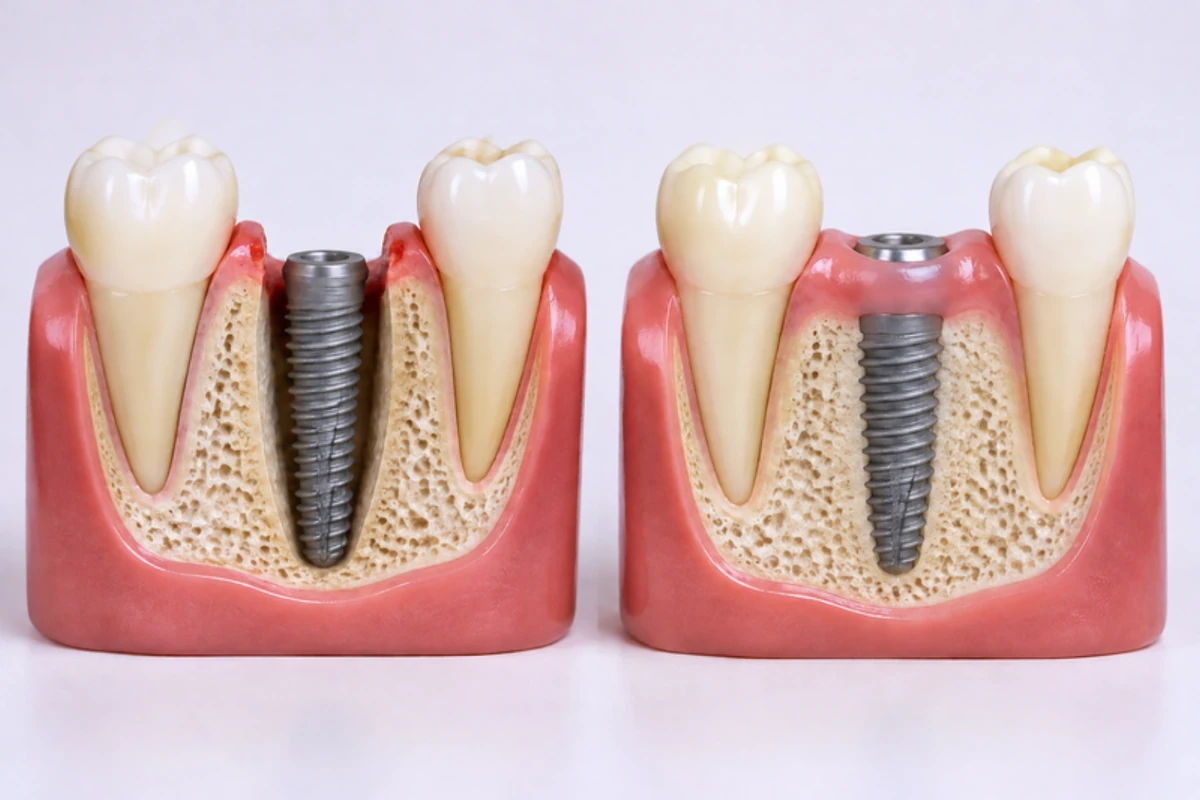
The advantages of placing it straight away are easy to see: fewer surgeries, less time with a gap, and the gum around the original tooth tends to keep its shape better. That matters a lot for a front tooth, because the shape of the gum affects how good the crown looks.
But a freshly emptied socket isn’t exactly the same shape as the implant, so the dentist has to check that the implant will hold firmly enough. If the bone wall around the socket is thin, or there’s inflammation, that has to be dealt with first or at the same time.
Waiting for healing has its own benefits. The dentist works with bone and gum that have settled, can position the implant more precisely, and if the original tooth was infected, there’s time to calm that down first. The trade-off is a longer total time, and the bone or gum in that area may shrink while you wait, so some people also need a bone graft.
Studies that pool the results of several trials have found that in many situations the two approaches give similar results, and that in some areas the evidence is still unclear. That’s why the dentist chooses for each person based on their own situation. No single method is right for everyone.
Who can often have it straight away, and who often needs to wait
These are the situations we see most often in the consulting room. Treat this as a general guide only. The dentist always needs to examine you and look at your actual X-rays first.
If it’s a single tooth coming out, the bone and gum around it are in good shape, and there’s no pus or swelling, you’re often in the group that can have it done straight away. This is especially true for a front tooth whose bone wall around the socket is still intact.
If the tooth has decayed until it broke, but there’s no infection around the tip of the root, the dentist uses the X-ray and the exam to see whether the socket is ready.
If there’s pus, or an abscess at the tip of the root, the dentist will usually suggest treating the infection and letting it settle first. Some cases can still be done straight away if the socket can be cleaned very thoroughly, but each one is judged individually, and the dentist will always tell you why.
If the bone is thin or the socket is badly damaged, a bone graft is often needed, or waiting for healing first. Read more about bone grafting for dental implants.
bone grafting for dental implants
And if several teeth, or all of them, need to come out, the plan is more involved. See the options at full-mouth missing teeth.
Health matters to tell your dentist
Several things don’t rule out an implant but make the dentist more careful, and sometimes they’re the reason we suggest waiting or preparing first.
Smoking and vaping slow healing. Studies pooling many trials have found that smokers are more likely to have problems with their implants. Stopping or cutting down before surgery and during healing really does help.
Diabetes is similar. If blood sugar is poorly controlled, wounds heal more slowly and infection is more likely. If it’s well controlled, the risk is close to anyone else’s. Please bring your latest blood sugar result for the dentist to see.
If you’ve ever had serious gum disease, your gums need to be calm before the implant, and looked after continuously afterwards. Read about gum disease. If you grind your teeth hard at night, the dentist will usually recommend a night guard too, so the biting force doesn’t put too much pressure on the implant and crown.
Some medicines, such as certain osteoporosis drugs, or past radiation treatment to the jaw, affect how bone heals. Always tell the dentist beforehand.
If you take blood thinners (anticoagulants), don’t stop them on your own. Ask the doctor who prescribed them first. The dentist will work with your doctor and plan how to control bleeding.
If any of these apply to you, just tell the dentist honestly. It lets the dentist plan around you.
The day itself, and the temporary tooth
It starts with an exam visit. The dentist checks your teeth and gums, asks about your health and the medicines you take, and takes X-rays. If needed, a 3D X-ray may be used to see the thickness and height of the bone (3D X-ray, CBCT). Then the dentist explains whether your case can be done straight away, and if not, why not, and tells you the cost before starting.
On the day of surgery, the dentist numbs the area with a local anesthetic, takes the tooth out carefully to protect the bone around the socket, cleans the socket, and places the implant. If there’s a gap around the implant, bone graft material may be added before the wound is closed. The dentist then checks whether the implant is firm enough, which decides whether a temporary tooth can be fitted.
A temporary tooth can help a lot with a front tooth, but it can only be fitted in some cases. The implant must be firm enough, and the temporary tooth must not hit the opposite tooth directly during the early period. You’ll also need to chew on the other side and avoid hard food. If your case isn’t suitable yet, the dentist may give you a removable temporary denture instead, so the implant can heal without pressure on it.
After that, the implant needs several months to fuse with the bone before the permanent crown is fitted. The dentist schedules check-ups during that time.
After an immediate implant
For the first few days, follow the dentist’s instructions on medicine and wound care. A cold compress, as advised, helps reduce swelling. Avoid hard, sticky or very hot food, and chew on the other side. Don’t poke or push at the wound with your tongue. Brush your other teeth as usual, brush gently around the wound as the dentist shows you, and stay off cigarettes as the dentist advises.
Keep your appointments even if you have no symptoms, and read about long-term care at looking after your implant. If bleeding won’t stop, swelling keeps getting worse, pain grows instead of easing, or the implant or crown feels loose, contact the clinic right away.
Your first visit: what to ask
If you have old X-rays, bring them, or send them to the dentist before your appointment. If you don’t have any, that’s fine, the dentist can take new ones. Bring a list of your medicines and medical conditions, and tell the dentist what worries you most, for example a gap at work, how your front teeth will look, or how long it all takes.
You could ask something like this.
- Can this tooth have an implant placed straight away? If not, why not?
- Is there enough bone? Will I need a bone graft?
- If I need to wait, for how long, and what temporary tooth would I have in the meantime?
- Is a fixed temporary tooth on the same day suitable for me?
- How many visits will it take, and what happens at each one?
Frequently asked questions about immediate implants
Is it safe to place an implant right after a tooth extraction?
It can be done in suitable cases. The dentist selects cases based on X-rays and the exam. If the bone or gum isn’t ready, the dentist will suggest waiting or preparing first.
Will I leave with a tooth on the same day?
Not always. The implant can be placed straight away in some cases, and a temporary tooth can be fitted only in some cases. The permanent crown has to wait until the implant has fused with the bone.
Can an implant go in straight away if the tooth has pus or an abscess?
We usually suggest treating the infection and letting it settle first. Some cases can be considered, but it depends on the individual.
Can I have an implant if I smoke?
Yes, but smoking slows healing and raises the chance of problems with the implant. If you can stop or cut down, the result will be better. You can talk to the dentist about it openly.
I take blood thinners. Do I need to stop them?
Don’t stop them on your own. Ask the doctor who prescribed them first. The dentist will plan how to control bleeding and work with your doctor.
Does the surgery hurt?
You’re given a local anesthetic, which reduces pain during the procedure, though you may still feel some pressure or vibration. Once it wears off, there may be some soreness and mild swelling. Take the medicine the dentist prescribes, and it usually eases gradually.
How often do I need check-ups afterwards?
Keep your appointments in the early period. After that, have your teeth cleaned (scaled) every 6 months and your implant checked once a year.
Can I send old X-rays to the dentist before my appointment?
Yes, whether you’re a Thai or an international patient.
Summary
An immediate implant after tooth extraction is one option, not a better method for everyone. It can be done when the bone and gum are ready and there’s no infection that can’t be controlled. A temporary tooth can be fitted in some cases. If you need to wait or have a bone graft first, that’s planning for a good long-term result. Be open with the dentist from your first visit about smoking, diabetes, gum disease and the medicines you take.
You don’t have to decide before you come. We’d like the dentist to see the tooth that needs to come out and the X-ray, and then talk through what suits you. You can book an appointment at Kitcha Dental Clinic, call +66 53 200 201, message us on LINE @kitchaclinic or WhatsApp +66 91 797 7888. See our service information at implant treatment at the clinic and the implant section of the prices page.
implant treatment at the clinic
implant section of the prices page
The clinic is open every day, 09:00-20:00, except 31 December, 1 January and 13-15 April. Walk-ins are welcome, but our dentists see patients with appointments first, so you may have to wait a while. Booking ahead gives you a fixed time.
Sources for this article
- Cochrane Database of Systematic Reviews, comparisons of the timing of implant placement after tooth extraction (Esposito et al.) 2010, and of the timing of placing teeth on implants, 2013
- Lang et al., systematic review of implants placed immediately after tooth extraction, Clinical Oral Implants Research, 2012
- ITI Consensus Conference, Group 2 (2018) and Group 5 (2023, Morton et al.), on the methods and timing of placing implants and teeth
- Reviews of implant risk factors: smoking (Chrcanovic, 2015), diabetes (Naujokat, 2016), history of gum disease (Annunziata, 2025), tooth grinding (Häggman-Henrikson, 2024), anticoagulant medicines (Zou and Hua, 2023)
- Cleveland Clinic, patient information on dental implants
- The clinic’s own experience