
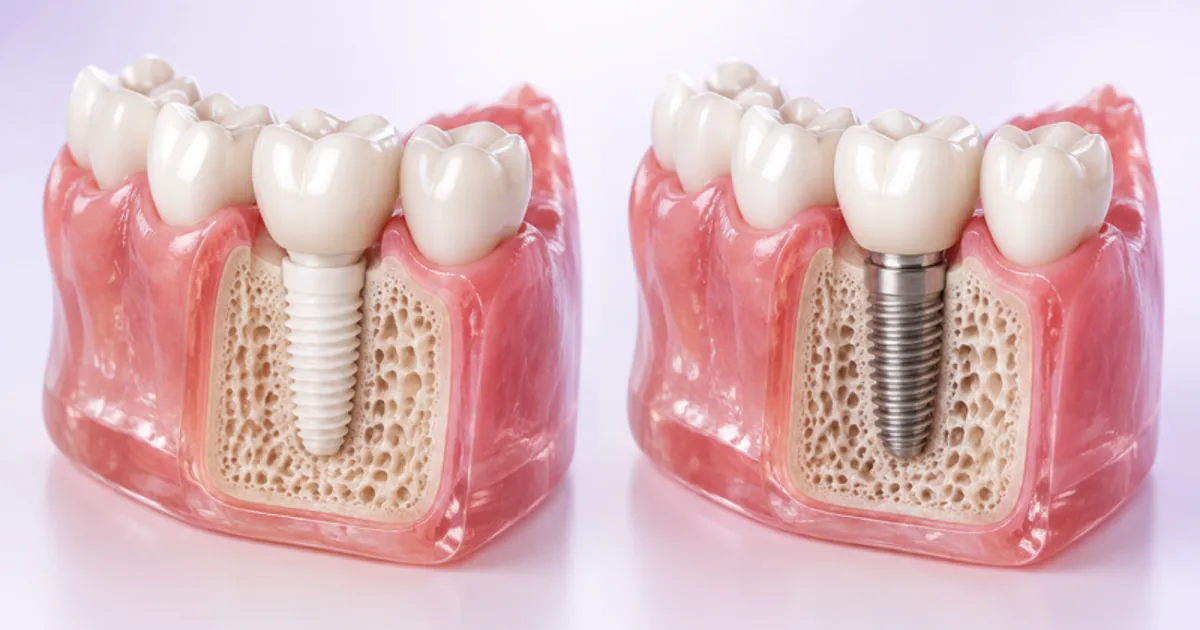
You want a new tooth that looks natural, but the thought of metal under your gum makes you uneasy. Maybe you smile and show your front teeth, and you worry the gum will look dark. Maybe you care a lot about a clean, healthy mouth, or you have searched from abroad for an implant that is not metal and want to know if it is a real option.
The answer is yes, and it is a good one. A ceramic implant has a white root close to tooth color, and the root is not metal. The gum gets along well with the material, and it works like any dental implant: it replaces the root and holds a crown. Research that gathers many studies together has found that, in the follow-up so far, ceramic implants stay in place about as well as metal ones.
In short: a ceramic implant gives you a white root, a root that is not metal, gums that respond well, and everyday use like any implant. It can suit front teeth, thin gums, and people who prefer to avoid metal. The dentist confirms the fit after an exam and a 3D scan.
Curious whether a ceramic implant fits you? You can book a consult and have a check with a 3D scan.
Ceramic dental implants in Chiang Mai
Before dental implant treatment: checks, visits and costs
What is a ceramic implant?
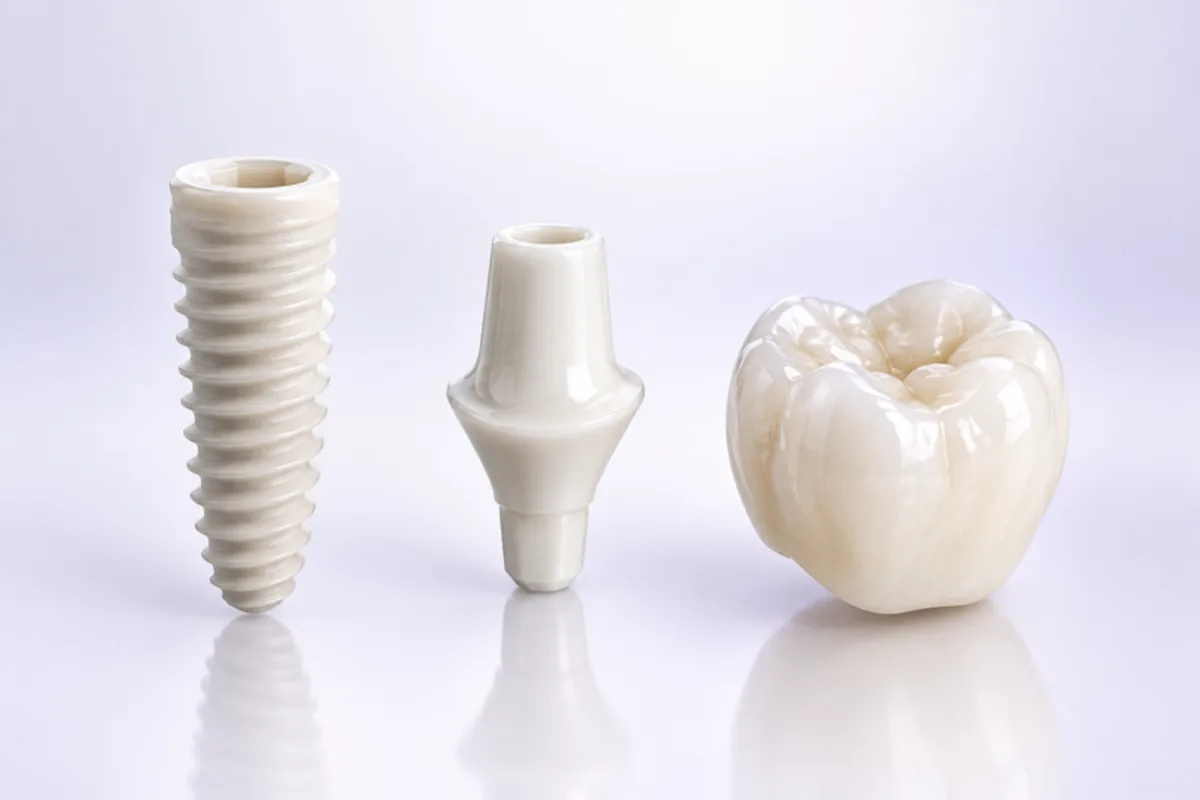
A dental implant takes the place of a tooth root. It is placed in the jawbone, the bone settles around it, and then a crown goes on top. Most implants are made of metal. In a ceramic implant the root part is made of zirconia, a hard white ceramic that is also used for many dental crowns.
So the idea is simple. A ceramic implant works like a regular implant, but the root is white and not metal. Many people say ceramic implant and zirconia implant to mean the same thing.
What are the good points of a ceramic implant?
People choose ceramic for a handful of clear reasons. Here is what you get.
A white root close to tooth color
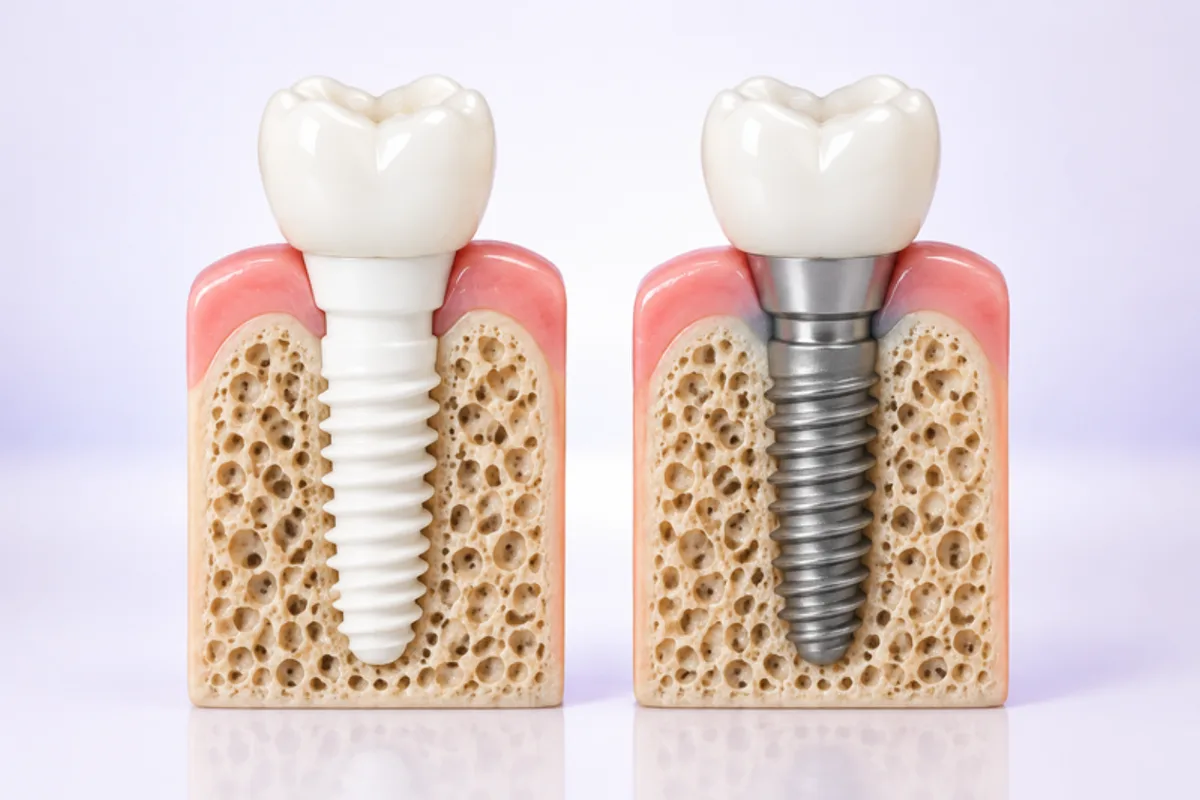
The white color helps most when the gum is thin. A metal root can sometimes show through thin gum as a gray shadow, and this matters most for front teeth that show when you smile. A white ceramic root does not cast that gray shadow, so the gum line looks more natural and the smile looks more even. Your dentist also checks how thick your gum is, because that affects the look too.
A root that is not metal
If you prefer to avoid metal in your body, a ceramic root is a way to do that. The root of a ceramic implant is zirconia, which is a ceramic and not a metal. It suits people who simply want a non-metal choice and people who feel uneasy about metal, and your dentist can talk it through with you. Inside the implant, the small screw that holds the parts together is titanium, chosen for strength. So the root is not metal, but the whole system is not entirely without metal.
Gums that get along with the material
Gums respond well to zirconia. In the clinical research available, they are not worse than with a metal implant, and in lab studies gum cells attach to zirconia well. A healthy gum around the implant is what keeps it comfortable for the long run, so this is a good sign.
Less plaque in some studies
A review that gathered several reviews reported slightly less plaque on zirconia abutments than on titanium abutments, with no significant inflammation. The difference is small and comes mostly from studies of the part that connects the crown, so daily cleaning still matters. It is one more reason that people who care about a clean mouth look at ceramic.
Everyday use like any implant, with a crown that blends in
A ceramic implant stands in for the root and carries a crown, just like any implant. You get a tooth you can brush, floss and chew with as normal, and the crown on top can be shaped and colored to blend with your natural teeth.
Planned with 3D and digital scans
At the clinic the dentist plans from a 3D CBCT scan of your jaw and a digital scan of your mouth. This shows how much bone you have and where the implant can sit, so the plan fits you and not just a standard case.
The ceramic system at the clinic is Neodent Zi, a zirconia implant for suitable cases.
Would these good points matter for your smile? A consult and a 3D scan will show whether a ceramic implant suits you.
Ceramic dental implants in Chiang Mai
What does a ceramic implant do for my worries?
| What you care about | What a ceramic implant gives | How the clinic does it |
|---|---|---|
| You smile and show your front teeth | A white root with no gray shadow, and a crown shaped and colored to blend in. | Checks the gum thickness, plans the position from the 3D scan, and matches the crown to the teeth beside it. |
| Your gum is on the thin side | The color blends better with thin gum, and research on the connecting part supports this. | Looks at the gum and bone together, and explains what can be done for the look. |
| You would like to avoid metal | A root made of zirconia, a ceramic and not a metal. The small screw inside is titanium. | Listens to your reason, and asks about any past metal allergy so the plan can take it into account. |
| You care about gum health and a clean mouth | Gums respond well, and less plaque was seen in some studies. | Shows how to clean around the implant, with scaling every 6 months and an implant check once a year. |
| You are coming from another country | A plan you can see before you travel. | Reviews the X-ray or CBCT you send first, and explains the plan and the healing time. |
Who may benefit most from a ceramic implant?
If one or more of these sound like you, a ceramic implant is well worth asking your dentist about.
- You are missing a front tooth that shows when you smile, and you want the gum line to look natural.
- Your gum is on the thin side and you would like to avoid a gray shadow.
- You feel uneasy about metal in your body and would like a non-metal root.
- You care about oral health and a clean mouth, and like the idea of gums that respond well.
- You are travelling from abroad. Send a recent X-ray or CBCT before you book flights, so the plan and the healing time can be explained first.
Your dentist confirms the fit after looking at your bone, tooth position and bite. If another system suits you better, you hear that plainly too.
Why have a ceramic implant at Kitcha Dental Clinic?
- A team of dentists from several specialties plans your case together.
- A 3D CBCT scan shows your bone and the spot of the missing tooth.
- A digital scan of your mouth helps shape a crown that blends with your teeth.
- The clinic has both ceramic and titanium systems, so the advice follows your real case.
What is good to know before you decide
A good decision is an informed one, so here are a few simple points. None of them is a reason to worry. They are things to talk through with your dentist.
- Ceramic is a newer system than titanium, which has the longer record, so the follow-up over many years is still smaller.
- It suits suitable cases, not every case. Bone, tooth position and the way you bite all play a part, and the dentist picks the cases with care.
- The small screw inside the implant is titanium, for strength. The root is zirconia, but the system is not entirely without metal. If you have had a metal allergy, tell the dentist so it can be planned for.
- Much of the research on gum color looks at the part that connects the crown, and more studies are still coming.
- Ceramic is hard but more brittle than metal. If you grind your teeth at night, tell the dentist, so the bite and a night guard can be planned for.
- If you need a bone graft first, the plan changes, and the dentist explains what that means for you.
The easy way to know where you stand is an exam with a CBCT scan. After that the dentist can tell you plainly whether a ceramic implant fits you.
Dental 3D X-ray (CBCT): what it is used for
Your ceramic implant visit, step by step
- Talk and exam. You tell the dentist what matters to you, such as the look of your smile or a wish to avoid metal, and the dentist examines your mouth.
- 3D CBCT scan. The dentist looks at your bone and the spot of the missing tooth, and explains whether a ceramic implant suits you.
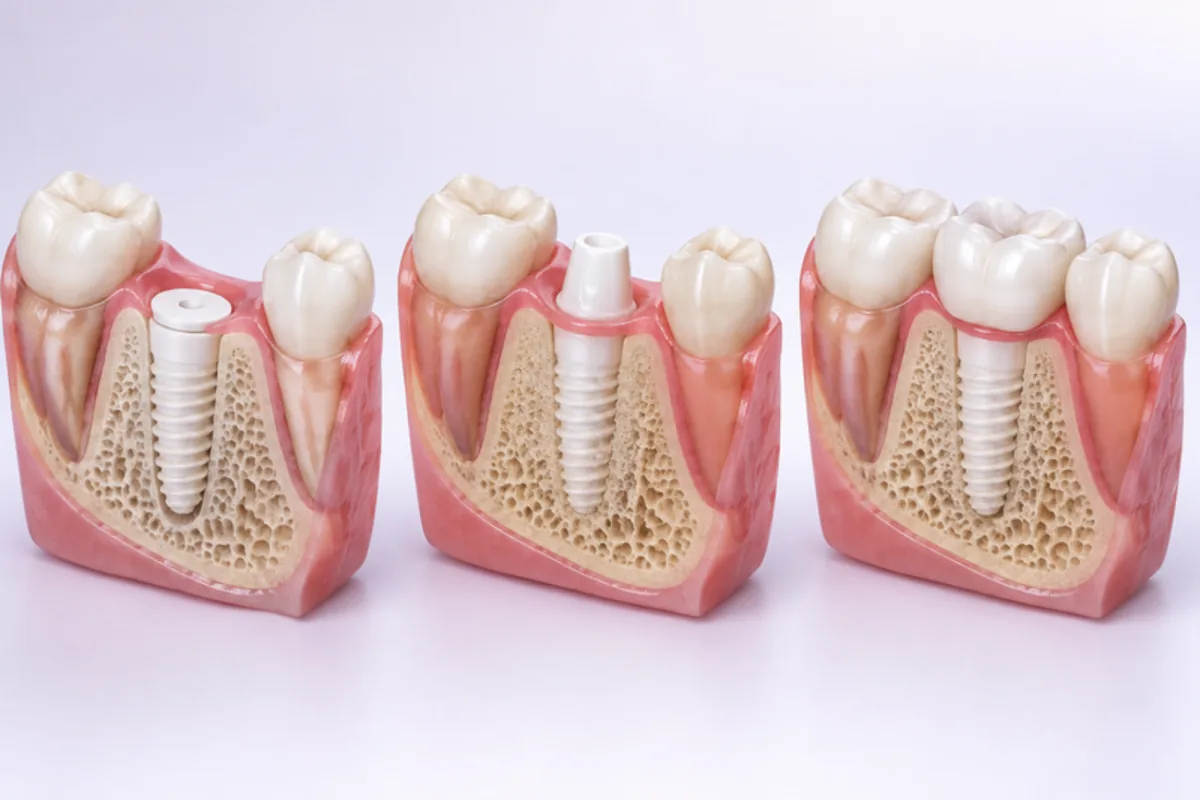
- Implant placement. The implant is placed in the jawbone in a procedure. Bone grafting is added first only if you need it.
- Healing. The bone settles around the implant, usually in about 3 to 4 months. The dentist confirms the timing for you.
- Crown. When the bone is ready, you have an impression taken and the new crown is fitted on the implant.
- Aftercare. Scaling every 6 months and an implant check once a year keep the gum around it healthy.
Common myths and the facts
| What people sometimes say | What is closer to the truth |
|---|---|
| Ceramic implants break like a plate. | The root is zirconia, a strong ceramic made for dental use. It is more brittle than metal, so the dentist picks cases with care and plans the bite. |
| You only choose ceramic if you are allergic to metal. | Most people choose it for the look, for peace of mind about metal, or both. Allergy to the metal in implants is rare. If you have had a metal allergy, tell the dentist and decide together. |
| A ceramic implant means a very different treatment. | The main steps are the same: placement, healing, then the crown. You brush, floss and chew as normal afterwards. |
Questions people ask about ceramic implants
Who is a ceramic implant good for?
It suits people with a missing front tooth, a thin gum, a wish to avoid metal, or a strong interest in a clean, healthy mouth. It also works for people planning from abroad. The dentist confirms the fit after an exam and a 3D scan.
Can I have a ceramic implant if my gum is thin?
Thin gum is one of the reasons people look at ceramic, because a white root does not cast a gray shadow. The dentist checks the gum and bone together and explains what can be done to make the look as natural as possible.
How is a ceramic implant different from a regular implant?
The material of the root. It is white zirconia and not metal. The steps, the healing time and the daily care are the same: clean around the implant every day, have scaling every 6 months and a check once a year.
Are a ceramic implant and a zirconia implant the same thing?
Yes. The ceramic used for the implant root is zirconia. Porcelain, which some crowns use, is a different ceramic.
How long does it take at the clinic?
There are two stages: placement of the implant, then around 3 to 4 months for the bone to settle, then the crown. The dentist confirms the timing and the number of visits after the CBCT scan.
Can everyone have a ceramic implant?
The dentist chooses the cases and plans the bite so that the result works well for you. After a look at your 3D scan, you hear plainly whether ceramic fits and what the plan would be.
What if I need a bone graft?
Bone grafting is done when the bone is not enough. The plan then changes, and the dentist explains how, and whether a ceramic implant is still a good match in your case.
How much does it cost?
Prices are on the prices page, together with the other implant packages. The final cost depends on your exam.
Want to know if a ceramic implant fits you?
A consult is a relaxed conversation, not a commitment. Bring a recent X-ray or CBCT if you have one. The dentist looks at your bone and bite, explains what a ceramic implant could do for your smile, and tells you honestly whether it suits you.
Book a consult and have a check with a 3D scan, through the booking button or by LINE or WhatsApp.
Ceramic dental implants in Chiang Mai
Summary
A ceramic implant is a real option with clear good points for people who want a natural gum line or a root that is not metal. A consult and a 3D scan show whether it fits you.
- A white root close to tooth color, with no gray shadow through a thin gum, so front teeth look natural.
- A root that is not metal, for people who prefer to avoid metal.
- Gums respond well, and in the clinical research available it is not worse than a metal implant.
- Everyday use like any implant, planned with a 3D scan, with a crown that blends in.
- It is a newer system and the dentist picks the cases with care, so an exam and a CBCT scan come first.