

The dentist looks at the X-ray and says the cavity is quite large: you could have a big filling, but an onlay or a crown might protect the tooth better. Then comes a string of unfamiliar words, a few prices, and a decision you are expected to make. Many people leave the chair wondering whether they are being offered more than they need, or whether a simple filling would really be enough.
Here is the reassuring part. All four options do the same basic job: they replace the part of the tooth that has been lost to decay or a break. The real difference is how much of the tooth is missing and how much protection the remaining tooth needs. Once you understand that one idea, the choice becomes much less mysterious, and you can ask your dentist sharper questions.
This article walks you through it step by step: a quick self-check to see which group your tooth is likely in, what each option actually is, why cavity size matters so much, comparison tables for tooth removed, visits and materials, how dentists decide, what the visits look like, how to look after the result, common myths, the signs that need a prompt check, and what happens at our clinic.
In short: a filling suits small to medium cavities and is usually done in one visit. An inlay or onlay is a made-to-measure piece for a larger cavity when the tooth walls are still strong; an onlay also covers one or more cusps. A crown covers the whole tooth when it is broken, cracked, heavily filled or has had root canal treatment. The rule of thumb: keep as much healthy tooth as possible, while giving the tooth enough protection.
Which option is your tooth likely to need? A quick self-check
Only an examination and an X-ray can tell for sure, but these signs give you a fair idea before your visit. Read all three groups and see which one sounds most like your tooth.
A filling is often enough
- The dark spot or hole is small, and the tooth around it looks whole.
- It is sensitive to sweet or cold for a moment, then settles.
- Your dentist found it at a routine check-up, before it caused much trouble.
- It is an old filling that has a small chip or a stained edge.
An inlay or onlay may suit better
- The cavity is wide, often between two back teeth, but the outer walls of the tooth still look solid.
- A large old filling has worn down, leaked or cracked and needs replacing.
- One cusp, the pointed corner of a back tooth, has chipped off, and the rest of the tooth is sound.
- Food keeps catching in the same gap because the old filling no longer shapes the contact well.
A crown is likely to be discussed
- The tooth has had root canal treatment, especially a back tooth.
- A large part of the tooth has broken away, or several cusps are cracked.
- It hurts sharply when you bite on something and then let go, which can be a sign of a crack.
- The tooth is mostly filling material already, with thin walls left.
- The tooth is badly worn from grinding, or very discolored.
If the tooth aches on its own, keeps you awake, or the gum next to it is swollen, the question is no longer which restoration to choose. The nerve may be involved, and the tooth needs to be examined first. The section on warning signs below explains this in more detail.
The four options, explained simply
Picture the top of a back tooth as a small table with raised corners. The flat middle is where the grooves are, and the raised corners are the cusps. Each option replaces a different amount of that table.
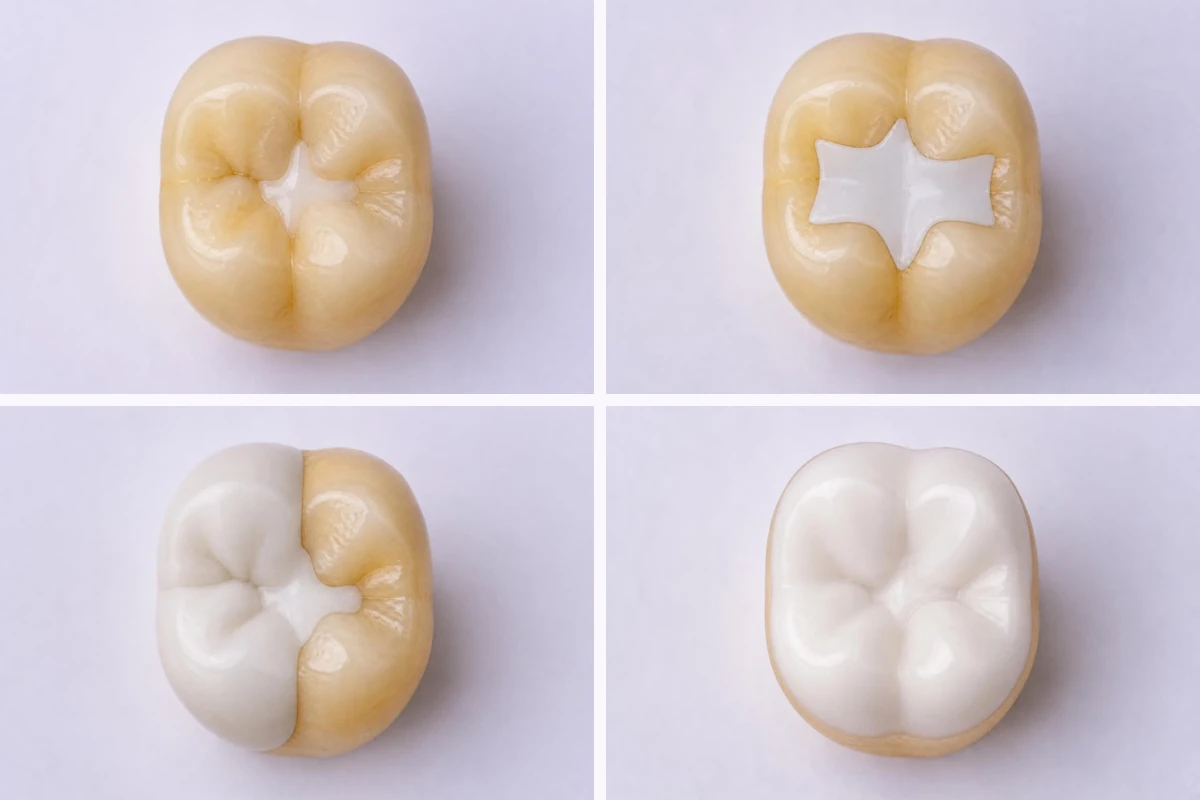
Filling: built directly in the mouth
After the decay is removed, a soft tooth-colored material called composite resin is placed into the cavity in layers and hardened with a curing light, then shaped and polished. Because it is built directly in the tooth, most fillings are done in one visit. Composite works well for small and medium cavities that take moderate chewing forces.
Inlay: a made-to-measure piece inside the tooth
An inlay fills the area between the cusps without covering them. Instead of being shaped in the mouth, it is made outside the mouth from a scan or impression of the prepared tooth, then bonded in place. Because it is made to fit, the shape of the biting surface and the contact with the neighboring tooth can be very precise.
Onlay: an inlay that also covers one or more cusps
An onlay is made the same way as an inlay, but it extends over one or more cusps. Covering a weakened cusp spreads the biting force across the tooth, so an onlay can protect a tooth with a broken or thin cusp while keeping the healthy sides of the tooth untouched. Some people call it a partial crown.
Crown: a cover for the whole visible tooth
A crown covers every surface of the tooth above the gum, like a cap. To make room for it, the tooth is shaped all the way around. In exchange, the crown holds the remaining tooth together and protects it from splitting, which is why crowns are used for teeth that are broken, cracked, heavily filled or root canal treated.
| Option | What it covers | Typical situation |
|---|---|---|
| Filling | Only the cavity, built up inside the tooth | Small to medium cavity, healthy walls around it |
| Inlay | The area between the cusps, made outside the mouth | Larger cavity or old filling, cusps still strong |
| Onlay | The area between the cusps plus one or more cusps | A broken or weakened cusp, other walls still sound |
| Crown | The whole tooth above the gum | Broken, cracked, heavily filled or root canal treated tooth |
Why the size of the cavity matters so much
A healthy back tooth is strong partly because it is a closed ring. The ridges of enamel along the front and back edges of the tooth, called marginal ridges, tie the cusps together like the rim of a bowl. When a cavity breaks through these ridges, the cusps lose their support and flex more each time you bite.
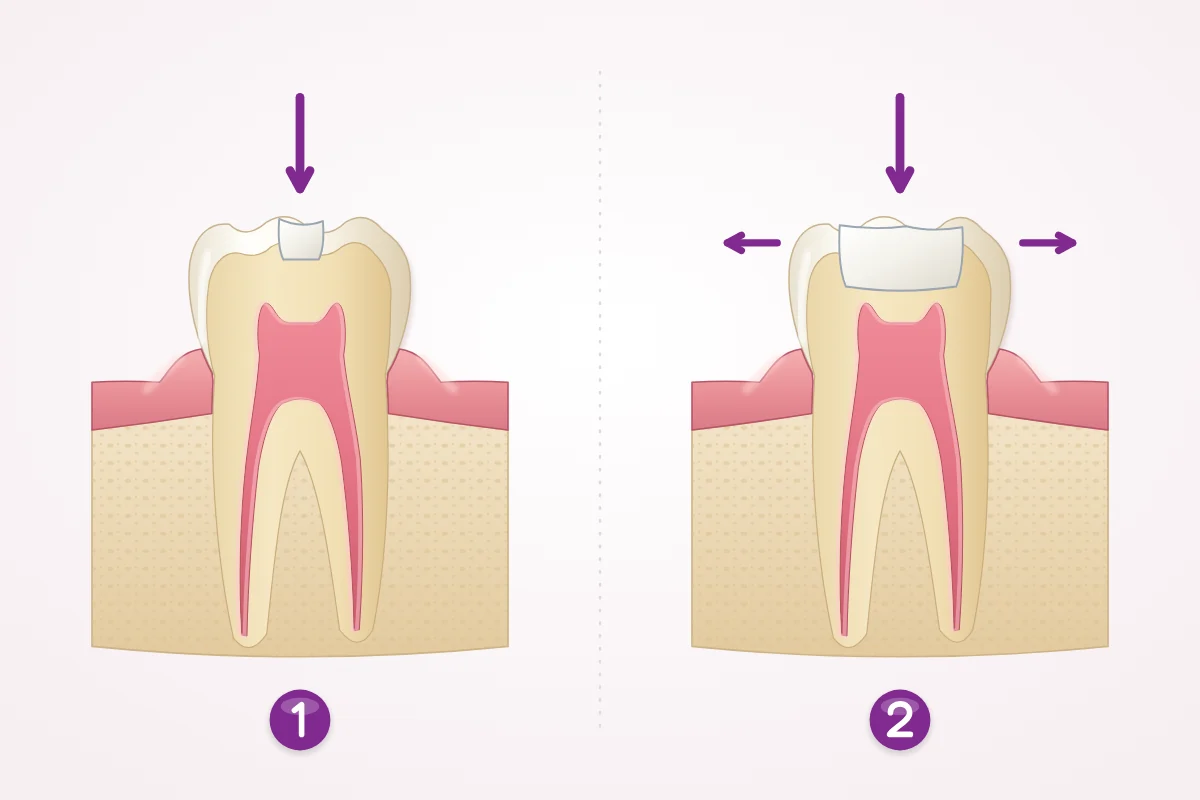
A laboratory study on extracted premolars showed how big this effect is. A small cavity on the biting surface reduced the stiffness of the cusps by about a fifth, while a cavity that opened both side walls, known as an MOD cavity, reduced it by about 63 percent on average. By comparison, the root canal procedure itself reduced stiffness by only about 5 percent. In other words, it is mainly the loss of tooth structure, not the root canal, that weakens a tooth.
That is the logic behind the four options. A small cavity leaves the ring intact, so a filling is enough. A larger cavity that has opened the ring but left strong cusps can be rebuilt precisely with an inlay. When a cusp has become thin or has already broken, covering it with an onlay holds it down. When too little tooth is left, or the tooth has had a root canal, a crown holds everything together.
Research on root canal treated teeth points the same way. In a long-term university study, back teeth that were not crowned after root canal treatment were lost at a much higher rate than teeth that were crowned, about six times higher when other factors were taken into account. This is an association from one study, not a rule for every tooth, but it explains why dentists so often recommend cusp coverage after a root canal.
There is a second reason size matters. Composite fillings shrink slightly as they harden and wear over time, and a very large filling has more edges where new decay can start. A large study combining data from many trials found that fillings covering more surfaces of the tooth, and fillings in people with a high risk of decay, failed more often, mainly from new decay and fractures. For a big cavity, a piece made outside the mouth can give a closer fit and a stronger biting surface.
Inlay vs onlay vs crown vs filling: side-by-side
The tables below compare the four options on the points people ask about most. Visit numbers for crowns and fillings come from our treatment pages; general points come from the sources listed at the end.
How much tooth is removed, and how many visits
| Option | Healthy tooth removed | Usual number of visits |
|---|---|---|
| Filling | Least: mainly the decay itself | Usually one visit |
| Inlay | Little: the cavity is shaped so the piece can slide in | Usually two: preparation, then bonding the lab-made piece |
| Onlay | Moderate: the covered cusps are reduced, healthy sides kept | Usually two, like an inlay |
| Crown | Most: the tooth is shaped all the way around | Usually two; often fitted 3 to 5 days after preparation |
Strengths and things to consider
| Option | Strengths | Things to consider |
|---|---|---|
| Filling | Quick, keeps the most tooth, easy to repair or redo | Very large fillings wear and can leave thin walls at risk of cracking |
| Inlay | Precise fit and contact with the neighboring tooth; strong, tooth-colored options | Does not protect weak cusps; needs a second visit |
| Onlay | Protects weakened cusps while keeping healthy tooth | Needs enough sound tooth to bond to; technique-sensitive |
| Crown | Holds a badly damaged or root canal treated tooth together | Removes the most tooth; a temporary crown is worn in between |
Is an onlay as strong as a crown? For back teeth, a review of the available studies found that tooth-colored onlays and partial crowns performed about as well as full crowns over the short term, with no clear difference in survival or fractures. The authors noted that longer studies are still needed. In practice, this means an onlay is a sound choice when enough healthy tooth remains, and a crown remains the safer choice when it does not.
Materials: what inlays, onlays and crowns are made of
Material choice affects appearance, strength and how the piece is bonded. At our clinic, inlays and onlays can be made in ceramic (zirconia or IPS e.max), composite or metal. Crowns can be zirconia, all-ceramic (IPS e.max or Empress), porcelain fused to metal, or full metal, including digital CAD/CAM crowns.
| Material | Used for | Points to know |
|---|---|---|
| Glass-ceramic such as IPS e.max | Inlays, onlays, crowns | Natural tooth color; bonded to the tooth; fracture is the most common problem |
| Zirconia | Onlays, inlays, crowns | A strong tooth-colored ceramic, often chosen for back teeth |
| Composite resin | Fillings, and some inlays and onlays | Gentle on opposing teeth and easy to repair, but wears more and can stain |
| Gold or other metal alloys | Inlays, onlays, crowns | Very durable and needs little reduction, but metal colored |
| Porcelain fused to metal | Crowns and bridges | Metal strength with a tooth-colored surface; the porcelain can chip |
Your dentist chooses the material for your case based on the tooth, where it is in the mouth, how hard you bite, and the shade of your teeth. Back teeth take a heavier bite, so a stronger material may be recommended there. If you grind your teeth, mention it, because grinding puts extra force on any restoration.
How your dentist decides
There is no single answer that fits every tooth. Your dentist examines the tooth and takes an X-ray if needed, then weighs a set of questions like these.
- How much healthy tooth is left after the decay or old filling is removed, and how thick the remaining walls are.
- Whether the marginal ridges are intact and whether any cusp is thin, cracked or already broken.
- Whether there are crack lines, and how far they seem to run.
- Whether the nerve is healthy, or the tooth has had or needs root canal treatment.
- Where the edge of the damage is: if it goes below the gum, bonding is harder and the plan may change.
- How hard you bite, and whether you grind or clench your teeth.
- Your decay risk and how easy the area will be to keep clean.
- Your priorities: keeping as much natural tooth as possible, appearance, number of visits and your travel dates.
The table below shows how these points often translate into a recommendation. It is a guide to help you follow the conversation, not a substitute for an examination.
| What the dentist finds | Often recommended |
|---|---|
| Small cavity, marginal ridges intact | Filling |
| Medium cavity between two teeth, thick walls | Filling or inlay |
| Large old filling to replace, cusps still strong | Inlay |
| One or two cusps thin, cracked or broken | Onlay |
| Back tooth after root canal treatment | Crown or onlay covering the cusps |
| Most of the tooth lost, or several cracked cusps | Crown |
| Decay that has reached the nerve | Root canal treatment first, then a restoration |
Which crown material suits which tooth: zirconia, ceramic or metal
What the visits look like, step by step
Filling: usually one visit
- Examination, with a small X-ray if needed, and an explanation of the plan.
- For deeper cavities the tooth is numbed with local anesthesia; small, shallow fillings often do not need it.
- The decay is removed, composite is placed in layers and hardened with a curing light.
- The filling is shaped and polished, and your bite is checked for high spots.
Inlay or onlay: usually two visits
- Visit 1: the tooth is numbed, the decay or old filling is removed and the cavity is shaped.
- A digital scan or an impression is taken, the shade is chosen with you, and a temporary filling protects the tooth.
- The laboratory makes the piece. Your dentist tells you when to come back, depending on the material.
- Visit 2: the temporary is removed, the piece is tried in for fit, contact and color, then bonded.
- The bite is checked and adjusted, and the edges are polished.
Crown: usually two visits
- Visit 1: the tooth is shaped, a digital scan or impression is taken, the shade is chosen with you, and a temporary crown is fitted.
- Making the crown takes time. It can be as little as 1 day; usually the crown is fitted 3 to 5 days after the tooth is prepared, depending on the crown type, the dentist and public holidays.
- Visit 2: the new crown is tried in for fit, color and bite, adjusted if needed, and then cemented.
If the tooth needs root canal treatment or a post first, more visits are added, and your dentist explains the plan after the examination. If you are traveling, tell us your dates when you book so the visits can be arranged around them.
| Moment | What to expect | What helps |
|---|---|---|
| Until the numbness wears off | Lip and cheek feel numb | Wait to eat so you do not bite your cheek |
| With a temporary in place | It can loosen with sticky or hard food | Chew on the other side and floss gently by sliding it out |
| First days after bonding | Mild sensitivity to cold and slight gum soreness | Usually settles within a week or two; tell your dentist if it does not |
| Whenever you bite | The tooth should feel like part of your bite, not the first to touch | If it feels high, come back for an adjustment |
Looking after your filling, inlay, onlay or crown
No restoration is immune to decay. The edge where the restoration meets your tooth is where new decay usually starts, so daily cleaning matters just as much after treatment as before. Long-term studies of ceramic inlays and onlays show that most keep working well for many years, and when they fail, the usual reasons are fracture, loosening and new decay at the edge. The risk of fracture is higher in teeth without a living nerve and in people who grind their teeth.
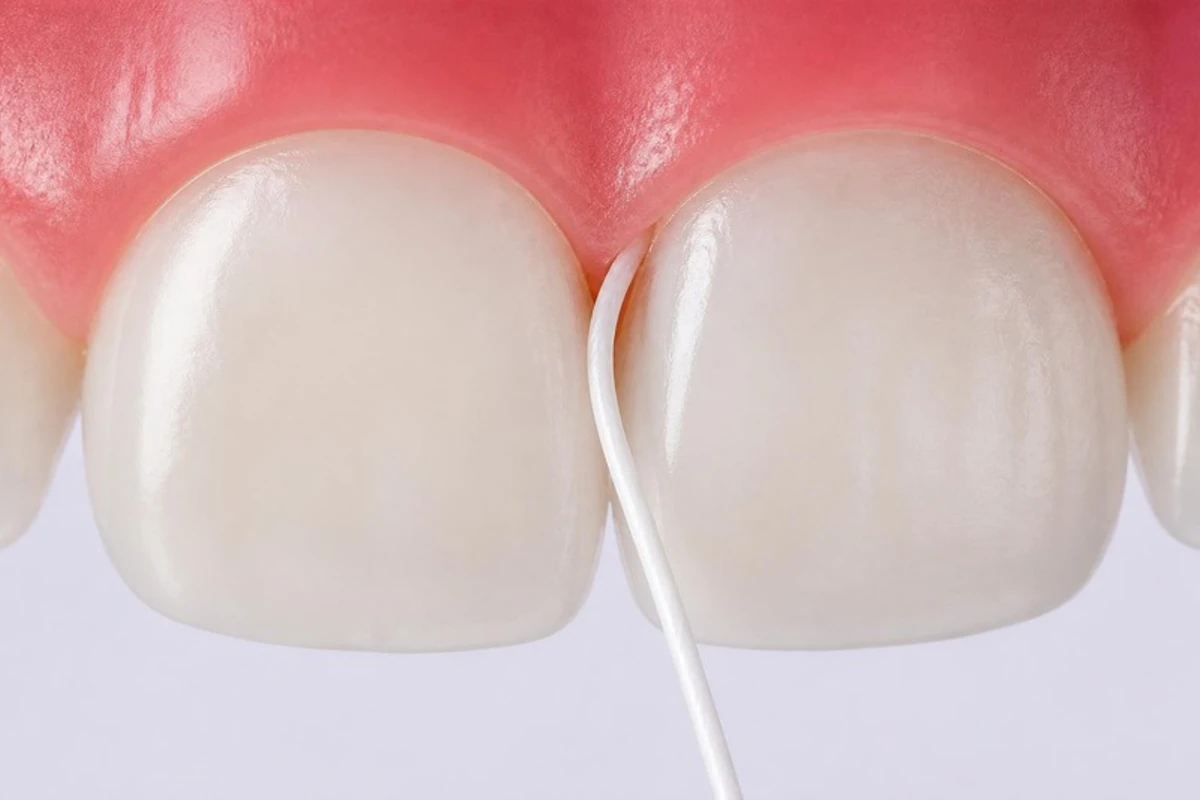
- Brush twice a day for 2 minutes with a fluoride toothpaste, paying attention to the edge of the restoration at the gum line.
- Clean between your teeth every day with floss or an interdental brush, especially where the restoration touches the next tooth.
- Avoid biting ice, hard nuts, bones or unpopped popcorn kernels on the restored tooth, and do not use your teeth to open packets.
- If you grind or clench at night, ask about a night guard, which protects both natural teeth and restorations.
- Keep your regular check-ups so small problems at the edges can be found early.
Teeth grinding (bruxism): causes, signs and treatment
Common myths about fillings, inlays, onlays and crowns
| Myth | Fact |
|---|---|
| A crown is always the strongest choice, so it is always the safest. | A crown removes the most healthy tooth. When enough tooth remains, an onlay can protect the tooth while keeping more of it. |
| An inlay is just an expensive filling. | An inlay is made outside the mouth to fit, so it suits larger cavities where a direct filling would be large and harder to shape well. |
| Once a tooth has a crown, it cannot decay. | The tooth under a crown can still decay at the edge near the gum, so brushing and cleaning between teeth still matter. |
| If it does not hurt, a large cavity can wait. | Decay often causes no pain until it is deep. Treating it while it is still a filling or inlay keeps more tooth and keeps options open. |
| A root canal makes a tooth brittle, so it always needs a crown. | The loss of tooth structure weakens a tooth more than the root canal itself. Back teeth usually need cusp coverage; your dentist decides with a crown or an onlay. |
| Tooth-colored materials are weak. | Modern ceramics such as zirconia and IPS e.max are strong enough for back teeth when chosen and bonded correctly. |
Signs that need a prompt dental check
Most restorations settle in quietly. These signs are not common, but they are worth having checked soon, before or after treatment.
- A tooth that aches on its own, throbs, or keeps you awake: the nerve may be inflamed and may need root canal treatment.
- Pain to hot or cold that lingers long after the drink is gone.
- Sharp pain when biting and releasing, which can be a sign of a crack.
- Swelling of the gum or face, a pimple on the gum, or a fever: see a dentist the same day.
- A temporary, inlay, onlay or crown that comes loose or breaks: keep the piece and call to arrange a visit.
- A bite that still feels high after a few days, or a sharp edge that catches your tongue.
If facial swelling is spreading quickly, or you have difficulty swallowing or breathing, go to a hospital emergency department straight away.
A tooth with a cavity: a filling, or root canal treatment?
At our clinic: from examination to bonding
At Kitcha Dental Clinic, crowns, inlays and onlays are planned and placed by our dentists, including dentists with postgraduate training in prosthodontics, the field that covers crowns, bridges and dentures. This is what the process usually looks like.
- Examination and X-ray: your dentist checks how far the decay or damage goes, using a small X-ray if needed.
- Options explained: your dentist recommends a filling, an inlay, an onlay or a crown after examining the tooth, explains why, and tells you the treatment and fee before starting.
- Fillings: made with tooth-colored composite resin, with the shade matched to your teeth, usually in one visit.
- Inlays, onlays and crowns: the tooth is prepared, a digital scan or impression is taken and the shade is chosen with you. Pieces are made by our ISO-certified partner laboratory or with digital CAD/CAM.
- Second visit: the piece is tried in for fit, color and bite, adjusted if needed, and then bonded or cemented.
- Follow-up: if you grind your teeth, your dentist may suggest a night guard to protect the new work, and regular check-ups keep an eye on the edges.
If the tooth needs root canal treatment or a post first, the dentists involved plan it together within the clinic. If you are traveling, tell us your dates when you book so we can arrange the visits around them.
Fees are listed on our prices page. Fillings are priced by the number of surfaces filled, and inlays, onlays and crowns by the material. Crowns, inlays, onlays and other laboratory work have a 1-year warranty on the restoration, terms apply, used at our clinic in Chiang Mai. Full payment for an inlay, onlay or crown is due on the day the tooth is prepared or the impression is taken.
See filling, inlay and crown prices
If this sounds like you: filling, inlay, onlay or crown?
These are example situations, not patient stories, to help you find the next step that fits.
- A check-up found a small cavity between two back teeth and it does not hurt: a filling is usually enough. Treating it now keeps the tooth ring intact and keeps the bigger options off the table.
- A big old filling in a molar is cracked, but the tooth has never had a root canal and the cusps look strong: ask whether an inlay suits it, since it can rebuild the contact and biting surface precisely.
- One corner of a back tooth broke off while eating, and the rest feels fine: an onlay that covers the broken cusp may protect the tooth while keeping the healthy sides.
- You have just finished root canal treatment on a molar: plan the cusp coverage soon. Your dentist will recommend a crown or an onlay depending on how much tooth is left.
- It hurts sharply when you bite on one spot and let go: mention it at the visit. It can be a crack, and covering the cusps can protect a cracked tooth.
- You grind your teeth at night and your old fillings keep chipping: tell your dentist. A stronger material and a night guard are often part of the plan.
- You are visiting Chiang Mai for a short stay: tell us your dates when you book. A filling is usually one visit; an inlay, onlay or crown usually needs a second visit, so plan for that.
Frequently asked questions about inlays, onlays and crowns
What is the difference between an inlay and an onlay?
The cusps are the dividing line. An inlay sits inside the tooth between the cusps and does not cover them. An onlay also covers one or more cusps, so it is used when a cusp is broken or weak. Both are made outside the mouth and then bonded to the tooth.
Is an onlay better than a crown?
Neither is better for every tooth. An onlay keeps more healthy tooth and, for suitable back teeth, has performed about as well as a crown in short-term studies. A crown is the safer choice when much of the tooth is gone or several cusps are cracked. Your dentist recommends the one that fits how much tooth remains.
Inlay or filling: which should I choose?
For a small or medium cavity, a filling is quicker, keeps the most tooth and is usually done in one visit. For a large cavity or a large old filling that needs replacing, an inlay made outside the mouth can give a closer fit, a better contact with the next tooth and a stronger biting surface. Your dentist explains which suits your tooth after the examination.
Does getting an inlay or onlay hurt?
The tooth is usually numbed with local anesthesia while it is prepared, so you feel pressure and vibration rather than sharp pain. Tell your dentist if you feel anything sharp. Afterwards the tooth may be sensitive to cold or the gum a little sore for a while, which usually settles; tell your dentist if it does not.
Can I have an onlay instead of a crown after a root canal?
Sometimes. Back teeth after a root canal usually need their cusps covered, and that can be done with a crown or, when enough sound tooth remains, with an onlay that covers the cusps. Teeth without a living nerve carry a higher risk of fracture, so your dentist looks closely at how much tooth is left before choosing.
Root canal treatment: how many visits, and do you need a crown?
How many visits does an inlay or onlay take?
Usually two. At the first visit the tooth is prepared, scanned or recorded with an impression, and protected with a temporary filling. Ceramic and metal pieces are made by the laboratory, so a second visit is needed to bond them, as with a crown. Your dentist tells you the timing for your material.
What if my temporary filling or temporary crown comes off?
Keep the temporary if you can find it and call us to arrange a visit so it can be put back or replaced. Until then, chew on the other side, avoid sticky and very hard food, and keep the area clean with gentle brushing. A temporary protects the prepared tooth and keeps the space for the final piece, so it is worth replacing.
Can an old filling be replaced with an inlay, onlay or crown?
Yes. A large old filling that is worn, leaking, chipped or has decay underneath is one of the most frequent reasons for an inlay, onlay or crown. Once the old material is removed, your dentist can see how much tooth is left and recommend the option that protects it, and explains this before starting.
Summary
A filling, an inlay, an onlay and a crown all rebuild a damaged tooth. The choice depends on how much healthy tooth is left and how much protection it needs.
- Small to medium cavity: a filling, usually in one visit.
- Larger cavity with strong cusps: an inlay; a broken or weak cusp: an onlay. Both usually take two visits.
- Broken, cracked, heavily filled or root canal treated tooth: a crown, or sometimes an onlay that covers the cusps.
- Treating decay early keeps more tooth and more options.
- Whatever you choose, brush, clean between your teeth, protect against grinding and keep your check-ups.
References
Cleveland Clinic: Dental Fillings
Cleveland Clinic: Dental Crowns
Cleveland Clinic: Restorative Dentistry
American Dental Association (MouthHealthy): Crowns
American Dental Association (MouthHealthy): Dental Filling Options
American Dental Association: Materials for Indirect Restorations
American Association of Endodontists: Cracked Teeth
University of Bristol Dental School: Inlays and onlays, patient information
Abduo J, Sambrook RJ. Longevity of ceramic onlays: a systematic review. J Esthet Restor Dent, 2018