

You bite into something chewy, feel a strange crunch, and suddenly there is a hard little cap on your tongue. Or you find it in your hand after flossing. A crown that fell off brings a rush of questions at once: did I swallow part of it, is the tooth underneath broken, will it hurt tonight, and if I am traveling, can this wait until I get home?
The reassuring part first: a crown that comes off is usually not a medical emergency, and in many cases the same crown can be cleaned and cemented back once a dentist has checked the tooth. What matters most is what you do in the first hours: keep the crown safe, protect the tooth, and avoid quick fixes that make the next step harder.
This guide walks you through it step by step. You will find a one-minute urgency check, what to do in the first hour, the reasons crowns come loose, a table of when a crown can go back on and when it needs to be remade, a day-by-day plan until your appointment, advice for travelers, common myths, the signs that need prompt care, and what happens at the clinic, including crowns that were made somewhere else.
In short: keep the crown in a small clean container, do not glue it back yourself, and chew on the other side. Contact a dentist within the next few days, sooner if there is pain, swelling or a front tooth. In many cases the same crown can be re-cemented after the tooth is checked; if not, a new filling or crown is planned.
How urgent is a crown that came off? A one-minute check
Usually fine to book in the next few days
- The crown came off in one piece, and you have it.
- The tooth underneath feels smooth and only a little sensitive to cold air or drinks.
- There is no pain at rest, no swelling and no bleeding.
- It is a back tooth that you can avoid chewing on for now.
Try to be seen within a day or two
- The tooth hurts when you bite, or it aches on its own.
- The tooth underneath has a sharp edge that cuts your tongue or cheek.
- It is a front tooth and you feel uncomfortable about how it looks.
- A piece of tooth came off inside the crown, or the crown is cracked.
- A temporary crown came off while you wait for the final one.
- A crown on an implant feels loose or has come off.
Get help promptly
- You think you breathed the crown in, or you have coughing, wheezing or trouble breathing.
- You swallowed it and now have chest pain, pain on swallowing, stomach pain or vomiting.
- There is swelling of the gum or face, or a fever.
- The crown came off because of a fall or a blow to the face.
The last group is covered in more detail in the warning signs section below. Most people with a crown that came off are in the first two groups.
What to do in the first hour after a crown comes off
These steps take only a few minutes and keep every option open for your dentist.
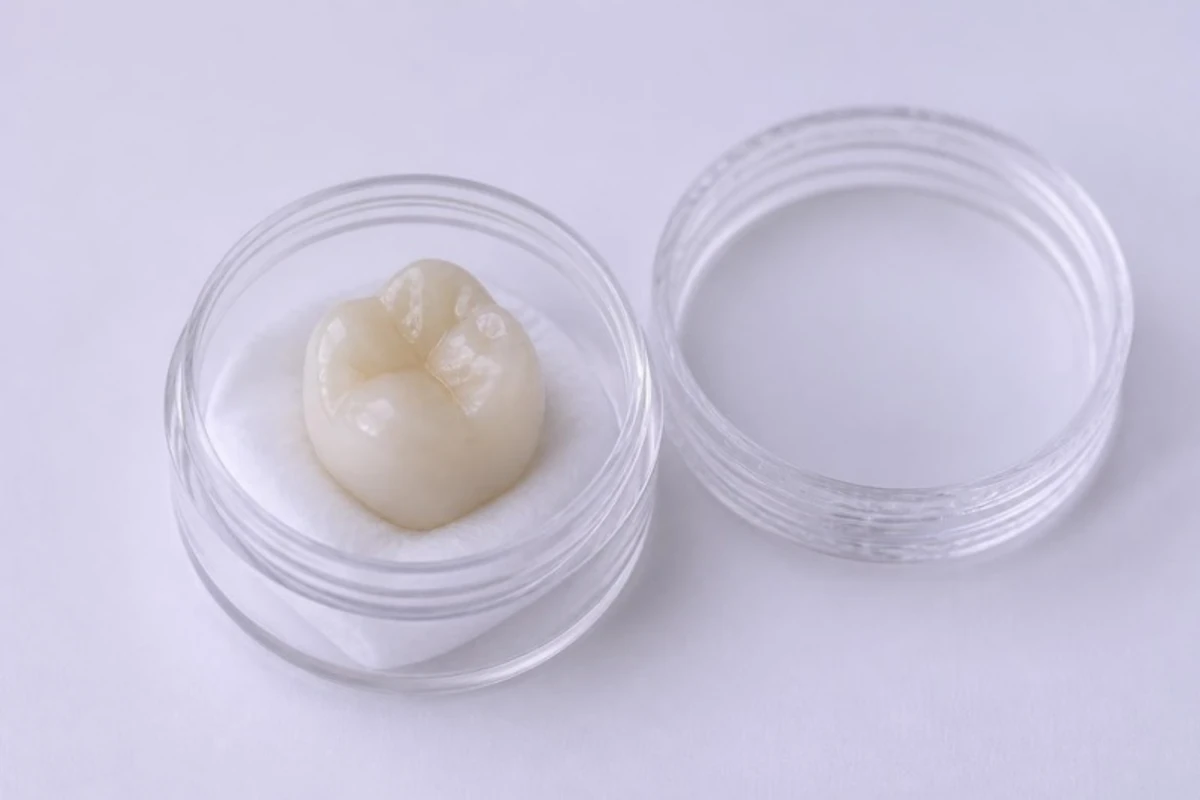
- Take the crown out of your mouth so you do not swallow it. If you are eating, stop and check your food for small pieces.
- Close the sink drain before you rinse anything, so a small crown cannot slip away.
- Rinse the crown gently under running water. Do not scrub out the inside or try to scrape off old cement.
- Put it in a small hard container or a clean sealed bag, not wrapped in a tissue, which is easy to throw away by mistake.
- Rinse your mouth with warm water and look at the tooth in a mirror: note any sharp edges, broken pieces, swelling or bleeding.
- Take a clear photo of the tooth and of the crown, inside and out. It helps the clinic judge how urgent it is.
- Contact your dentist, say which tooth it is, whether it hurts, and whether the crown is whole.
What not to do
- Do not use superglue or household glue. It is not made for the mouth, it can set with the crown in the wrong position, and it can damage both the tooth and the crown.
- Do not force the crown back on and bite down hard to hold it. A crown pushed on at an angle can crack the tooth.
- Do not sleep with a loose crown in your mouth, because it can be swallowed or breathed in.
- Do not file down a sharp edge yourself. Cover it with dental wax or sugarless gum until your visit.
Emergency dentist in Chiang Mai
Why do dental crowns come off?
A crown stays on because of two things working together: the shape of the tooth underneath, which is prepared with nearly parallel walls so the crown grips it, and a thin layer of dental cement that seals the gap. When either of these weakens, the crown can loosen. Laboratory research shows that both the taper of the prepared tooth and the type of cement affect how firmly a crown holds, including when it is cemented a second time.
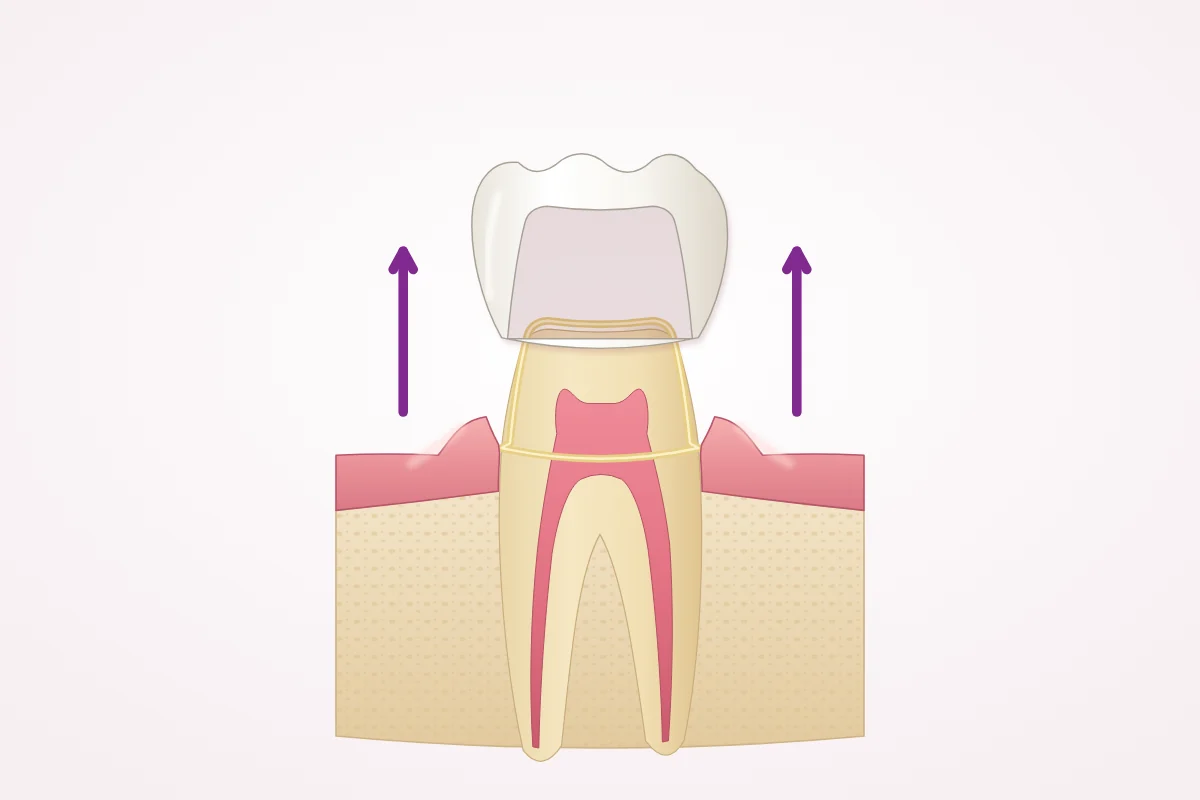
Reviews that pooled many clinical studies found that most crowns keep working well over the follow-up periods studied, and that coming loose, called loss of retention, is one of the recognized technical problems. In one large review it was reported more often with some zirconia crowns than with metal-ceramic crowns. In other words, a crown coming off is a known event, not a sign that something rare has happened to you.
The question your dentist will try to answer is why this particular crown came off, because the reason decides whether it can simply go back on.
| Cause | How to tell | What to do |
|---|---|---|
| Decay under the edge of the crown | Soft, dark or brown tooth under the crown; sometimes a bad taste or smell before it came off | The decay is removed first; the crown may go back on, or a new one is needed |
| Cement that has washed out over time | Crown and tooth both look intact; the crown slips on and off easily | Often the same crown can be cleaned and re-cemented |
| Sticky or very hard food | Came off while eating toffee, chewing gum, ice or hard nuts | A check for cracks, then re-cementing if all is sound |
| The tooth under the crown broke | A piece of tooth is stuck inside the crown; very little tooth is left above the gum | The tooth may need a post and core, sometimes root canal treatment, then a new crown |
| Grinding or clenching | Worn, flat teeth, chipped crowns, a tired jaw in the morning | Re-cement or remake, and ask about a night guard to protect the crown |
| A short or tapered tooth that offers little grip | The crown has come off before, from the same tooth | The dentist may change the design, the cement or the tooth shape, or suggest a new crown |
| A temporary crown | Came off between the preparation visit and the fitting visit | Normal to happen sometimes; call so it can be put back to protect the tooth |
| A crown on an implant | The crown wobbles or turns, or comes off with or without the connecting part | The dentist checks the screw and connecting part, then tightens or re-cements them |
Teeth that have had root canal treatment are a special case. They are more brittle, and a well-known study found that root-treated back teeth that were not crowned were lost far more often than those that were. That is why, if a crown comes off a root-treated tooth, it is worth protecting the tooth and getting it covered again rather than leaving it bare for months.
Root canal treatment in Chiang Mai
Can a crown that fell off be put back, or does it need to be remade?
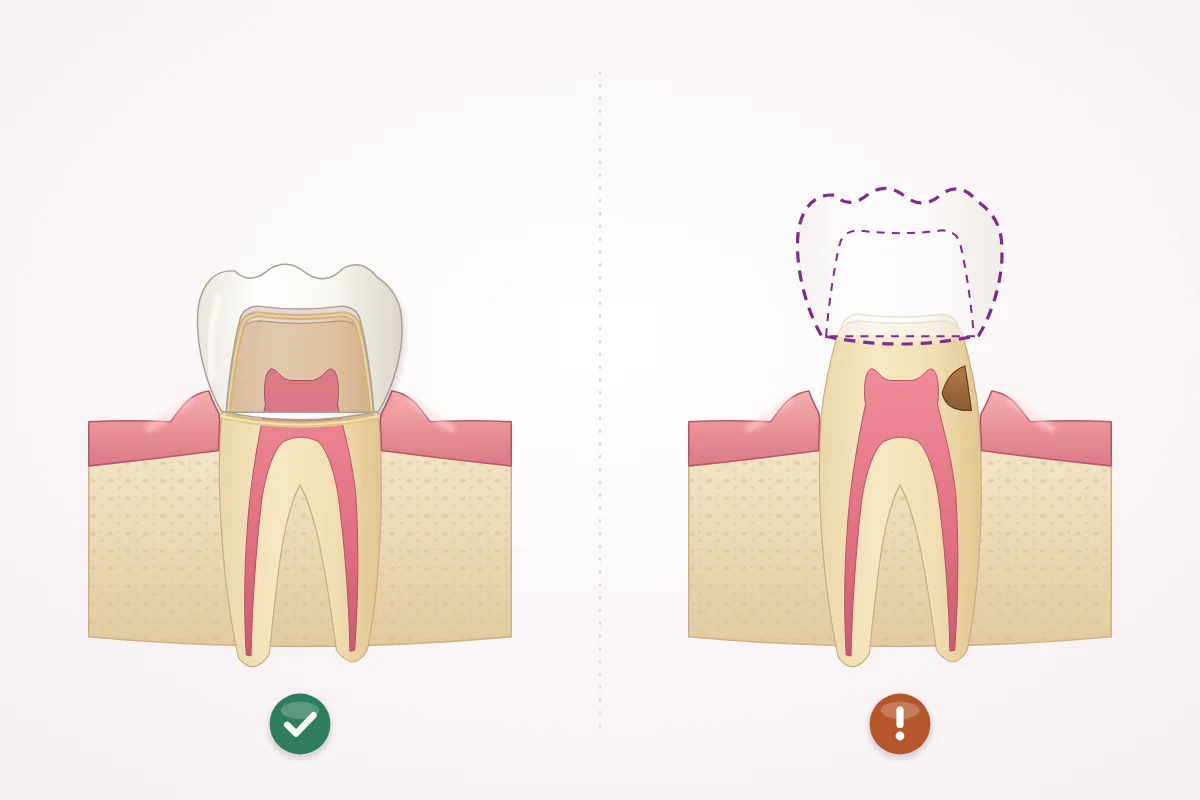
This is the question most people ask first. The honest answer is that it depends on the tooth more than on the crown. A perfect crown cannot be cemented onto a tooth that has decay or a fracture underneath, and a crown that no longer fits will come off again. The table shows what dentists commonly find and what usually follows.
| What the dentist finds | What is usually done | Why |
|---|---|---|
| The tooth is sound and the crown is whole and still fits | Clean both surfaces and cement the same crown back | The fastest and simplest option when nothing else has changed |
| A small area of decay at the edge | Remove the decay and rebuild the tooth, then re-cement or make a new crown | A crown sealed over decay would trap it underneath |
| The crown is cracked, worn through or no longer fits | A new crown is planned, with a temporary crown in between | A crown that does not fit closely tends to come off again |
| The tooth broke but the root is healthy | Root canal treatment if needed, a post and core, then a new crown | The post and core rebuild enough tooth for a new crown to grip |
| The tooth has split or broken far below the gum | The dentist explains the options to replace the tooth, such as an implant or a bridge | When too little tooth remains, replacing it gives a more lasting result |
| A bridge has come loose on one side only | An early check, because the loose side can hide decay | Food and plaque collect under the loose end |
Only an examination, often with an X-ray, can tell which row applies to you. Still, knowing the possibilities in advance makes the conversation at the clinic easier, and it explains why your dentist may not cement the crown straight back the moment you sit down.
A plan from the moment it comes off until your appointment
A bare tooth is more sensitive and easier to damage than a crowned one, but with some care it can wait a few days safely. Use this as a guide while you wait.

| When | What to focus on |
|---|---|
| First hour | Keep the crown safe in a container, rinse with warm water, take photos, and contact the clinic |
| Rest of the first day | Chew on the other side, choose soft food, and avoid very hot, very cold, sweet or sticky things |
| Day 1 to your visit | Brush the bare tooth gently twice a day with fluoride toothpaste and clean beside it; it helps protect the exposed tooth |
| If it is sensitive | A toothpaste for sensitive teeth dabbed on the tooth with a clean finger can ease it; take pain relief only as the label says |
| Before you go to bed | Make sure the crown is out of your mouth and in its container, and clean the bare tooth well |
| Day of the appointment | Bring the crown, the photos, your list of medicines and any old records or X-rays of that tooth |
| First days after it is fixed | Some sensitivity or a slightly different bite can be normal at first; tell the clinic if the bite feels high or it does not settle |
If you are traveling or live far from your dentist
Many people discover a lost crown on holiday, on a business trip, or just before a flight. Flying with a bare tooth is not a problem in itself. The aim is to keep the tooth clean and comfortable until a dentist can see it, and to keep the crown so it can be assessed.
- Keep the crown in your hand luggage, in a hard case, not in checked baggage.
- Pack a small travel kit: a soft brush, fluoride toothpaste, floss, dental wax and pain relief you already use.
- Pharmacies in many countries sell temporary dental cement in the dental section. Consumer dental guidance describes it as a stopgap until you can see a dentist, while household glues are not safe in the mouth. If you use it, follow the instructions closely, do not force the crown, and still see a dentist.
- If you are visiting Chiang Mai, ask for an itemized receipt and a medical certificate in English for travel insurance claims.
Our clinic prefers that you bring the crown in rather than cementing it yourself, because the inside of the crown and the tooth must be clean and dry for the cement to hold, and a crown fixed at home may need to be removed again before it can be cemented properly.
Planning treatment from abroad
Common myths about a crown that came off
| Myth | Fact |
|---|---|
| If it does not hurt, it can wait for months. | A bare tooth can decay, chip or shift without pain. Waiting a few days is fine; waiting months often turns a simple re-cement into a new crown. |
| Superglue is a good emergency fix. | Household glue is not made for the mouth, can set the crown out of position and can damage the tooth and crown. |
| A crown that fell off means the dentist did a poor job. | Cement wear, new decay, grinding and sticky food are frequent reasons. The cause is found by examining the tooth. |
| The same crown can never be used again. | If the tooth is sound and the crown still fits, it can often be cleaned and re-cemented. |
| Swallowing a crown always needs surgery. | Most swallowed objects pass on their own. Breathing one in is different and needs prompt medical care. |
| A crown on an implant cannot come loose. | Implant crowns can loosen at the screw or the cement. It is usually a straightforward fix when checked early. |
Warning signs after a crown comes off
Most lost crowns are calm, practical problems. A few situations are different and are worth acting on the same day.
- Coughing, wheezing or trouble breathing after the crown disappeared: it may have been breathed in. Go to a hospital emergency department.
- Chest pain, pain on swallowing, stomach pain, vomiting or blood in the stool after swallowing a crown: see a doctor promptly.
- Swelling of the gum or face, a pimple on the gum, or fever: the tooth may be infected.
- Throbbing pain that keeps you awake, or pain that pain relief does not ease.
- A crown lost in a fall or after a blow to the face, especially with other injuries.
Go to the nearest hospital emergency department, rather than waiting for a dental appointment, if swelling spreads toward the eye, neck or under the tongue, if breathing or swallowing becomes difficult, or after an injury to the head or jaw.
What happens at the clinic when your crown came off
At Kitcha Dental Clinic, a lost crown is handled as an urgent problem. You can call, or message us on WhatsApp, LINE or email, and send a photo. Coordinators look for a time with a suitable dentist based on how urgent it is, including the same day when possible. The clinic is open every day from 09:00 to 20:00 and closed on 31 December, 1 January and 13 to 15 April. You can walk in, but dentists see patients with appointments at their booked times first, so you may need to wait a while. Booking ahead gives you a confirmed time.
- Tell us what happened: which tooth, when it came off, whether it hurts, and whether the crown is whole. Bring the crown, your ID or passport, and a list of the medicines you take.
- Examination: the dentist checks the tooth, the crown and your bite, and takes an X-ray when needed to look for decay or a crack under the crown.
- Explanation and plan: the dentist explains why the crown came off and whether it can go back on, and tells you the cost before starting.
- If the tooth and crown are sound, the crown is cleaned and cemented back, and your bite is checked.
- If there is decay or the crown no longer fits, a new filling or a new crown is planned. If the tooth needs root canal treatment or a post first, the dentist explains this before anything starts.
- A new crown: the tooth is shaped, scanned or an impression is taken, the shade is chosen with you, and a temporary crown protects the tooth while the crown is made.
New crowns are made by our ISO-certified partner laboratory or with digital CAD/CAM. How long it takes depends on the crown type, the dentist treating you and public holidays. It can be as little as 1 day, and usually the crown is fitted 3 to 5 days after the tooth is prepared, so plan for a second visit. Crowns are planned and fitted by our dentists, including dentists with postgraduate training in prosthodontics, the field of crowns, bridges and dentures.
Fees for the examination, X-rays, re-cementing and new crowns are listed on our prices page, under fillings, inlays and crowns. Crowns made at our clinic come with a 1-year warranty on the restoration, terms apply; it is used at the clinic in Chiang Mai. Direct billing is available for eligible Cigna, Allianz, International SOS and April patients after benefit checks; for other insurers, we provide itemized receipts and medical certificates in English.
A crown made at another clinic or abroad
You do not need to go back to the clinic that made the crown. We also care for crowns made at another clinic or in another country. Depending on the condition of the tooth and the crown, it is cemented back or a new crown is made. Your dentist explains which applies after the examination.
- Bring the crown, even if it looks damaged. It shows the dentist how it fitted and what material it is.
- If you have them, bring or send earlier X-rays, treatment notes or the name of the crown material.
- Tell the dentist if the tooth had root canal treatment or a post, and roughly when the crown was made.
- If you are planning a trip, send photos and your travel dates first, so the visits can be arranged around them.
Warranty terms are set by the clinic that made the crown. If you still have a warranty with that clinic and can return there easily, it is worth checking with them as well.
How to keep a crown from coming off again
Once the crown is back, a few habits protect both the crown and the tooth underneath. Most of them are the same habits that protect natural teeth.
- Brush twice a day with fluoride toothpaste, paying attention to the line where the crown meets the gum, because decay there is a common reason crowns come loose.
- Clean between the teeth every day. Slide the floss out sideways near a new or temporary crown instead of pulling it up.
- Go easy on toffee, chewy candy and gum, and do not crunch ice or open packets with your teeth.
- If you grind or clench, ask about a night guard. It helps protect crowns, veneers and implant crowns from grinding forces.
- Keep regular check-ups and cleanings, so the edges of your crowns are checked before a small problem grows. If you have implants, the clinic recommends a cleaning every 6 months and an implant check once a year.
- Pay attention to early signs: a crown that feels loose, a bad taste near it, or floss that catches or shreds at the edge. Have it checked before it comes off.
Teeth grinding and night guards
If this sounds like you: what to do
These are example situations, not patient stories, to help you find the next step that fits.
- Your crown came off while eating, it is whole and nothing hurts: keep it in a small container, chew on the other side, and book a visit in the next few days. There is a good chance it can be re-cemented.
- A front crown came off the day before an important event: contact the clinic and say so. Ask about a time before the event, and do not use household glue to get through the day.
- You are traveling and have a flight in two days: keep the crown in your hand luggage, keep the tooth clean, and either be seen before you fly or arrange a visit as soon as you arrive.
- There is a piece of tooth inside the crown: bring both. The tooth may need a post and core or other work before a new crown, and your dentist explains the plan.
- Your temporary crown came off between visits: call the clinic so it can be put back. It protects the tooth and keeps the space for the final crown.
- A crown on your implant feels loose: book a check soon rather than waiting for it to fall out. Loose screws and cement can usually be dealt with simply when caught early.
- The same crown has come off more than once: ask your dentist why. A new design, a different cement, treatment for grinding, or a new crown may suit you better than re-cementing again.
- You think you swallowed the crown and feel well: tell your dentist, watch for pain, and see a doctor promptly if you get any of the warning signs above.
Frequently asked questions about a crown that fell off
Is a crown falling off a dental emergency?
Usually it is urgent rather than an emergency. If there is no pain or swelling and you have the crown, a visit within the next few days is reasonable. Try to be seen sooner if the tooth hurts, has a sharp edge, is a front tooth or broke. Breathing problems after losing a crown, or swelling spreading in the face or neck, need hospital care the same day.
Can I glue my crown back on with superglue?
It is better not to. Household glues are not made for the mouth, they can set with the crown slightly out of place, and removing them later can damage the tooth or the crown. Keep the crown in a container and let a dentist cement it after checking the tooth. Consumer dental guidance describes pharmacy temporary dental cement as a stopgap for people who cannot see a dentist soon, as long as the crown is not forced on.
What if I swallowed my crown?
Stay calm. Most swallowed objects pass through the gut on their own. Do not make yourself vomit. Tell your dentist, because a new crown may be needed, and watch for chest pain, pain on swallowing, stomach pain or vomiting, which need a doctor. If you started coughing or wheezing when the crown disappeared, it may have gone into the airway, and you should go to a hospital emergency department.
Can the dentist put the same crown back on?
Often, yes, when the tooth underneath is healthy and the crown is whole and still fits closely. The dentist cleans both, checks the fit and your bite, and cements it. If there is decay, a crack or a poor fit, a new filling or crown is the more reliable choice.
How long can I leave a tooth without its crown?
A few days is usually fine if you keep it clean and avoid chewing on it. Over weeks, a bare tooth can decay, chip, become more sensitive, or shift so that the old crown no longer fits. Teeth that have had root canal treatment are more brittle, so it is worth covering them again promptly.
My temporary crown fell off. What should I do?
Keep it and call the clinic that is making your crown. The temporary crown protects the prepared tooth and keeps the neighboring and opposite teeth from drifting into the space, so it is usually put back on before the final crown is ready. Until then, chew on the other side and avoid sticky food.
My implant crown is loose or came off. Is the implant failing?
Not necessarily. Implant crowns are held by a small screw, by cement, or both, and either can loosen. Reviews of implant restorations list loose connecting parts and lost retention among the recognized technical problems. Book a check soon: the dentist looks at the screw, the connecting part and the gum around the implant, then tightens or re-cements them, or plans a repair.
Does it hurt to have a crown put back on, and how long does it take?
Re-cementing a crown on a sound tooth is usually a short appointment. The tooth may feel sensitive to air and water while it is cleaned, and if it is a living tooth that feels very sensitive, the dentist can use local anesthetic. If decay, a crack or a new crown is involved, the dentist explains the steps and how many visits to expect before starting.
Summary
A crown that falls off is usually urgent rather than an emergency, and the same crown can often go back on once the tooth has been checked.
- Keep the crown in a small container, chew on the other side, and keep the bare tooth clean with fluoride toothpaste.
- Do not use household glue or force the crown back on.
- See a dentist within a few days, sooner with pain, a sharp edge, a front tooth or a broken tooth.
- Whether the crown goes back on depends mainly on the tooth underneath: decay, cracks and fit decide it.
- Breathing problems, chest or stomach pain after swallowing a crown, or spreading swelling need medical care the same day.
References
NHS 111 Wales: Lost filling or crown
American Dental Association (MouthHealthy): Dental Emergencies
Colgate Oral Care Center: Lost filling or crown
American Dental Association (MouthHealthy): Crowns
Cleveland Clinic: Dental Crowns
MedlinePlus (US National Library of Medicine): Dental crowns
Huh JY. Foreign body aspirations in dental clinics: a narrative review. J Dent Anesth Pain Med, 2022